MCP Tool Categories and Enterprise Use Cases
MCP's three primitives map to enterprise function areas.
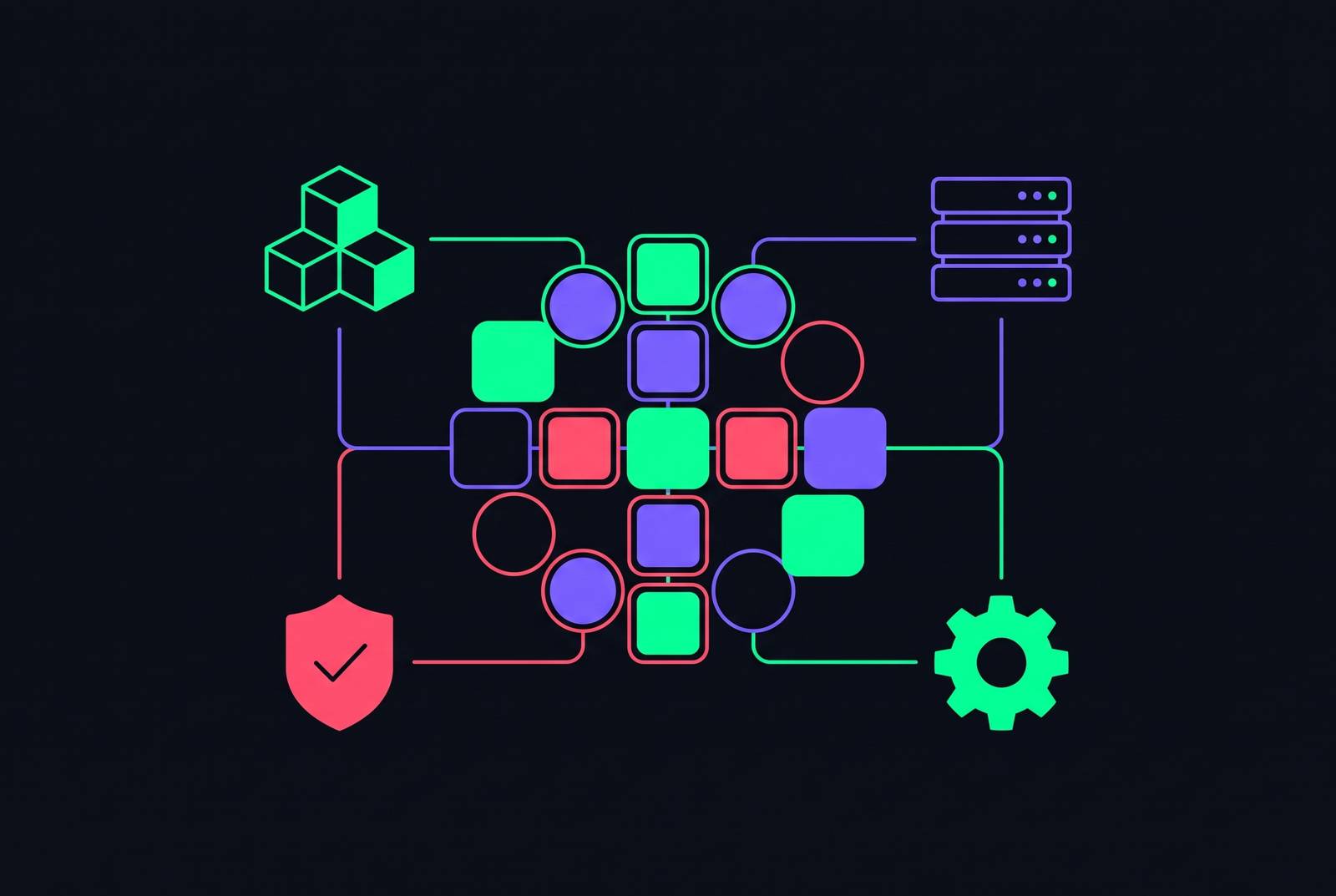
MCP's three core primitives, tools, resources, and prompts, correspond directly to the four types of work enterprises already assign to distinct function areas. That correspondence is the reason adoption can follow the org chart instead of demanding a separate integration strategy built from scratch. Before MCP, every connection between an AI model and a business system needed its own custom integration, and the cost of that approach multiplied with every new tool-model pairing. Teams that moved from point-to-point API connections to MCP-based architectures saw integration costs drop sharply, because the math turns additive: one MCP server per data source, usable by any compatible AI client, instead of a new build for every combination. The protocol now sits under the Linux Foundation's Agentic AI Foundation as a multi-company open standard, with AWS, Cloudflare, and Google publishing production commitments. That matters because the categories MCP defines aren't one vendor's naming scheme. They form a shared vocabulary that different enterprises, running different stacks, can build toward in common. Every business use case for MCP sits at the intersection of two things: the function area that owns the workflow (engineering, sales, support, marketing, finance, HR, IT/SecOps, legal/compliance) and the industry vertical it serves. The tool category supplies the mechanism. The function area supplies the ownership. That division is what the rest of this piece traces, category by category.
Data-access tools for function areas that live on live data
Data-access tools let an agent query a live system instead of reading a static document, and that distinction is the foundation everything else in MCP depends on. This appears hardest in finance, sales, supply chain, and legal/compliance, precisely because those are the areas where stale data produces decisions that are simply wrong. Before data-access tools existed in practical form, AI models working with enterprise data were effectively blind: they couldn't query inventory, couldn't check ad performance by SKU, couldn't read a compliance note filed the week before. Pilots got shelved because the generic output wasn't trustworthy enough to act on.
Microsoft's documentation for the Dynamics 365 finance and operations MCP server describes MCP as a unified framework that standardizes access to ERP operations, built for consistency, context, and control. The stated benefits include agents that can reach data and business logic across multiple applications, and agents that can be reused across different ERP systems rather than rebuilt for each one. For finance and compliance teams, that means real-time access to transaction data, policy repositories, and audit logs, with role-based access control and audit logging built in natively, so financial data stays governed and traceable even as agents query it.
Sales and CRM analytics follow the same pattern. Agents surface pipeline data and forecasts through plain-language queries, using native Salesforce and Dynamics connectors, with dynamic data masking protecting personally identifiable information along the way. What this changes operationally: a head of supply chain no longer needs an engineering sprint to get AI access to ERP data. One MCP server does the job, and in most cases a pre-built one already exists in the community registry.
The clearest illustration comes from a household goods manufacturer that connected its warehouse management system to an AI agent through a custom MCP server. Before any promotional campaign goes live, the agent checks real-time stock levels first. If a featured SKU falls below safety stock, the campaign is held automatically, so an approval cycle that used to take three days now compresses to something near-instant. The same live-data access turns cross-system questions that once needed an analyst, combining CRM, ERP, and catalog data, into queries answerable in seconds: which SKUs have conversion rates below threshold and are simultaneously out of stock in a given warehouse.
System-action tools: moving function areas from reading data to changing it
Reading data is the first step. System-action tools let the same function areas write back into the systems they've been querying, which changes what an agent is actually for.
IT incident response is the clearest example. Agents query monitoring tools and ticketing systems to recommend remediation, with custom tools enforcing precise workflows and approval gates, so the pattern runs read, diagnose, act within a single governed flow. CI/CD pipeline monitoring and remediation, using GitHub Actions, Datadog, and PagerDuty MCP servers, is rated at "proven" maturity, and teams running it report meaningful drops in incident mean time to resolution. Infrastructure drift detection, through AWS, Terraform, and Vault MCP servers, carries the same "proven" rating, with teams reporting faster drift identification than before.
HR onboarding shows the same shift from reading to acting. Previously, provisioning a new hire's accounts, collecting documents, and assigning onboarding tasks meant handoffs across three separate teams. Now agents trigger provisioning, document collection, and task assignment across HRIS, Active Directory, and ticketing systems in a single orchestrated sequence.
Marketing operations makes the shift concrete at the level of a single brand. A fashion company running campaigns across Google Ads, Amazon Advertising, and its own direct-to-consumer site built an MCP server for each platform. Every morning, an agent cross-references spend, impression share, conversion rate, and catalogue availability. SKUs where ad spend has crossed threshold while conversion is declining get flagged, with a brief already drafted, before the performance team has opened their laptops. That replaces an estimated eleven hours of manual analysis a week.
None of this is free of risk, and it shouldn't be treated as if it were. Agents acting on systems, rather than just reading them, can make mistakes at scale rather than one at a time. The containment comes from approval gates and least-privilege access policies enforced at the tool level, which give enterprises fine-grained control over which actions need a human's confirmation before they execute. The governance challenge of accountability for agent actions comes back in full later in this piece, because the more function areas adopt system-action tools, the more that challenge compounds.
Communication tools and the function areas that run on shared context
Communication tools connect agents to messaging, support, and collaboration platforms, and they solve a different problem than the first two categories. Support, sales, and HR workflows have historically needed human judgment because they require assembling information from systems that were never built to talk to each other before a response could be composed. Communication tools are what let an agent do that assembly itself.
Customer support is the sharpest case: an agent that can pull CRM history into a live conversation gives every support interaction the same context a long-tenured rep would carry in their head. Internal knowledge search works the same way. Agents searching across Confluence, SharePoint, and Notion through MCP represent one of the highest-value production patterns documented so far, because institutional knowledge sits scattered across systems that were never designed to be queried together.
HR and employee experience show where this category reaches furthest. Instant agent setup from Slack, where an employee starts an agentic workflow without leaving the communication surface they already use all day, is how enablement reaches the majority of employees who aren't power users and never will be. Atlassian's launch of remote MCP server support lets enterprise teams query Jira and Confluence through Claude via an admin-enabled OAuth flow, and that's the zero-friction adoption path this category makes possible. This gives every employee the same operational picture a seasoned analyst would otherwise have to build by hand, system by system.
Workflow orchestration tools and the function areas that cross team boundaries
Procurement intelligence shows the pattern clearly. An agent doesn't just pull from one system. It sequences a read from the procurement platform, a query against market pricing APIs, and a comparison against internal cost models, a cross-system workflow that used to require a human analyst running manually across three separate tools.
That kind of sequencing is no longer a pilot-stage curiosity. By mid-2026, roughly 28% of Fortune 500 companies have MCP servers deployed in production, adoption varies by sector, and most of those companies run between five and twenty servers. At that scale, orchestration is no longer a future capability, but a problem enterprises are actively managing today. Organizations are moving from single-agent pilots toward coordinated multi-agent systems that run business processes from data access through to action, and that shift requires coordinated scheduling and real deployment flexibility.
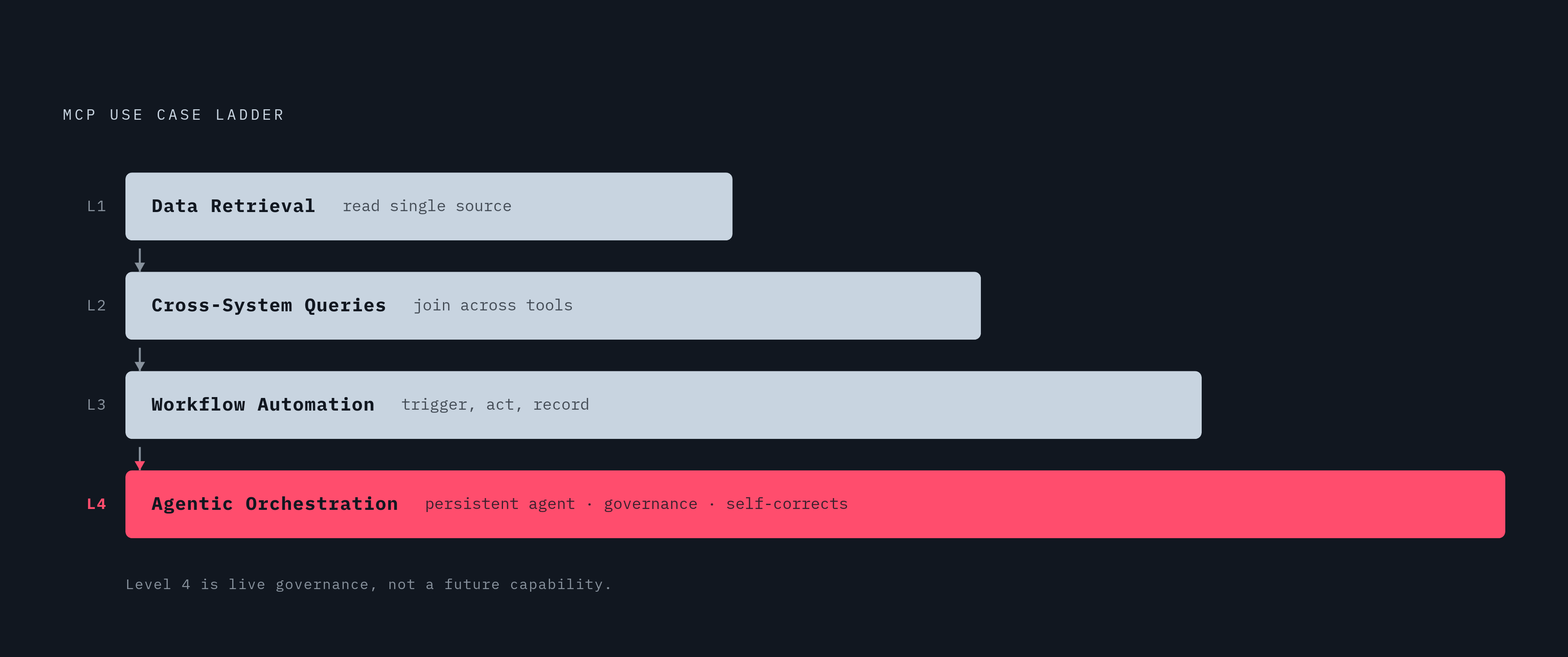
The MCP Use Case Ladder framework lays the progression out in four levels: data retrieval at Level 1, cross-system queries at Level 2, workflow automation at Level 3, and agentic orchestration at Level 4. At Level 4, a persistent AI agent runs continuously, watches data signals, makes decisions inside defined governance parameters, escalates exceptions, and self-corrects. Orchestration tools are what Level 4 requires at the infrastructure level. Reaching that level is the logical endpoint of adopting the first three categories at scale rather than a separate initiative layered on top of them.
It also raises a governance question the earlier categories only hinted at. When a workflow crosses engineering, finance, and procurement in a single sequence, accountability for what the agent did, and why, stops belonging to any one team. It becomes a cross-function problem, and the next section takes that problem up directly.
The cross-function reach that makes MCP valuable and creates its central security problem
MCP's cross-system architecture creates a security surface, and it doesn't map onto any single function area's existing controls. The vulnerability lives in the trust boundaries between systems, not inside any one of them, so security measures built for one function area alone aren't enough to cover it.
Tool poisoning is the dominant documented threat. An MCP tool's description, the natural-language metadata an agent reads to decide how and when to call the tool, can be silently modified while its name and user-facing summary stay exactly as they were. The tool still gets approved. The query still inherits the analyst's permissions. The outbound call still goes to a server on the allowlist. Nothing about the visible interface changes. The vulnerability sits in the trust boundary between systems rather than inside any single one of them, and that's exactly the boundary MCP's cross-function reach multiplies by design.
Confused deputy problems follow a related pattern. An MCP server can execute actions using its own elevated privileges rather than the privileges of the person who asked for them. A user without database admin access asks the agent to run a query, and the server, which does hold admin access, complies without checking whether the user should be allowed to ask. MCP servers routinely aggregate credentials for multiple enterprise systems behind one interface, and that convenience is also the risk: a single compromised server can become a single point of failure across every system it touches.
The exposure isn't theoretical. Scanning has identified a large number of MCP servers sitting on the public internet with no client authentication and no traffic encryption at all, and these are documented production deployments, not test environments someone forgot to secure. Supply-chain compromise is confirmed as well: independent audits of MCP skill repositories found a significant share carrying critical security issues, and a systemic architectural flaw disclosed in April 2026 by OX Security exposes a vast number of vulnerable instances across a supply chain tied to hundreds of millions of package downloads.
Enterprises still need to work out a governance gap that these exposures create. When agents get deployed without centralized ownership, that sprawl leads to broad inherited permissions and unclear accountability for what any given agent is actually allowed to touch. Centralized agent identity management closes that gap, and command injection and server-side request forgery remain real exposures in production environments right now, not edge cases reserved for a future audit. The same cross-function reach that lets one agent query a CRM, write to a database, trigger a pipeline, and post to a messaging channel in a single session is what makes securing that session a genuinely different problem than securing any one system on its own.