MCP Compliance Obligations for Healthcare AI Agent Deployments
The Model Context Protocol, or MCP, is a connector standard that lets AI models plug into file systems, databases, APIs, and enterprise software through one shared interface [1][2][3]. When a healthcare organization connects an AI agent to a patient record system through MCP, it is taking on a protocol whose security choices were left open on purpose, and someone downstream has to close them. The Cloud Security Alliance said as much in a research note: the risks tied to MCP are not the result of sloppy setup work. The protocol's own authorization spec builds in OAuth 2.1, which is a real and current security framework, but it marks the whole thing optional. Meanwhile, HIPAA's Technical Safeguards under 45 CFR §164.312 list unique user identification and audit controls as Required, full stop, while automatic logoff and encryption are Addressable, so an organization can document a substitute or a formal reason to skip them. Whoever deploys MCP in a healthcare setting has to build every one of those safeguards on their own, on top of a protocol that assumes someone else will.
The specific HIPAA obligations triggered by MCP-connected agent deployments
If an MCP-connected agent can touch protected health information, in any form, it has to meet the full HIPAA Security Rule. Several of its core rules run straight into how MCP behaves out of the box. Take the minimum necessary standard at 45 CFR §164.502(b): a covered entity or business associate has to make reasonable efforts to limit PHI to what's actually needed for the task at hand. Picture an agent scheduling a follow-up appointment: all it needs is a patient's name, provider, and a preferred time. A standard MCP connection may hand it the entire chart instead, because nothing in the system asks it to hold back.
The audit control rule at 45 CFR §164.312(b) calls for hardware, software, or procedural mechanisms that record and examine activity on any system holding electronic PHI. MCP has no built-in way to produce that kind of record. No native log shows you which user, acting through which agent, triggered which tool call against which piece of data. Shared service accounts, used across several agents or split between an agent and a human administrator, break that rule directly, and they are still where most MCP deployments start.
Any vendor that handles PHI on a covered entity's behalf, including an MCP server provider, a tool marketplace, or an agent platform routing requests that touch PHI, counts as a business associate and needs a signed business associate agreement. The basic mismatch is that HIPAA's safeguards were written with human behavior in mind, people logging in, making decisions, being supervised. AI agents operating with delegated authority can access, disclose, and process health data with no one watching in real time, and the law's requirements apply to them just as fully as they would to a person.
Confirmed incidents involving AI agents and health data
These aren't hypothetical failure modes. In 2024, an AI meeting agent at an Ontario hospital joined a recurring physician meeting through a calendar invite, and the case was confirmed in 2026. The agent did what it was built to do: join, transcribe, summarize, send. Nothing stopped it from handling PHI or sending that summary past the people who should have received it. It's a minimum necessary violation in its purest form, identifiable health information touched and redistributed with no authorization check and no record of who ended up with it.
Then there's the supply chain. In February 2026, Antiy CERT identified 1,184 malicious skills spread across ClawHub, the marketplace tied to the OpenClaw agent framework (the campaign was first flagged publicly by Koi Security). If a healthcare organization pulls in third-party MCP tools, that kind of compromise applies directly to it. An organization running a poisoned tool may have no way to know what data it touched, copied, or sent elsewhere, and the breach might not come to light until an outside audit or an incident report forces the question.
MCP's attack surface in healthcare: the four mechanisms that put PHI at risk
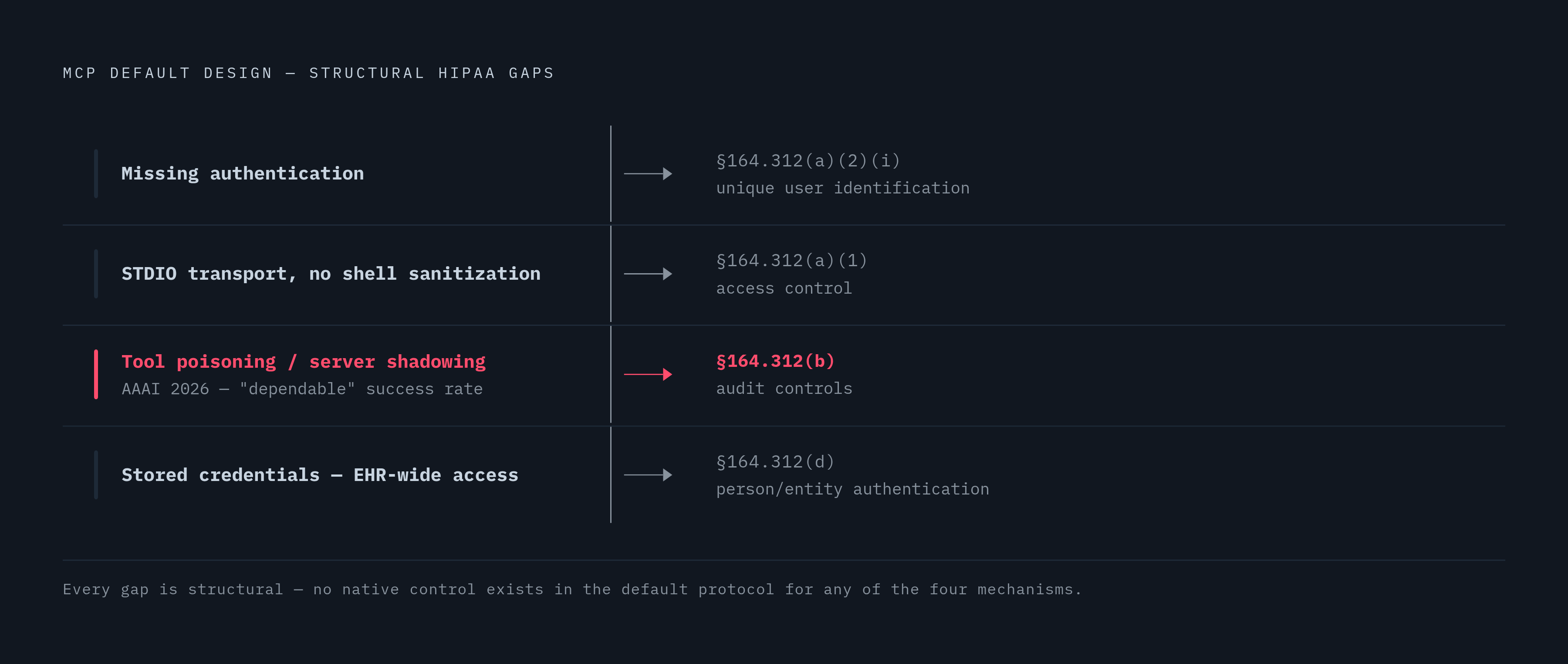
Four attack patterns show how MCP's default design turns into PHI exposure, and each one lines up with a HIPAA control the protocol doesn't supply on its own.
The first is authentication that simply isn't there. A server exposed that way gives HIPAA's unique user identification rule nothing to stand on, because it treats any request as legitimate.
The second runs through the STDIO transport method, which passes configuration parameters straight to the host operating system's shell with no sanitization. In a hospital setting, a server compromised this way opens the door to whatever PHI the host machine can reach, including EHR integrations, imaging systems, and lab results.
The third is tool poisoning and shadowing between servers. Research shown at AAAI 2026 found that a malicious MCP server can craft tool responses that steer a model's output toward actions it shouldn't take, with a success rate high enough to call it a dependable attack method. A hospital's well-vetted EHR integration can be undermined through a far less scrutinized tool sitting in the same agent session.
The fourth sits in the credentials themselves. In a hospital, a credential tied to an EHR system means access to the entire patient population that account covers, not just the one record the agent was supposedly asked to pull.
Implementers' obligations under the July 2026 MCP specification
The specification published July 28, 2026, made real progress on authorization. It laid out three distinct patterns for how access should work: a client acting on behalf of a human user, an unattended agent acting under its own machine identity, and enterprise-managed access run through an organization's identity provider. OAuth 2.1 and PKCE now protect delegated login flows, and tokens tied to specific resources, combined with per-request authorization, give organizations clearer points to enforce policy.
The most useful addition for healthcare is the Enterprise-Managed Authorization extension, which reached stable status in mid-2026. You can use it to control MCP server access centrally through your existing identity provider, so one-off consent prompts for each server give way to a single sign-on flow. That lines up well with HIPAA's demand for unique, trackable user identity, because access now routes through the same identity system an organization already uses for its workforce.
None of that closes the gap on its own. It still can't prove which agent or which runtime is actually holding a given token. Verifiable identity at that level is left to whoever builds and runs the deployment. And authorization remains, as it has from the start, optional. A server built to the letter of the July 2026 spec can still run with no authentication whatsoever. The update gave healthcare organizations better tools to build with. It didn't build the compliance program for them.
The six controls that close the gap between MCP defaults and HIPAA requirements
Closing the distance between what MCP allows and what HIPAA requires takes a specific set of controls, not a general tightening of settings. The first is OAuth 2.0 or 2.1 authentication with credentials kept out of the AI's own context window. No credential should live for more than an hour, no secret should sit embedded in code, and every credential in use should be short-lived, tied to a specific context, and revocable the moment something looks off. This maps directly to the person or entity authentication rule at §164.312(d).
The second is authorization checked at the level of each individual operation, using role-based and attribute-based rules, not a single check made when the session starts. A session-level check only confirms the AI is allowed to connect to a system. A per-operation check confirms that this particular user, asking for this particular action on this particular piece of data, is actually permitted to have it, and that check has to run on every single MCP tool call. This is where §164.312(a)(1), access control, and §164.502(b), the minimum necessary standard, get satisfied in practice.
The third is audit logging that attributes every MCP operation to a named human principal, not just to a service account or an agent's own identity. So each agent needs its own distinct, trackable non-human identity, because shared accounts split across multiple agents, or between an agent and an administrator, leave no way to trace who did what. This maps to §164.312(b), audit controls, and §164.312(a)(2)(i), unique user identification.
The fourth is path and scope control that limits exactly which data sources and operations any given agent can reach. Scope restrictions need to be enforced at the depth of each tool call, not just checked once when the connection opens.
The fifth is sensitivity label evaluation: PHI gets classified before any agent is allowed to act on it. This control supports §164.312(a)(2)(iv), which covers encryption and decryption, and it reinforces the minimum necessary standard from a different angle than access control alone.
The sixth is real-time behavioral monitoring built specifically for MCP's threat patterns. Tool poisoning, prompt injection, agents drifting from their intended purpose, and attempts to pull data out all need detection systems that understand how MCP tool calls are structured, because standard SIEM rules written for human login activity won't catch an agent behaving strangely. If an organization pairs tamper-proof audit logs with full distributed tracing, using a standard like OTEL, it has the evidence it needs when HHS asks it to stand behind its compliance posture.
Non-human identity governance as a HIPAA compliance requirement, not just a security practice
HIPAA's rules on unique user identification and access control treat whoever is accessing PHI as an actor in the system, not as a passive tool being used by someone else. So how an organization manages the identity of its AI agents isn't a technical nicety; it's a direct regulatory obligation for any covered entity or business associate running MCP-connected agents.
AI agents don't behave like the static service accounts that HIPAA compliance programs were built around. An agent working under delegated access can end up with a far wider reach than any policy anticipated, and when that happens the potential damage is larger while the trail left behind is thinner than what a human doing the same work would leave.
Meeting the governance bar here takes three things. Every agent needs its own distinct, trackable identity, since identities shared across agents, or shared between an agent and a human administrator, fail §164.312(a)(2)(i). And you need identity verifiable down at the workload level, because the July 2026 MCP specification still can't confirm which agent or runtime is holding a particular token, and closing that gap is work the implementer has to do.
The regulatory frameworks converging on healthcare AI agent deployments in 2026
HIPAA sets a floor for healthcare organizations that run MCP-connected agents, but it isn't a ceiling. Several other frameworks taking shape through 2026 are converging on the same demands, tightening expectations that MCP's defaults were never built to meet.
NIST launched its AI Agent Standards Initiative, known as CAISI, in February 2026, covering interoperability, authentication, authorization, and identity management for AI agents. NIST has an AI Agent Interoperability Profile planned for release in the fourth quarter of 2026, and organizations building compliance programs now should expect HHS guidance to incorporate these controls.
Article 14's design-time duties fall on the provider building the underlying technology, while Article 26 puts operational duties on the deployer actually running it. If a healthcare organization has EU ties, it has to keep real human oversight over agent decisions involving PHI; this framework makes it a legal requirement.
Singapore's IMDA published its Model AI Governance Framework for agentic AI in January 2026, and it is the first comprehensive governance framework built specifically for autonomous agents. NIST, the EU AI Act, and Singapore's framework are all arriving at the same short list independently: verifiable identity, authorization checked per operation, and audit logs that can't be altered after the fact. That convergence is a strong signal these are becoming the baseline expectation anywhere a regulated AI agent operates. Gartner has forecast that 25% of enterprise breaches will trace back to AI agent abuse by 2028, driven by outside attackers and malicious insiders both exploiting the wider attack surface agents create, a forecast that lines up with the incidents already piling up in healthcare specifically.
Demonstrable compliance for an MCP-connected healthcare deployment
An organization can't set up compliance once in an MCP-connected deployment and walk away from it. It's a standing posture that has to produce evidence, continuously, of authentication, authorization, audit, and oversight for every single action an agent takes involving PHI.
The core demonstration requirement is straightforward to state and hard to satisfy: an organization has to be able to show, in a future HHS audit, that every AI data access running through MCP was authenticated, checked against RBAC policy, logged with full attribution back to a named person, and consistent with the sensitivity classification of the data involved. A machine making the request instead of a human does not exempt it from the requirement. That means the audit log has to tie back to a named human principal through the on-behalf-of chain, and it has to be tamper-proof. A log that only shows an agent connected to a system, with nothing more, doesn't clear the bar.
There's a documentation chain to maintain as well. Alongside that sits a record of human oversight: for any agent running autonomously in a clinical or administrative workflow touching PHI, the organization needs evidence that oversight mechanisms were actually active while the agent worked, which satisfies both HIPAA's administrative safeguards and, for organizations with EU exposure, the Article 14 duty under the AI Act.
Finally, there's the problem of speed. The compliance record an organization needs to produce is proof that controls existed on paper and were fast enough to catch the behavior in time to actually limit the harm.