MCP vs CLI Interfaces for Enterprise AI Agent Engineering Teams
CLI agents waste fewer tokens than MCP, but governance costs flip the equation at scale.
Enterprise engineering teams have stopped asking whether to deploy AI agents and started asking how those agents actually touch production systems. That shift turns an abstract preference into a real engineering decision, because the interface an agent uses to act carries its own cost structure and its own risk profile. The line spread fast, but Steinberger's actual point was narrower than the discourse made it out to be. He was describing ergonomics in personal, single-user agent workflows, not making a claim about what enterprises need from a governed, multi-user system, and that distinction got flattened as the quote traveled. The backlash against MCP that followed did not hold. Search interest and adoption for MCP rebounded through mid-2026, and Firecrawl reported roughly a 35% uplift in MCP usage in a single month, driven largely by teams building products that needed multi-user access and enterprise governance. MCP's institutional backing in that same window kept growing: Anthropic launched the protocol in November 2024, and by early 2026 OpenAI, Google, and Microsoft had all backed it, with the protocol now sitting under the Linux Foundation's Agentic AI Foundation and its SDK pulling tens of millions of monthly downloads. CLI, meanwhile, never left. CLI-based agentic tools had amassed an enormous GitHub following and were already running in production at thousands of organizations during this same period, an actively chosen path rather than a legacy habit teams haven't gotten around to replacing.
What each interface does at the mechanical level
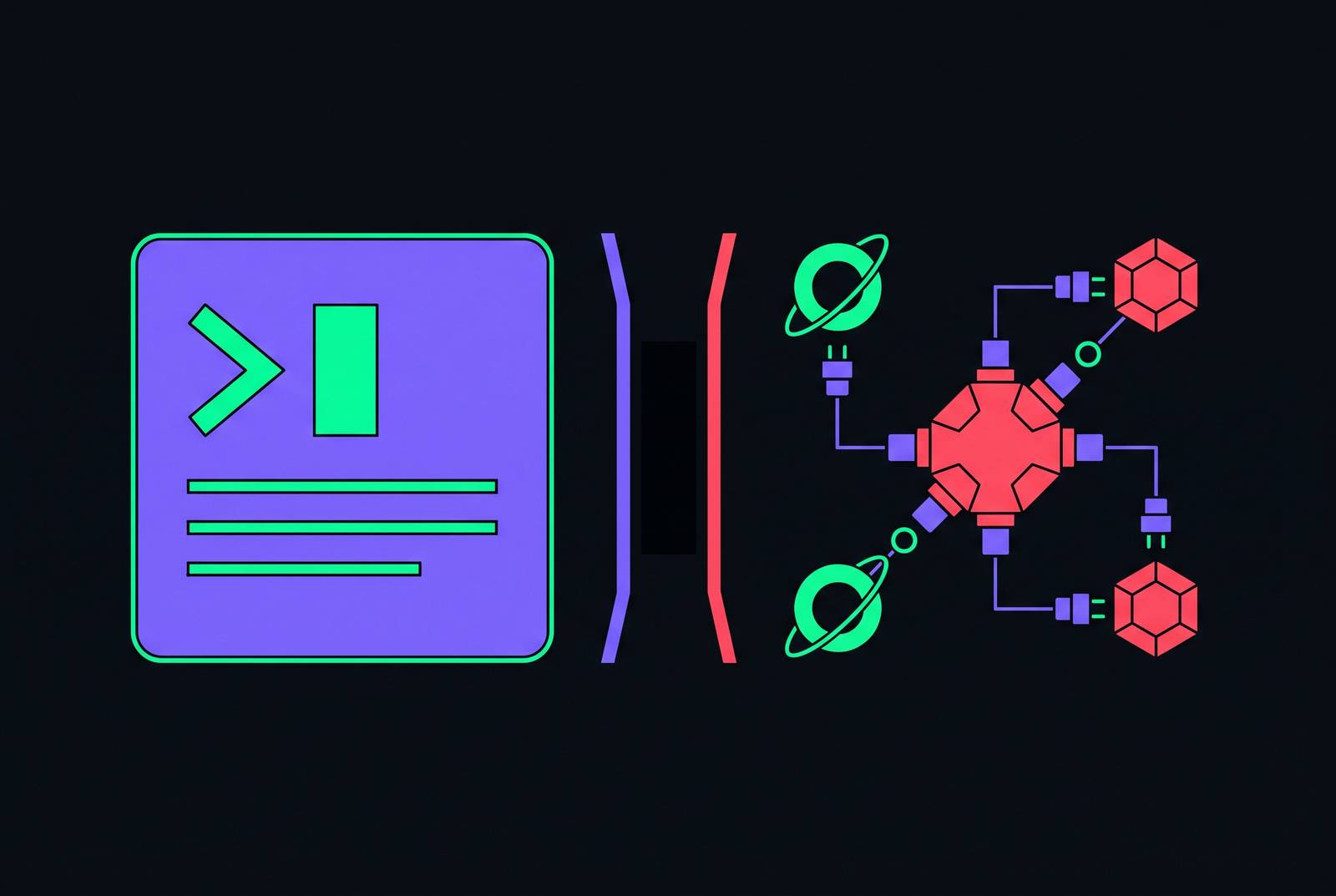
The two approaches solve the same problem of connecting an agent to external capabilities through fundamentally different mechanisms, and understanding the mechanism is what makes the trade-offs legible.
CLI is a text-based surface. An agent invokes software through verbs, flags, and arguments, chained together in pipelines, the same way a human operator would type git, docker, kubectl, or the AWS CLI into a terminal. Text goes in, text comes out. There is no schema to load and no protocol handshake before the real work starts. The agent reads command output directly and reasons about it the way it would reason about any other block of text.
MCP works differently. It is an open protocol built on JSON-RPC 2.0 messages, with stateful connections and capability negotiation happening between what the protocol calls hosts, clients, and servers. That upfront load is the single biggest mechanical difference between the two approaches, and it is the reason the rest of this comparison keeps returning to the schema.
Token budget: why CLI wins the inner loop and what it costs
Token overhead is working memory the agent spends before it starts reasoning, and at enterprise scale, that spend keeps a complex multi-step workflow reliable or causes it to start dropping context it needs later in the task.
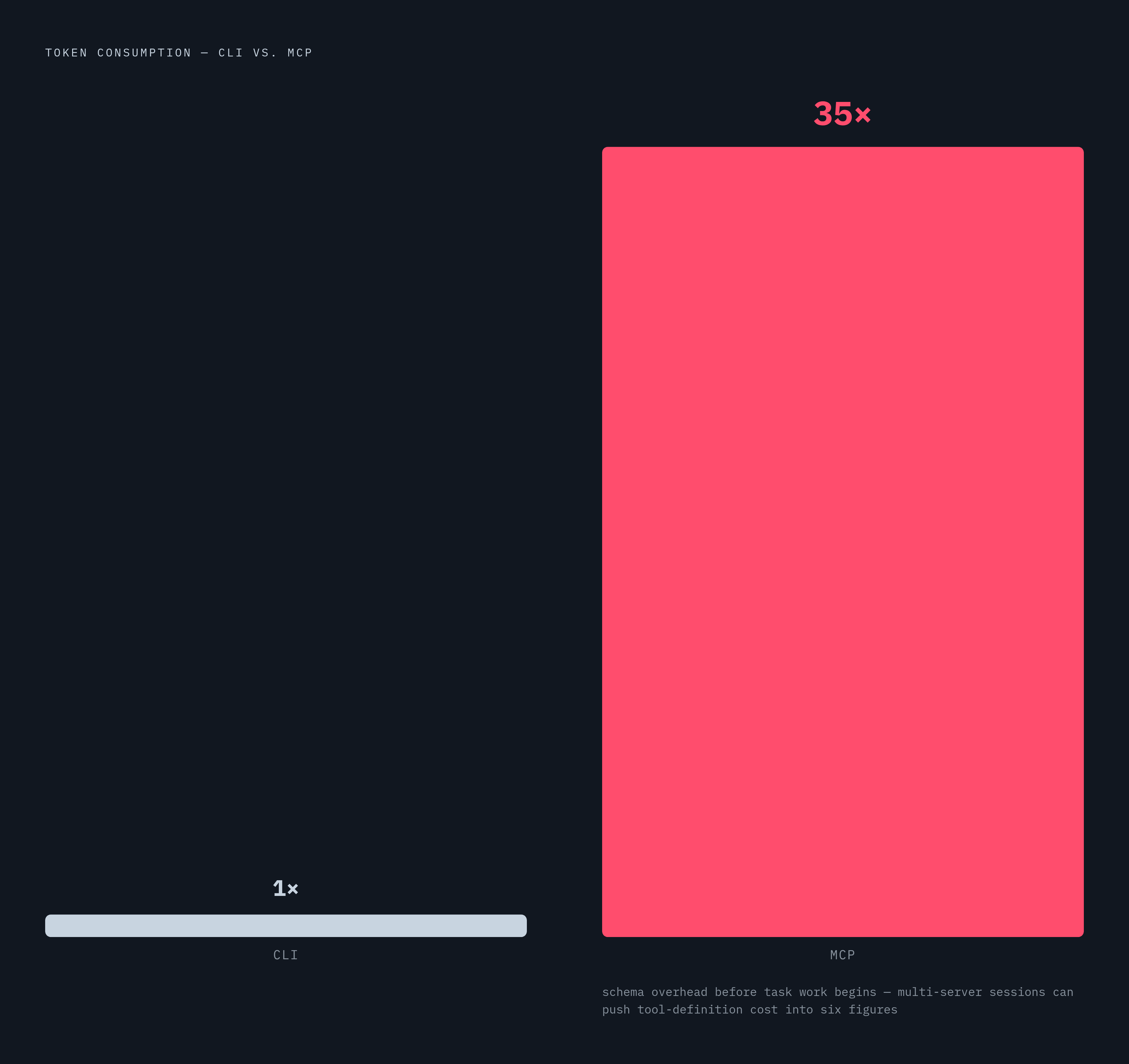
The schema cost is concrete and it adds up fast. A GitHub MCP server with a large tool catalogue can cost tens of thousands of tokens before any task work begins, and stacking several MCP servers in one session pushes total tool-definition overhead into six figures. A side-by-side example from an Intune device management workflow makes the gap tangible: managing a small fleet of devices through MCP consumed roughly 35 times more tokens than the same workflow run through CLI. CLI's per-command footprint, by contrast, stays small, which leaves most of the context window free for actual reasoning instead of protocol bookkeeping. This gap in token counts is visible in task quality as well, not just in token counts. In one browser automation benchmark, CLI achieved a higher task completion score with roughly the same total token count, meaning tokens were spent on reasoning rather than schema.
A concrete side-by-side in an Intune workflow managing a small fleet of devices showed the MCP flow consuming roughly 35x more tokens than the CLI flow, illustrating how quickly protocol overhead compounds in real tasks.
Part of CLI's advantage also comes from architecture, not just token count. MCP tends to route intermediate data through the model itself, while a shell pipeline lets the agent filter before anything reaches the model at all, using grep, jq, or awk to narrow a result down before it ever becomes a prompt. That gives the agent progressive disclosure of data instead of a full payload dump every time.
None of this makes token efficiency the only metric that matters. It matters most in tightly looped, stateless, single-user workflows, the kind of fast local iteration a solo developer runs dozens of times an hour. In multi-user, multi-tenant systems, the cost that matters most shifts from tokens per call to total system complexity, and that shift is where the rest of this comparison has to go next.
Why models are fluent in CLI but must learn MCP at runtime
CLI's token advantage has a cognitive explanation behind it, not just a mechanical one: models already know the interface before they ever see a task, while MCP schemas arrive as brand-new context the model has to absorb on the spot.
Large language models trained on enormous volumes of CLI content. Stack Overflow answers, GitHub READMEs, blog posts, and documentation all contain commands like git commit, docker build, kubectl get pods, and aws s3 ls, repeated across millions of examples. That means a model doesn't look up how to use git. It has the pattern baked into its weights the same way it has grammar baked in. When an agent encounters something like git checkout -b feature/login, the syntax itself carries intent in a compact, familiar shape, and help text, man pages, and --help flags double as documentation the agent can read without anyone injecting a schema for it.
MCP schemas don't get that same head start. When an agent encounters a new MCP schema, it has to learn that particular abstraction before it can use it to solve anything, which is a cost layered on top of the raw token count. Schema structure helps with one kind of error and not the other. A 2026 controlled study found that well-structured schemas reduced interface misuse, cases where the agent sends a malformed call or gets a parameter type wrong. The same study found schemas did nothing to stop semantic misuse, where the agent calls the exact right function with syntactically valid arguments but the wrong intent behind the call. Reliability, in other words, comes from clarity and simplicity in what the agent is asked to do, not from how rigorously the schema is written.
MCP does close part of the gap once a session is running. After a model has loaded a well-designed schema once, later calls within that same stateful session skip the reloading cost entirely, and the ongoing overhead of a persistent connection is far lower than spinning up a new CLI process for every single command.
Familiarity and token cost are both inner-loop arguments. They explain why CLI wins fast, local, single-user iteration. The outer loop, the world of many users, shared infrastructure, and compliance review, introduces requirements that familiarity and token savings can't satisfy on their own.
Where CLI's structural limits become enterprise blockers
CLI is a tool built to solve a different problem than MCP, and that problem was never "how does a system manage access for many different identities at once". The moment a system has more than one user, CLI's efficiency advantage runs into a wall, because CLI has no built-in way to manage per-user identity at all. That's a limitation baked into the design, not something a configuration change fixes.
The authentication gap is the clearest version of this. CLI typically offers one shared token for everyone who uses it, while MCP supports per-user OAuth, with the ability to revoke access for any single user without touching anyone else's access. In a multi-tenant enterprise deployment, a shared token means a shared blast radius: one compromised credential exposes everyone riding on it.
Audit trails follow the same pattern. CLI's audit trail is bash history, and MCP offers structured logs with access revocation built directly into the protocol. Bash history isn't tamper-proof, isn't tied to a specific user identity, and can't be queried at the level of granularity a regulator or a security team actually needs when something goes wrong. That gap is visible directly in compliance conversations. An agent running with raw shell access on production infrastructure invites a question that rarely survives a compliance review well: "so the AI can run any command on the server?"
Stateful, long-running work raises a separate, more technical limit. MCP keeps a persistent connection open with roughly 5 milliseconds of overhead per call, while CLI spins up a brand-new process for every command, at roughly 200 milliseconds each. For something like a long browser session or a database transaction that depends on maintained state, CLI's per-command process model compounds that latency call after call.
There's also a real argument for keeping one interface for both human operators and agents, since it simplifies tooling and keeps everyone working against the same surface. That argument cuts both ways, though: the moment an agent's scope of action needs to be narrower than a human operator's, scoped to one tenant or one task, a single shared interface has no way to enforce that boundary. Enterprise deployments are exactly where that boundary stops being optional.
What the 2026 MCP authentication changes deliver for enterprise teams
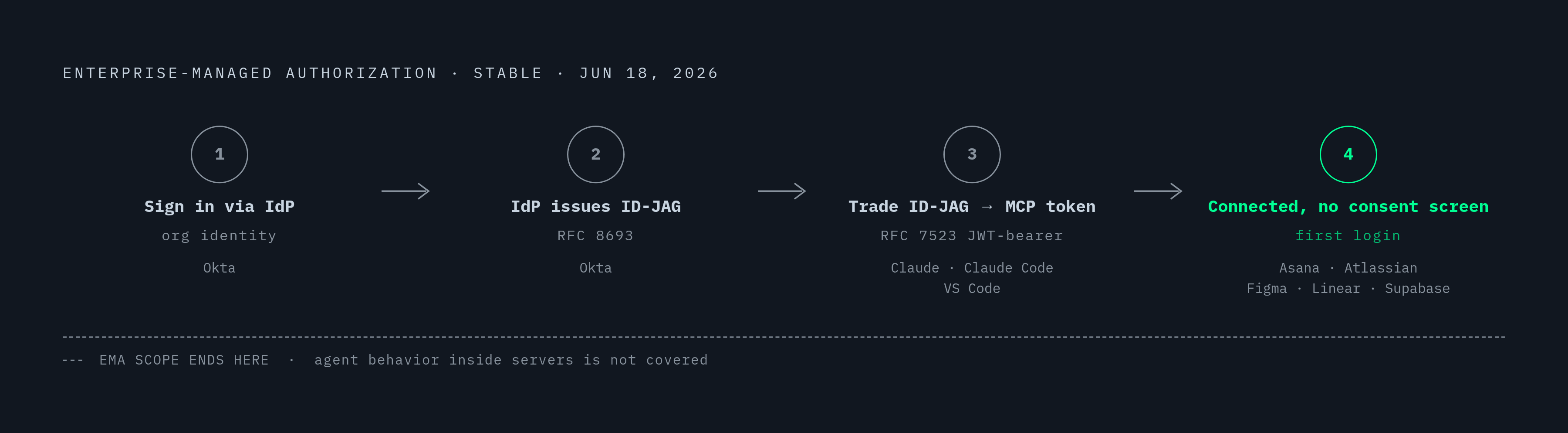
MCP's authentication story changed in a concrete way in mid-2026. The Enterprise-Managed Authorization extension reaching stable status means access to MCP servers can now run through an organization's own identity provider, the same place every other access decision in the company already gets made.
The mechanics are specific. A user signs in, the identity provider issues an ID-JAG using RFC 8693 token exchange, the client trades that ID-JAG for a real MCP access token using RFC 7523 JWT-bearer, and the user never gets redirected to the MCP server's own separate per-app consent screen. In practice, that means a user gets connected servers on first login, without clicking through a separate OAuth approval for every single app.
The extension went stable on June 18, 2026, and launched with real partners already running it: Okta as the identity provider, Claude, Claude Code, Cowork, and VS Code as clients, and Asana, Atlassian, Canva, Figma, Granola, Linear, and Supabase as servers, with Slack adding support. It's a working chain, shipping across tools enterprise teams already use, not a proof of concept sitting in a sandbox. Separately, Auth0 by Okta brought Auth for MCP to general availability in May 2026, folding OAuth 2.1 and OpenID Connect directly into the MCP ecosystem.
What this change does not do matters just as much as what it does. The extension is not a replacement for OAuth 2.1, and it is not a runtime policy engine that governs what an agent does after it connects. It governs access to MCP servers. It says nothing about what the agent does once it's inside one. Every connected tool still has to be treated as untrusted input, and that responsibility sits with the engineering team, not with the protocol. The honest way to describe where things stand: an engineering team can now defend its MCP access model in an audit in a way it couldn't six months earlier, because that access runs through the same identity provider as everything else the company governs. That is a real, specific improvement. It is not a complete security solution on its own.
The security threats that make MCP governance non-optional in 2026
The push toward governance around MCP in 2026 is a direct response to a specific class of attack that exploits metadata agents read as part of normal operation, metadata that no human reviewer ever actually looks at. These threats are already occurring at enterprise scale, not sitting as theoretical edge cases in a research paper.
Tool poisoning is the clearest version of this. A malicious or compromised MCP server can embed instructions inside a tool's description field, the same field the agent reads as part of the schema it loads before the task even starts. The agent treats that description as trustworthy context because it arrived through the same channel as every legitimate tool definition. A human operator reviewing the tool list sees a short, plausible description. The agent sees the full text, including anything hidden inside it meant to redirect its behavior. That asymmetry, between what a human glances at and what an agent actually parses in full, is the structural opening these attacks are built around, and it is exactly the kind of risk that identity-based access control through an extension like EMA does not touch. EMA decides who gets to connect to a server. It says nothing about whether that server's tool descriptions can be trusted once the connection is live. Treating every MCP server as untrusted input remains a standing requirement for any engineering team running agents against production systems.
Sources
- CLI-Based Agents vs MCP: The 2026 Showdown That Every AI Engineer Needs to Understand
- MCP vs CLI for AI Agents: Which One Should You Use in 2026?
- CLI Tools vs MCP: The Hidden Architecture Behind AI Agents - DEV Community
- MCP vs CLI for AI Agents - xpander.ai
- CLI Tools vs MCP: Better AI Agents With Less Context