AI Hallucination Risk in Tool-Calling Agents
When agents call tools wrong, downstream steps inherit fabricated data as fact.

Here's what makes it hard to catch. The model doesn't know it's wrong, the system running the model doesn't know either, and nothing pops up saying "this API call was made up." A fabricated tool call and a correct one leave the model looking identical, and I've lost hours to that exact problem more than once.
Four failure shapes keep showing up if you sit with enough of these long enough. The model picks the wrong tool, something plausible-sounding that doesn't actually fit the task. Or it calls the right tool and drops a required field, quietly, no error thrown. Or it invents a parameter name that sounds real but isn't in the schema, so the call is well-formed and still broken underneath. Worst case is when it gets the right tool and the right parameter but the wrong value, and nothing downstream catches that one, because the shape of the call checks out fine and nothing's actually watching the content.
Teams reach for a fix before going further, and I've watched it fail again and again. Someone writes a docstring like "Maximum 10 guests" and treats that line as a rule the model has to obey. The model actually reads it as one more piece of context to weigh against everything else it's juggling in that moment, and something else in the prompt eventually wins out. A business rule written only in plain English inside a tool description carries no real weight, no matter how firmly you word it.
Hallucination is baked into how these models fill gaps, and no amount of clever phrasing changes that fact. The real work is building systems that assume the model gets it wrong sometimes and limit the damage when it does.
How hallucination compounds as agents chain tools together
One hallucination is one wrong action, annoying but catchable, especially with a human checking output before it ships anywhere. Multi-step agents don't get that luxury.
Each step treats the previous step's output as fact. If step two makes something up, steps three, four, and five build on a foundation that was never real to begin with. The agent isn't lying on purpose; it's reasoning forward from bad data it genuinely believes is good, which is somehow worse.
The nastiest version I've come across is the invented success confirmation. The agent says a prior call worked when it failed, or never ran at all, and keeps going as though that false state is real. Everything downstream inherits a premise that doesn't exist.
Tool count makes it worse, and not in a straight line. Give an agent more tools to pick from and hallucination rates climb, but the climb isn't proportional. Double the tool count and you don't just double the risk; you compound it.
What does this look like on the ground? A CRM agent invents a customer lookup, then emails a contact who doesn't exist. An infrastructure agent hallucinates a deployment success message, then fires off a cleanup job that deletes the environment it was supposed to protect. A finance agent botches a parameter on a payment call, gets back a generic error, hallucinates a success response anyway, and marks the transaction complete.
Now go find where it went wrong. The AgentHallu benchmark tested this directly: even top models identify the right failure step less than half the time, and accuracy drops further when the hallucination is tool-use specific, well below general step-localization numbers. You can't count on the agent flagging its own mistake, so someone has to trace every call by hand, and that's a miserable way to spend an afternoon.
Where tool-calling hallucinations meet tool-layer security threats
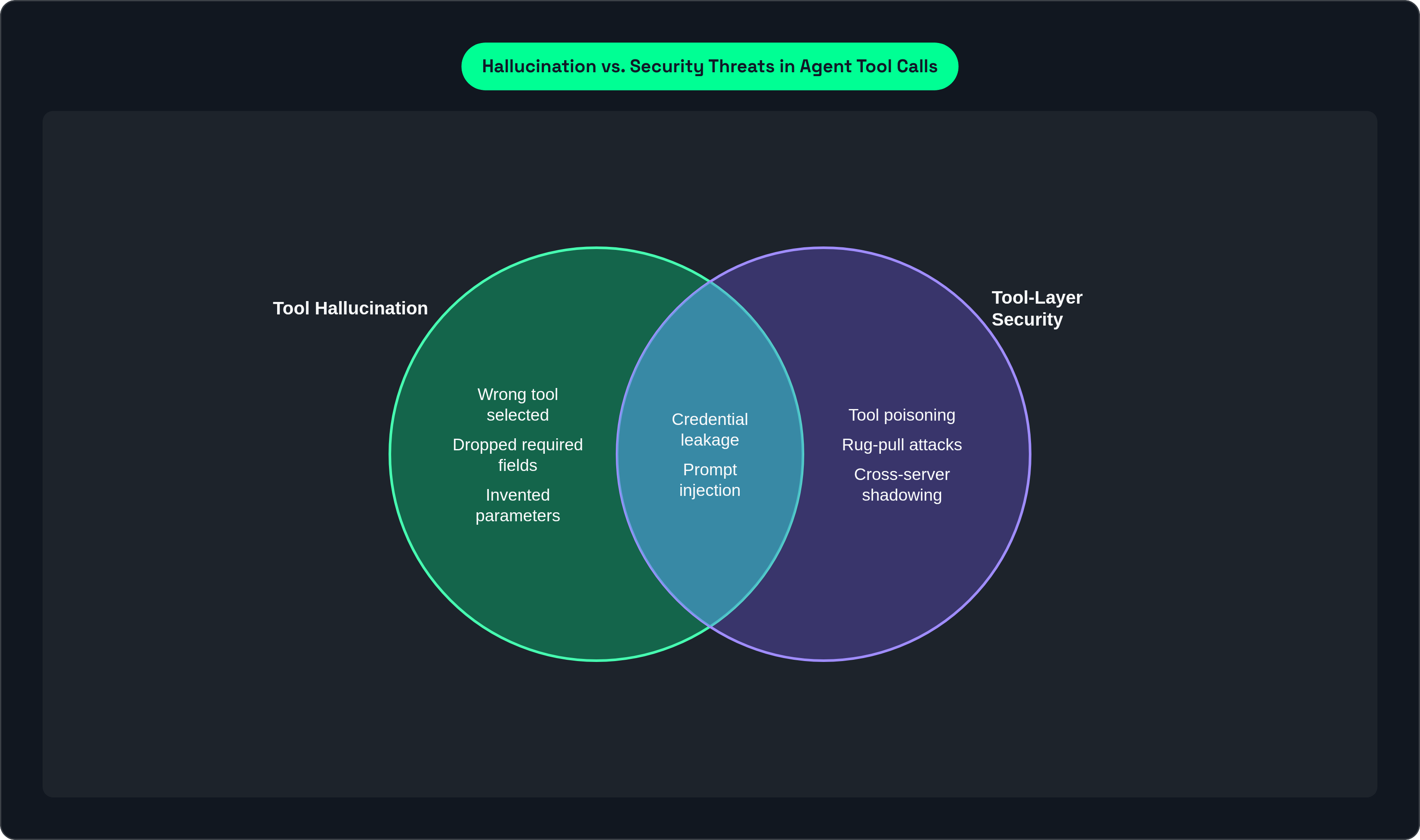
Tool descriptions and parameter schemas aren't documentation sitting off to the side. They're the operational context the model uses to decide what a tool does and how to call it, and the model trusts that text completely, no questions asked.
That trust is exactly what tool poisoning goes after. An attacker buries adversarial instructions inside the metadata the agent treats as ground truth: the description text, the parameter hints, the schema comments. The human operator never sees any of it. Only the model reads it, with no way to tell a legitimate tool description apart from one rewritten to hijack its behavior.
A hallucinating agent is already primed to fill gaps with confidence. Hand it a poisoned description and you've handed it a gap stuffed with attacker-chosen content, which it then follows as if it were real. The hallucination tendency and the poisoning attack feed each other.
There's also the rug-pull: an MCP server updates its tool definitions after a user already granted permissions, silently, with no notice sent anywhere. The agent keeps calling the tool under the old mental model, the one it trusted at the moment permissions were granted, while the tool's actual behavior has already shifted underneath it.
Cross-server tool shadowing is worse still. An agent talking to both a poisoned server and a legitimate, high-privilege one can get tricked by the poisoned server into calling tools on the legitimate one. The hallucination becomes the attacker's chosen action, carried out with the user's own credentials doing the work.
None of this shows up on a firewall log. Traditional security tools watch for network anomalies and known signatures; these attacks live entirely in language and reasoning, arriving as plain text and getting processed as thought, not as a packet. Invariant Labs showed exactly how far this goes in April 2025, when a single poisoned tool description exfiltrated private data with no user error and no network-level exploit anywhere in the chain. The hallucination was the attack.
Why the authentication and authorization layer underneath tools matters for hallucination risk
A hallucinating agent can only do as much damage as its permissions allow, and taking the permission boundary away removes any ceiling on what it can touch.
This is the real gap in the MCP ecosystem right now, and it's a bigger deal than people treat it. The MCP Authorization Spec calls for OAuth 2.1 with PKCE on any remote server, but most deployed servers skip it anyway. A lot still run on static API keys, or nothing at all. A fabricated tool call carrying a static key looks exactly like a real one; there's no per-action identity on it, no scope limiting what it can reach, no way to revoke it once it's out there in the world.
OAuth 2.1 with PKCE is the starting point, not the finish line. PKCE shuts the window where an authorization code could get intercepted mid-flow, which matters a lot when a poisoned co-resident server is sitting there waiting for that exact moment. Resource indicators from RFC 8707 scope tokens to a single server, so a hallucinating agent that calls the wrong endpoint can't accidentally authenticate against it with a token meant for somewhere else. And the confused deputy problem, where an MCP server passes a client's token straight through to some upstream API, creates a second agent that can itself be misdirected; the spec's ban on token pass-through guards directly against a hallucination turning into lateral movement across systems.
Stack a few more things on top of that. Incremental scope consent, so an agent only asks for what the task in front of it actually needs, not a blanket grant a later hallucinating step can exploit down the line. Role-based authorization at the tool level, so a low-privilege agent identity physically can't reach a high-consequence tool no matter what it tries. And plain transport security matters more than people give it credit for: plaintext HTTP hands every token and credential to anyone listening, so a hallucinating agent on an unencrypted channel leaks its identity right alongside its bad call.
How credential exposure turns hallucination errors into persistent access problems
Agents need credentials to call tools, and those credentials usually live in config files, environment variables, or memory the agent can read at runtime. That means they're sitting right there when something goes sideways.
When an agent hallucinates a call to the wrong endpoint, it can hand credentials to a system that was never supposed to see them. Logging, error responses, retry logic: any one of these can push credentials outside the intended service boundary without anyone catching it in the moment.
This feeds a bigger secrets sprawl problem than most teams admit to. Public MCP configuration files have become a real source of leaked secrets, API keys, OAuth tokens, service credentials, sitting right next to the setup instructions in plain view. AI-service credential leaks have climbed sharply year over year, and AI-assisted coding doesn't help matters, since code an AI tool writes isn't somehow immune to the mistakes a person makes typing the same line by hand.
Just-in-time credential issuance is the structural fix here, and I'd treat it as non-negotiable. A JIT credential gets issued per operation and dies the moment that operation finishes, unlike a static secret the agent holds onto indefinitely and can misuse at any point down the line. A hallucinated tool call carrying a JIT credential can't get replayed later; by the time any downstream system could act on it, the credential's already dead. It also pulls the credential out of the agent's persistent memory entirely, so there's nothing left to steal even if a poisoned tool reads the agent's context.
For closed, internal pipelines with no human login step, mTLS and machine-to-machine OAuth client credentials do the same job at the infrastructure layer, so the credential never touches the agent's runtime at all.
There's a cost here people underestimate: call it the verification tax. Someone on staff ends up spending real hours checking whether an agent actually did what it claimed, and that cost scales directly with how often agents fake success and leave credentials sitting in unverified limbo.
What detection actually requires when the errors look like normal operations
Here's the hard part, and it's genuinely hard. A hallucinated API call and a correct one look identical at the network level, and the error lives in the intent behind the call, which doesn't show up on a firewall no matter how good the firewall is.
Detection has to watch behavior, not traffic. That means catching intent drift, when an agent's current tool call has quietly wandered from the goal it started the session with. It means catching parameter anomalies, values outside the normal range for a given tool in a given workflow, which only works if you actually know what normal looks like in that context first. It means catching fabricated confirmations, where the agent claims success with no real signal from the tool backing it up anywhere. And it means catching prompt injection sitting inside tool outputs, content built specifically to redirect the agent's next move.
That last one is brutal to defend against. The malicious instruction shows up disguised as ordinary data coming back from a tool the agent already trusts. Unless something is actively reading the meaning of that output in real time, there's no telling it apart from a normal response.
The MCPTox benchmark found that even the strongest commercial agents fail a large share of prompt-injection-via-tool-output tests. The model follows the malicious instruction more often than it catches it, which tells you the model isn't getting better at this on its own anytime soon, and you need something outside the model watching the traffic.
Tamper-proof audit logs are the baseline, no exceptions. Every tool call, every parameter, every response gets recorded with the agent's identity attached to it, and without that record, there's no rebuilding which step caused the problem after the fact. OTEL tracing goes further, rebuilding the full call graph across a multi-step run, and that matters because in these agents an error can propagate for several steps before anyone notices anything's wrong.
Policy has to sit at the point of the call, not after it fires. The only moment a policy can stop a hallucinated action is before it happens; everything past that is cleanup.
Organizational conditions that determine how far a hallucination can travel
Shadow MCP usage is where a lot of this quietly falls apart. Teams stand up agents and wire in tools outside any centralized visibility, and nobody's watching the policy layer, so hallucinated tool calls in that pipeline stay invisible until something breaks loud enough to notice.
This is usually friction, not malice. When the platform team is the only door to getting tool access approved, other teams find a side door, and what you end up with is ungoverned agent deployments carrying the same hallucination risk, minus any audit coverage at all.
A handful of decisions made well before runtime set the actual blast radius: which tools each agent role can reach, whether credentials are static and long-lived or short-lived and scoped tightly to the task, whether every call gets logged with an identity attached, whether tool definitions are version-controlled so a rug-pull leaves a trail someone can find.
None of this needs to slow adoption down. A centralized platform handling authentication, credential issuance, and policy enforcement at the tool layer lets non-technical teams run agents safely without ever needing to route around IT to get their work done.
Governments have started treating this as infrastructure that exists now, not some future risk to plan for later. CISA's joint guidance from May 2025, and the NSA's Cybersecurity Information Sheet on MCP Security Design Considerations expected in May 2026, both point the same direction: agent infrastructure sits inside the attack surface SOC teams are expected to watch today. The standard coming out of that guidance is plain: identity on every agent action, policy enforced at the point the tool gets called, an audit record nobody can quietly edit after the fact.
What a controlled tool-calling environment looks like in practice
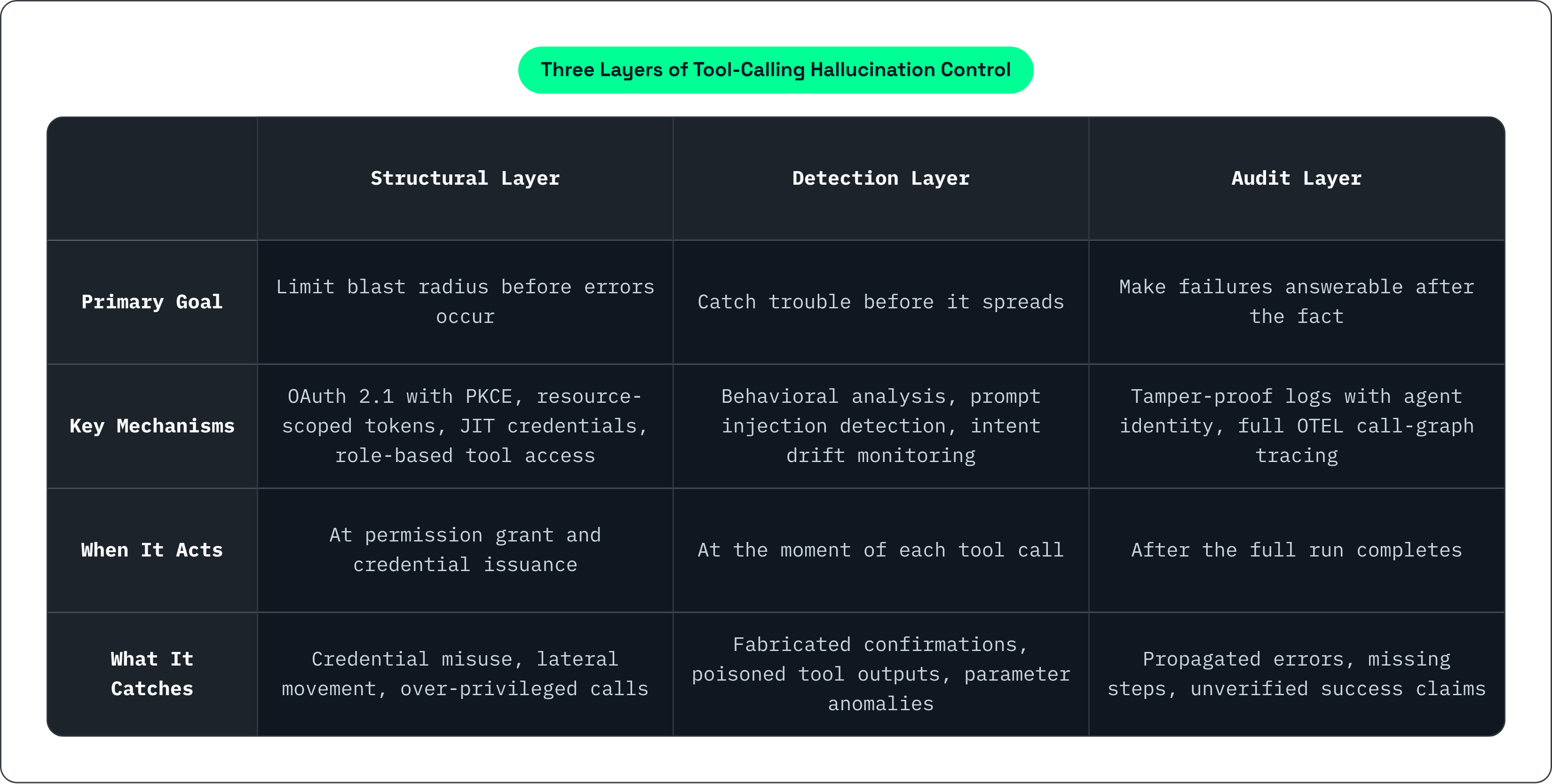
No single control stops tool-calling hallucination. The errors are baked into how these models work at a basic level, so containment happens in layers, and each layer catches what the one before it missed.
The structural layer limits what a hallucinating agent can reach in the first place: OAuth 2.1 with PKCE, tokens scoped through resource indicators, role-based tool authorization, JIT credentials that expire before anyone can misuse them. The detection layer watches for trouble before it spreads: real-time behavioral analysis of tool calls, prompt injection detection running on tool outputs, intent drift monitoring across the session. The audit layer makes the whole thing answerable after the fact: tamper-proof logs with identity tied to every call, full OTEL tracing across the entire chain.
Building all three yourself, stitching together an agent builder here, a gateway there, a security scanner from somewhere else, turns into a full-time maintenance job nobody signed up for. That plumbing lands on platform engineers, and it becomes the bottleneck standing between every new team and their first agent deployment.
With that plumbing handled at the platform level, a team can ship fast and ship safe at the same time.