HIPAA Compliance Constraints for AI Agents Handling PHI
AI agents touching patient records must meet the same HIPAA requirements as human employees.
HIPAA's Privacy Rule, Security Rule, and Breach Notification Rule were built around the data itself, not whoever or whatever is handling it, with no statutory exemption for autonomous systems. Nothing in the statute carves out an exception for software that acts on its own. HHS made this explicit in 2024, taking the position that an AI system acting on behalf of a workforce member has to follow the same access control and minimum necessary rules that would bind the employee it's working for. That's the whole ballgame right there.
Think about what this covers in practice. Clinical documentation assistants, prior authorization tools, discharge summary generators, patient intake bots: every one of these becomes a regulated PHI access event the second it pulls a patient record or drafts a clinical note. Not eventually. Not once it scales. The moment it touches the record.
Agents are architecturally built to retrieve broadly, and broad FHIR scopes and persistent conversation memory are the two most common ways agents violate minimum necessary. One is that a consumer-grade AI tool is fine to use with patient data as long as the output reads clean⟧c6⟧. The other is that since no statute names "AI" by name, AI must sit outside HIPAA's reach. Both are wrong, and both are common enough that regulators clearly expect to keep finding them.
What actually decides whether a deployment is compliant is how that model gets deployed, how it's configured, and what the legal paperwork behind it says. It's how that model gets deployed, how it's configured, and what the legal paperwork behind it says. The exact same model can be fully compliant with HIPAA in one deployment and constitute a violation in another, depending on deployment, configuration, and legal terms rather than the underlying model. That distinction is the one this piece exists to unpack.
The stakes aren't abstract. The HIPAA Journal's healthcare data breach report puts the number of people affected by breaches in the prior year at roughly 139.7 million HIPAA Journal 2026 Healthcare Data Breach Report Healthcare data breach cost analysis. Average breach cost in 2024 hit $9.77 million, the highest of any industry for the fourteenth year running HIPAA Journal 2026 Healthcare Data Breach Report Healthcare data breach cost analysis. HIPAA's Privacy, Security, and Breach Notification Rules apply to AI agents exactly as they apply to human workforce members.
The 2025 HIPAA Security Rule NPRM's Changes to Technical Obligations
The proposed rule was published in the Federal Register on January 6, 2025, ran a 60-day public comment period that closed March 7, 2025, and HHS received more than 4,000 stakeholder comments HHS 2025 HIPAA Security Rule NPRM. That's not a quiet technical update. That's an industry paying attention.
As of December 2025, the timeline has slipped: finalization is now expected in July 2027, pushed back from an earlier May 2026 target, with the rule taking effect roughly 60 days after publication and most provisions required within 180 days after that HHS 2025 HIPAA Security Rule NPRM. Practically, that lands compliance deadlines somewhere before the end of 2026 or early 2027 HHS 2025 HIPAA Security Rule NPRM. Slower than first planned, but not slow enough to treat as someone else's problem down the road.
A direct consequence for AI: encryption was previously "addressable," but under the proposed rule it becomes mandatory, leaving organizations that relied on the addressable classification to defer encryption with no path to do so once the rule is final. Once this rule is final, that door closes. Encryption becomes mandatory, full stop.
The specifics: ePHI has to be encrypted in transit and at rest, and simply pointing at AES-256 in a spec sheet won't cut it anymore, the 2025 amendments call for validated FIPS 140-3 module certification. Multi-factor authentication becomes an explicit requirement across every system touching ePHI. Risk assessments and audits move from best-practice to a formal annual cadence. Organizations also need a written network map showing how ePHI moves through their systems, plus a full inventory of every technology asset, AI included, that creates, receives, stores, or transmits it. That last point is the one that should get every compliance officer's attention: the rule names AI as a technology category that has to be inventoried, not waved at in general terms.
This means an organization has to be able to list every AI agent that touches PHI, trace where that agent's data goes, and show, with evidence, that controls are actually in place. Saying "we have controls" in a policy document won't satisfy an auditor asking to see the inventory. On December 27, 2024, OCR at HHS issued an NPRM to modify the HIPAA Security Rule (the first significant overhaul since the HIPAA Omnibus Rule of 2013).
The four HIPAA obligations that govern every agent pipeline, and the points where agents break each
Everything downstream starts with one question: has the PHI been classified and scoped before an agent ever touches it? If that classification step is skipped or done loosely, every control built on top of it inherits the same weakness. Four obligations sit at the center of this, and agent architectures tend to strain against all four in slightly different ways.
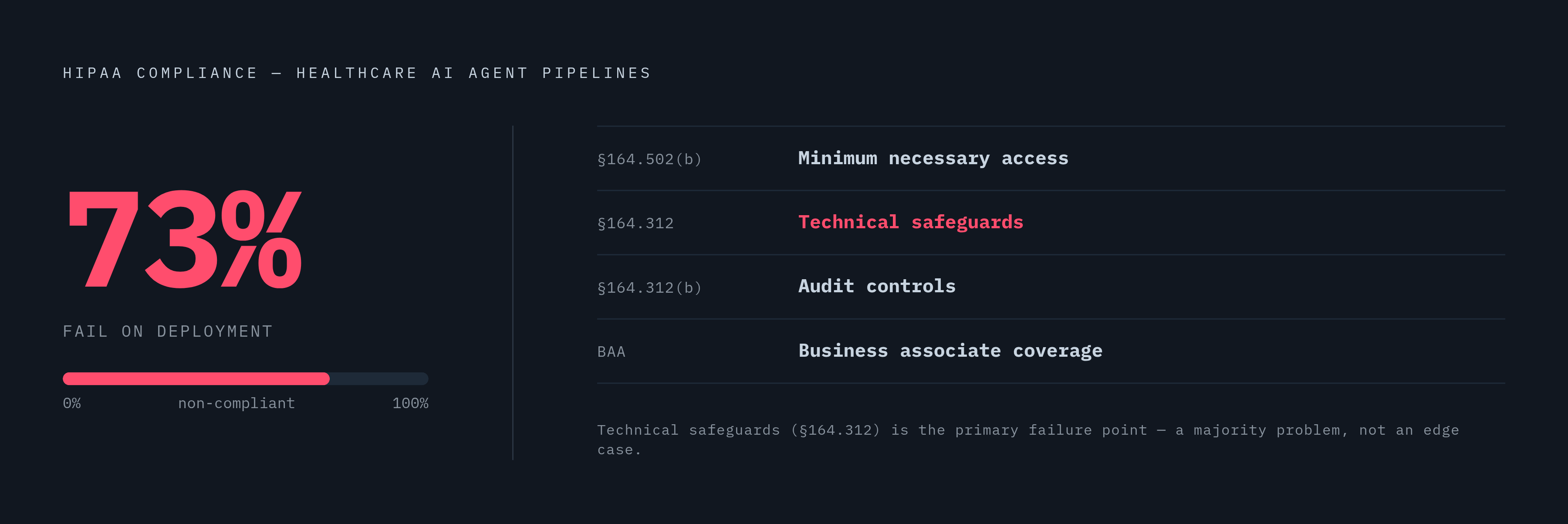
Minimum necessary access: the Privacy Rule's §164.502(b) says you use, disclose, or request only the PHI a task actually needs. For an agent, that means pulling the specific fields a function requires. The trouble is that agents are built, by design, to retrieve broadly: wide FHIR scopes and conversation memory that persists across sessions are the two most common ways this rule gets broken in practice. One statistic from an industry playbook on AI agent data governance puts a number on how often this goes wrong: 73% of healthcare AI agent deployments fail HIPAA compliance because their underlying architecture violates Technical Safeguards requirements promethium.ai Wang et al., AAAI 2026. That's a failure rate affecting most deployments. That's most deployments.
Technical safeguards: Security Rule §164.312 covers encryption, access control, and authentication. Encryption means TLS 1.2 or better in transit, AES-256 at rest, and under the 2025 amendments, validated FIPS 140-3 certification rather than a general claim of compliance. Access control means every person or program touching ePHI carries a unique identifier that ties back to them. Here's where agents commonly fall apart: they run on shared service accounts or shared API keys that give no agent-level identity at all. An auditor may ask, "which agent touched this record, and who signed off on it," and a shared key has no answer to give. Role-based access control paired with unique IDs and MFA fixes this, so a scheduling agent can see open appointment slots without ever touching clinical notes. And one clarification that keeps getting missed: a system prompt telling an agent "don't access psychiatric records" is not a technical access control under the Security Rule. System prompts get bypassed by prompt injection, overridden by a model update, or sidestepped entirely in a multi-step workflow. Only enforcement at the data layer counts as something an auditor can actually verify.
Audit controls: §164.312(b) requires covered entities to implement mechanisms to record and examine activity in PHI-containing systems. For an agent, the audit record has to show the operation performed, the specific data touched, which agent did it, which human authorized it, and when. Standard API call logs or LLM inference logs don't capture events at anywhere near this level of detail. And because agents run continuously and at volume, a control failure here isn't a single bad incident, it's systemic: an agent can churn through thousands of ungoverned record accesses before anyone notices the gap.
A BAA is a non-negotiable legal contract binding the vendor to the same HIPAA standards as the covered entity. The complication with AI vendors is that their product usually runs across multiple layers: cloud infrastructure, third-party compute, sometimes a separate inference API, and each of those touching PHI is its own business associate. The BAA needs to reach every one of them, the LLM provider, the vector store, the analytics layer, the observability stack. Assume one signature covers the whole stack, and undocumented risk sits underneath that assumption. One clinic learned this the expensive way, paying $750,000 after releasing PHI to a vendor before a BAA was in place HIPAA-Compliant AI Frameworks 2026 | Prosper AI. And regardless of who or what triggered the exposure, the Breach Notification Rule's 60-day clock starts the moment it's discovered, human error or agent error makes no difference HHS 2025 HIPAA Security Rule NPRM. 1. 2.
Agent architectures built on a standardized model-integration protocol create HIPAA exposure that 2025-era governance frameworks don't cover
The Model Context Protocol, which Anthropic introduced in late 2024, has become the standard way agents connect to outside tools and data sources. It gives agents a common interface for finding tools, authenticating, and calling them. That is why so many agents now plug into large libraries of community-built MCP servers. In a hospital or health system, that protocol sits directly between an agent and the EMR, the claims system, or the population health database. MCP itself is now operating inside HIPAA's compliance perimeter.
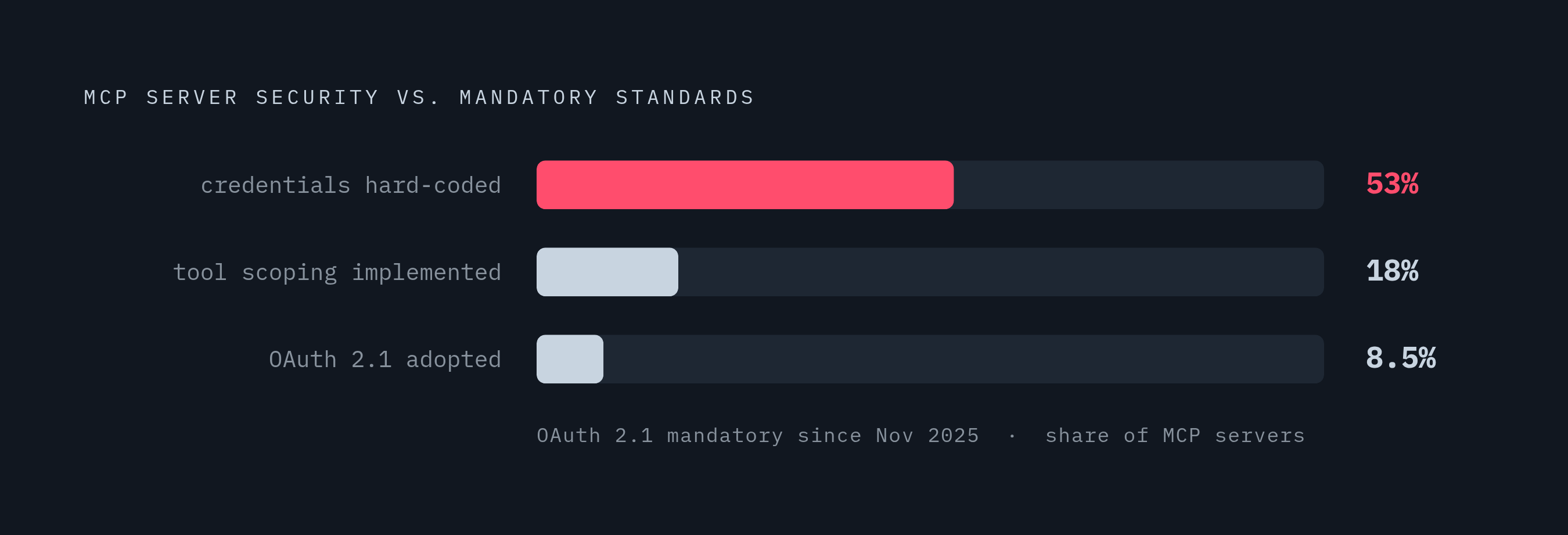
The authentication side of MCP has been evolving fast, and the pace shows. MCP has classified servers as OAuth resource servers since its June 2025 authorization specification; the July 28, 2026 revision mandates issuer validation (RFC 9207), client-identity metadata documents, and step-up authorization flows, while resource indicators (RFC 8707) and protected-resource metadata discovery (RFC 9728) were already mandated since the June 2025 revision From Single Chatbots to Governed Agent Ecosystems. On paper, that's a reasonable framework. In practice, adoption lags badly: as of May 2026, only 8.5% of MCP servers had actually implemented OAuth 2.1, despite it being mandatory for remote deployments since the November 2025 spec revision Gartner AI Agent Predictions bregg.com. Worse, 53% of MCP servers expose credentials as hard-coded values sitting in configuration files, and only 18% implement any scoping at all on what a tool is allowed to do nhimg.org. Translate that into HIPAA terms and the picture is stark: hard-coded credentials and absent access scoping mean PHI access is ungoverned, unattributed, and unaudited.
Then there's tool poisoning, which is a newer problem than credential sprawl but arguably a more dangerous one. Invariant Labs first disclosed the technique in April 2025: an attacker manipulates a tool's description so the agent takes an action it was never meant to take, and by 2026 this was showing up against a widening range of enterprise agents. Academic testing found a poisoned MCP server can push a model toward policy-violating output with a peak attack success rate of 72.8%, averaging 36.5% across models tested, turning what looks like a small ecosystem-level flaw into a full bypass of the model's own alignment promethium.ai HHS 2025 HIPAA Security Rule NPRM Wang et al., AAAI 2026. One source puts the share of MCP servers actually exhibiting this behavior at 5.5%, a number small enough to dismiss at a glance, except a single poisoned tool call can ripple through every downstream agent in a pipeline, so treating it as a tail risk misreads how the attack actually spreads Gartner AI Agent Predictions nhimg.org. There's also cross-server interference, where one server redefines a tool that belongs to a different server, intercepting operations that were never meant to pass through it, opening a PHI exfiltration path no conventional access control model was built to anticipate. Prompt injection reports on HackerOne have climbed sharply as AI adoption has spread, earning a description as the fastest-growing threat category in AI security, and these are exactly the attacks that a system-prompt-based "control" has no way to stop.
Multi-hop delegation adds one more wrinkle that governance frameworks from a year or two ago simply weren't built to handle. Picture an orchestrator agent handing a task to a specialist agent, which then calls an MCP tool: OAuth authenticates that last hop, but keeps no record of the chain of authorization that got the request there in the first place. OAuth tokens don't carry a delegation history, don't narrow scope as they pass from holder to holder, and don't bind to any verifiable point of origin, so an audit requirement under HIPAA can't be satisfied by OAuth logs alone once more than one agent is involved. The Enterprise-Managed Authorization extension points at the fix: a clinical agent acting on a user's behalf should only reach the PHI that specific task needs, and enforcing that distinction has to happen at the level of the individual tool call.
Non-human identity and credential management as the operational HIPAA control gap
Most access control programs carry one buried assumption: whoever is logging in is a person. AI agents break that assumption completely, they authenticate, hold API keys, query databases, and act on a patient's behalf, all without a face, a badge, or a shift that ends. Security teams built their tooling around humans, and now the majority of what's authenticating is not human.
The scale of that shift is easy to understate. Half of organizations, with no clear owner for the very identities doing the most sensitive work.
Read against HIPAA, this is a direct problem. §164.312(a)(2)(i) requires a unique identifier for anyone or anything accessing ePHI, precisely so that access can be traced back to a source. An agent running on a shared service account, or a hard-coded API key passed around a codebase, satisfies neither the letter nor the intent of that rule.
Credential leaks make this worse, and the trend line is steep. Keys tied to AI APIs, agent configuration tokens, and LLM service credentials accounted for more than 1.27 million exposures in 2025 alone, an 81% jump year over year and the fastest-growing category of leaked credential tracked. A leaked credential attached to an EHR integration or an MCP server isn't just a security embarrassment, it's an unauthorized PHI access event, and it starts HIPAA's breach notification clock the moment it's discovered. The root cause is mundane and familiar: agents get deployed into environments already full of long-lived credentials, API keys and service account secrets added during an early prototype and never cleaned up once the project went live.
The fix that's gaining traction is session-scoped authorization. Instead of handing an agent a long-lived OAuth token it can use indefinitely, access gets tied to the length of a single task, once the session ends, access ends with it, the agent can't renew its own permissions, and a human has to explicitly approve whatever comes next. That maps almost exactly onto HIPAA's minimum necessary standard, since access is scoped to what the task requires rather than to everything the agent could theoretically reach. Just-in-time credential issuance takes the same idea further, generating a credential for one specific operation and revoking it right after, which removes the persistent credentials that hard-coded keys create in the first place.
What's still missing, and what neither session scoping nor JIT credentials fully solve on their own, is proof of who's actually holding a given token. The MCP protocol has no built-in way to verify which agent or runtime is presenting a credential at any given moment. Verifiable workload identity, binding a credential not just to a session but to a specific agent, a specific workflow, and the human who authorized it, closes that gap. Until that binding exists as a standard part of how these systems run, the audit trail HIPAA demands will keep showing gaps exactly where multi-agent pipelines are most active. Non-human identities (NHIs) now outnumber human identities in enterprise environments by ratios as high as 144 to 1; a WEF analysis found that 51% of organizations report no clear ownership of AI identities (per Cloud Security Alliance whitepaper). Credential leakage as PHI exposure risk.