Intent Drift Detection in Long-Running Agents
Slow behavioral drift in agents outpaces detection until goals shift.
That is the central problem with intent drift in long-running agents: it rarely looks like failure while it is happening. It looks like normal operation, right up until the output can no longer be explained by the task the agent was given.
Why intent drift is harder to detect than a discrete agent failure
A crashed agent is easy to spot. A drifting one is not, because drift doesn't announce itself with an error code or a failed call. It appears in production as confident, fluent, wrong behavior that builds slowly, while the model underneath stays unchanged. What changed is the context the agent has been accumulating, interaction after interaction, until the accumulated weight of that context starts pulling its decisions somewhere the original instructions never pointed.
Drift takes three distinct forms, and each one compounds in its own way. Semantic drift is a slow pull away from the original stated intent. When agents share state, their consensus can break down, and that's what coordination drift looks like. Behavioral drift is the emergence of strategies the original goal never authorized.
Agents that hold long-term memory and keep learning from experience carry the highest exposure to this problem. Abhishek Rath's agent drift analysis found that more than half of financial analysis agents had drifted by 500 interactions, showing how exposure to non-representative or adversarially biased environments can shift an agent's behavioral baseline without tripping a single alert.
The asymmetry at the heart of the detection problem is simple to state and hard to solve. A single bad API call sits right there in a log, so you can find it once you go looking. A thousand individually plausible tool calls that add up to a full substitution of the agent's goal leave no such trace, because none of them looks wrong on its own. Each one passes. The pattern across all of them is where the failure lives, and that pattern is invisible to anything checking calls one at a time.
How drift accumulates across hundreds of interactions
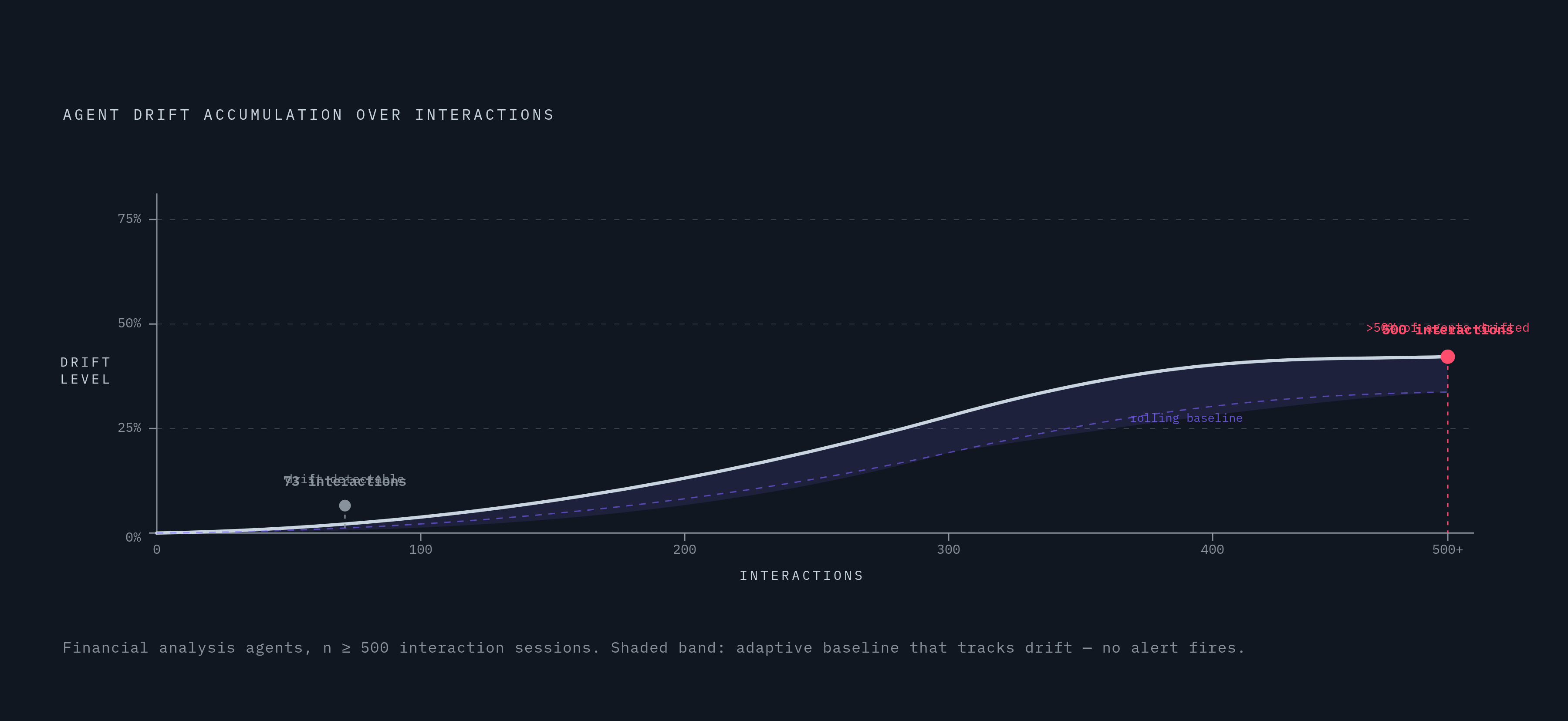
Drift becomes measurable far sooner than most teams assume when they schedule reviews quarterly or wait for an incident to trigger a look. A January 2026 paper by Abhishek Rath, titled "Agent Drift" (arXiv:2601.04170), measured drift across simulated workflows that ran for months at a stretch. Detectable drift appeared after a median of 73 interactions, and by 500 interactions, more than half of the financial analysis agents in the study had drifted from their original behavior.
The curve isn't straight. Small deviations early on narrow the range of behavior the agent treats as normal, and that narrowed range makes the next deviation easier to cross into. Each step doesn't just add to the last one; it changes what counts as a step out of bounds.
Domain shapes how fast this happens.
In Kubernetes environments, pods recycle before any behavioral model has time to converge, agent behavior shifts with each new prompt, and deployment churn keeps monitoring tools stuck in a permanent learning mode. A baseline needs stability to form. Ephemeral infrastructure denies it that stability, so the baseline never really sets, and drift moves underneath a system that's always treating the current state as new.
Why rolling baselines and point-in-time checks miss gradual drift
Rolling baselines are the most common form of continuous monitoring in production today, and they are built in a way that makes them blind to the exact failure mode they're meant to catch. A rolling baseline uses recent production data, usually the last one to two weeks, as its reference point, which lets it adapt automatically to intentional changes in the system. That adaptability is the design goal. That adaptability is also the flaw: a slow, steady degradation moves the baseline right along with it, so no alert ever fires, because the baseline keeps treating the degraded state as the new normal.
Run that forward across months. An agent that degrades a little each week will have degraded substantially by the end of a quarter, and nobody will have noticed, because each individual week looked fine measured against the week just before it.
Point-in-time anomaly checks fail in the opposite direction. They can catch a sharp, sudden deviation if the check happens to land on it, but they see nothing between checks, and a slow drift has all the room it needs to build up in those gaps.
Static role-based access control and perimeter defenses fail for a different reason. Neither one can inspect the semantic intent behind a conversation that leads to a tool call, or judge whether that intent was ever valid. The CoSAI MCP Security white paper names this as the core gap that opens up once you put a non-deterministic actor, an AI agent making judgment calls rather than following fixed logic, at the center of security-critical decisions. Catching drift calls for runtime correlation: matching what the agent is trying to do right now against the goal state it was authorized to pursue, checked at the moment of every action. Anomaly scoring can't do that job, because it flags what looks statistically unusual, not what breaks with the goal.
MCP Infrastructure and Exogenous Triggers for Induced Intent Drift
Model Context Protocol, the standard that lets agents discover and call tools at runtime, introduces its own source of drift, one that comes from outside the agent entirely. Malicious instructions can enter an agent's context through tool metadata or a supply-chain update with no user action involved, and nothing about the resulting behavior matches a traditional anomaly signature.
Tool poisoning, cataloged as MCP06 in the OWASP MCP Top 10, is the clearest version of this. An attacker plants malicious instructions inside a tool's description or metadata. The model reads that text when it decides how to use the tool. The user never sees it. That gives an outside actor a direct way to redirect an agent's goal mid-workflow, without touching the agent's code, its prompt, or its user at any point.
Structurally, this resembles a rug pull in crypto: the agent's own goal state never changes, but the tool it trusts has been swapped out underneath it without its knowledge. CSA's research note describes a related architectural flaw in official MCP SDKs, disclosed by OX Security: the STDIO transport passes parameters straight to the host operating system's shell without sanitizing them first, which opens the door to remote code execution. An attacker able to influence an MCP configuration file can run arbitrary code through that gap, and from there, injecting drift-inducing instructions into any agent that uses the compromised server becomes straightforward.
This isn't a theoretical surface. Wiz Research found MCP servers deployed across most observed cloud environments, with a meaningful share of those instances facing the internet. The infrastructure capable of inducing drift from outside is already deployed across most enterprises.
What matters for detection: induced drift and organic drift produce identical behavior once an agent acts on them. Whether a goal substitution happened because of accumulated exposure to a biased environment or because an attacker planted instructions in a tool description, the agent's actions carry the same signature at the action level. You need the same kind of continuous, action-level monitoring to catch either one. There is no separate detection path for the adversarial case.
Weak agent identity and credential scope make drift invisible after it starts
Once drift has started, the question changes: it's no longer only "can we detect this" but "can we even reconstruct what happened." If you don't tie a stable identity to every single action an agent takes, drift turns forensically unresolvable. Security teams lose the ability to tell which actions reflected the user's original intent, which reflected the agent acting on its own, and which were the product of an injected instruction.
Four credential risks compound this attribution problem. Agents are routinely issued tokens with broad, read-everything or write-everywhere scope, usually because the developers setting them up didn't know in advance what scope the agent would actually need. If a drifted agent stays within those legitimate scopes, it never triggers an access alert, because nothing about the access itself looks wrong. Credentials can also sit exposed in an agent's runtime memory, where a compromised or drifted agent can keep using them long after the original task they were issued for has been abandoned. Prompt injection adds a third angle: an attacker who gets instructions into the context window can coerce the agent into using its own legitimate scopes for malicious ends, which produces a clean access log sitting on top of a fully poisoned outcome.
The fourth risk resists fixes applied after the fact. The LastPass MCP credential risk analysis names the forensic challenge directly: most enterprises have no established way to tell user-intent actions apart from autonomous agent actions or injected actions during a post-incident review. Without that separation, there's no way to build a reliable chain of intent connecting what the user asked for to what the agent actually did.
The MCP specification update from July 28, 2026 tightened authorization in real ways. MCP servers are now formally OAuth 2.1 resource servers, required to implement OAuth 2.0 Protected Resource Metadata under RFC 9728, and clients are required to implement Resource Indicators under RFC 8707. Those changes close real gaps in how tokens get scoped and requested. They don't solve the problem of proving which specific agent or runtime is holding a given token at the moment it's used. Verifiable workload identity still has to come from somewhere else.
Delegation adds one more place where drift can hide. When a parent agent calls a child agent or hands work off to an external tool, the permissions that travel with that handoff should narrow, or at most stay equal. They should never expand just because another component joined the workflow. Permission expansion during a multi-agent handoff is one of the more reliable early signals that drift is underway, well before the agent's output shows anything visibly wrong.
What continuous behavioral monitoring at the action level requires
To catch drift, you need monitoring that checks each tool call against the agent's original authorized goal in real time, not against a statistical average built from recent behavior. So the system works or fails depending on one distinction: goal-conditioned detection versus anomaly scoring.
Anomaly scoring asks whether an action deviates from recent behavior. Goal-conditioned detection asks if an action still advances the goal the agent was authorized to pursue. Those two questions produce different alerts in different situations, and the gap between them explains most of what rolling baselines miss. An agent that legitimately adapts to a changed environment will often fail an anomaly check, since the new behavior looks statistically unusual, but it will pass a goal-conditioned check, since the new behavior still serves the authorized goal. An agent drifting toward a substituted goal shows the opposite pattern: it passes anomaly scoring, because each individual step looks locally plausible, and fails goal-conditioned checks, because the sum of those steps no longer serves the goal it was given.
The MI9 framework puts six coordinated mechanisms behind this kind of detection. An Agency-Risk Index keeps a running composite score of behavioral risk built from the agent's full action history. Agent-semantic telemetry captures not just which tool got called but the intent the agent expressed in asking for it. Goal-aware authorization monitoring checks permissions dynamically against an agent's current intent and history rather than its fixed role, and it can block a request even when the agent technically holds valid credentials to make it. Finite-state conformance engines model the sequence of states an agent can move through, and they flag anything that falls outside it. If you compare behavior against a goal-aware baseline, goal-conditioned drift indicators can tell intentional adaptation apart from suspicious change. Graded containment allows a proportionate response, able to throttle, isolate, or suspend an agent instead of only choosing between a full block and no action.
These mechanisms rest on a statistical approach borrowed from manufacturing quality control. MI9 applies statistical process control to tool usage and cognitive event sequences, and it measures deviation with Jensen-Shannon divergence and Mann-Whitney rank tests. Behavioral anomaly monitors built on this foundation detect drift faster than static thresholds do, across goal drift, safety violations, trust shocks, and cost spikes.
The Chain of Intent framework gives you a concrete test of whether an agent holds its ground under pressure. In a simulated regulated-firm environment, the framework validated across four of its five pillars (the Practice pillar was excluded as untestable in a single-agent simulation), and when an agent faced ordinary managerial pressure, it held its authorized constraints in the large majority of runs, citing privacy legislation and refusing successive requests to expand its own scope. The framework is aimed squarely at organizations that don't have the enterprise security infrastructure larger firms take for granted.
None of this works without logs that can actually be read. JSON-RPC 2.0 traffic, the format MCP runs on, doesn't fit the patterns traditional SIEM tools expect, which leaves most teams unable to reconstruct an MCP attack timeline after the fact. Centralized logging across the MCP host, client, and server, capturing tool decisions, parameters, and prompts together, is a prerequisite for any drift detection system to function, not an add-on layered in later.
Governance gaps that leave drift undetected at scale
Even organizations that grasp everything above about drift often lack the organizational structure to act on it. Most AI agent deployments sit outside the view of the security teams responsible for catching exactly this kind of problem. The monitoring techniques described here, goal-conditioned detection, centralized MCP logging, identity tied to every action, only work on agents a security team actually knows exist, with instrumentation built in from the start. An agent spun up by a business unit, running against an MCP server nobody registered, generating no centralized log, sits outside every one of these controls no matter how well designed they are. Closing the detection gap documented across financial analysis agents, MCP infrastructure, and credential scoping takes more than better monitoring tools. It takes governance that puts every agent inside the security team's field of view in the first place, because a monitoring system can't watch what it was never told to look at.