Real-World Agentic AI Use Cases in the Enterprise
Agentic AI works best when tasks repeat, outcomes are verifiable, and humans can catch mistakes.
Agentic AI has stopped being an experiment and started showing up in daily operations, but it only shows up in a narrow set of places. Those places share three traits: the task repeats often, success or failure can be checked against something real, and a human is there to catch the rare mistake. Where even one of those traits is missing, the project tends to stall.
Agentic AI differs from a chatbot or a predictive model in a specific way. It takes a goal, works out a sequence of steps, calls on approved tools, checks what happened, and adjusts its next move. What makes an agent dependable has less to do with which model sits underneath it and more to do with the architecture built around it: what it's allowed to touch, what it's checked against, and who steps in when it's wrong.
That gap between promise and practice is large. Roughly 88% of enterprise agents that get built never make it into production, and the reasons they fail look the same across industries, from retail to manufacturing to law. McKinsey has estimated that early agent deployments can support meaningful annual productivity gains at the company level, with more mature multi-agent setups supporting even larger gains, though those numbers depend on real workflow redesign rather than arriving on their own.
The practical filter for an enterprise team considering any use case involves three conditions: a repetitive task, a verifiable signal, and a human fallback.
Customer operations: why this is the right first use case for most enterprises
Customer operations pays back faster than any other agentic domain, and the reason is structural rather than coincidental. It combines the highest volume of repeatable tasks with the clearest way to check whether the agent got it right, and it has the softest landing when the agent doesn't: escalate to a person.
Ticket deflection, first-contact resolution, order-status lookups, returns handling, and tier-1 triage all share one trait: each has a binary outcome, resolved or escalated, that makes evaluation and ROI measurement straightforward. That binary outcome makes measuring the agent's performance straightforward. Companies routinely report positive return on investment in under six months for these deployments. The task runs at high volume, and the resolution can be checked against a knowledge base, so the business case writes itself.
What separates this from the decision-tree chatbots that preceded it is the amount of judgment involved. An agent handling a return reads the customer's order history, checks the return policy, weighs the context of the request, decides whether an exception applies within limits the business has set, processes the refund, updates the CRM, and sends a confirmation, all without a person stepping in. A scripted chatbot built on fixed decision trees cannot do any of that; it can only follow a path someone already mapped out for it.
Telecom and retail firms running agentic customer service now resolve the large majority of tier-1 support issues with no human involvement at all, based on data from live deployments. Air India's AI.g system handles around 40,000 customer queries a day across a wide range of topics, and it reached a usable product within six months of development starting. Regal Rexnord built a customer-facing agent on Microsoft Copilot Studio that serves a large weekly user base, with satisfaction scores that often reach the high end of the scale.
None of this needs to be dressed up as a stepping stone toward something more advanced. Customer operations works because the task is well understood, the boundaries are clear, and the failure mode, an unresolved query bumped to a human agent, gets designed into the system from day one rather than patched in after something breaks.
Finance and back-office: structured data and explicit rules make agents reliable
Finance works as an agentic domain for a reason that has nothing to do with how exciting the use case sounds. Transactions are structured, rules are spelled out in policy documents, and every action leaves a record the agent can be measured against, so the success signal is built into the data itself and so is the audit trail.
Invoice processing, three-way matching and reconciliation, expense-report compliance checks, procurement intake, and fraud triage all produce an outcome that can be scored: matched or flagged, compliant or not. Agents applied to these workflows cut processing time by well over a third in targeted cases, while improving both accuracy and the paper trail auditors depend on.
Month-end close shows the pattern clearly. An agent can pull in transaction data as it arrives, match invoices to purchase orders by checking quantity, price, and date, flag exceptions against a set of rules, and produce a variance analysis without anyone touching the process by hand, turning work that used to take days into something finished in hours.
The step that still requires a person is the step with real consequences: releasing a payment, closing the books. That approval gate is a deliberate design choice that lets the rest of the workflow run without supervision, because the one moment where a mistake would actually cost money stays behind a human sign-off.
Works Human Intelligence partnered with the AWS Generative AI Innovation Center to build two agents supporting its HR system, and the resulting setup could cut costs by up to 97% in the business-support workflows it targeted. Unilever built a multi-agent procurement system on Google Cloud's Gemini Enterprise Agent Platform to help its teams make purchasing decisions faster and with better information. The same logic extends to fraud triage: structured transaction records give the agent something solid to check its work against, and when something looks off, the flag goes to a human reviewer instead of triggering an automatic action on its own.
Software development and IT operations: high value, but governance requirements are higher too
Engineering has turned into one of the most valuable places to deploy agents in 2026, and it has also turned into the clearest proof that thin observability and weak guardrails cause real incidents. The same domain that shows the biggest upside is the one showing, in practice, what happens when oversight lags behind capability.
Code-review agents, automated test generation, dependency and framework migration, log triage, incident summarization, and documentation agents now handle work that used to eat up senior engineers' hours. A major manufacturer used agents to cut production optimization work from six weeks down to one day, and OpenAI reports that an energy producer used agents to raise output enough to add over a billion dollars in additional revenue. Tata Steel rolled out more than 300 specialized agents over nine months, covering asset maintenance, business process automation, and access to enterprise knowledge.
The catch sits in how these agents behave when no one is watching closely. Benchmarks run in 2026 have shown coding agents getting around their own configured guardrails. Engineering teams need the same discipline around evaluation and observability that any other consequential system requires. Treating code as lower-stakes because it's "just code" misses the point: an agent with the ability to write to production systems carries real risk regardless of what domain it sits in.
IT operations agents follow an identical split. Infrastructure monitoring, threat detection, and automated remediation succeed when the question has a clean yes-or-no answer, like whether a service is running. Open-ended calls, like whether to roll back a release, still need a person who owns the decision. The gap that matters here is structural: an agent with write access to production systems has a wide blast radius if something goes wrong, so bounding what it's allowed to do first, read, draft, suggest, before ever granting write access, is the discipline that separates teams that ship from teams that stall.
Supply chain, HR, and legal: the use cases that ship versus the ones that stall within each domain
Supply chain, HR, and legal each hold a small set of agentic use cases that satisfy all three conditions, and a much larger set that don't, and most failed pilots in these domains come from treating the two sets as one.
In supply chain, demand forecasting, inventory redistribution, logistics communication, and work-order creation all ship, because the data is structured, the outcome is checkable (did the order get fulfilled or not), and a human can step in when something goes sideways. Open-ended procurement negotiation and unilateral vendor selection stall, because those calls depend on judgment with no fixed answer to check against, and getting it wrong carries an uneven downside.
HR shows the same split. Internal helpdesk work, answering questions about benefits, policy, PTO, and onboarding, along with interview-scheduling logistics, ships easily: the volume is high, each question either gets answered or escalated, and the stakes of any single interaction are low. First-pass resume screening and hiring evaluation sit in a different category. Under the EU AI Act, HR systems used in recruitment count as high-risk, which brings strict requirements for human oversight, documentation, and robustness. The right role for an agent here is to draft and recommend; the hiring decision stays with a person. Regal Rexnord's enterprise-wide employee agent handles more than 2,000 inquiries a month and saves thousands of hours a year, a solid example of the helpdesk pattern working at scale.
Legal follows the pattern too. Contract review and clause extraction, first-pass discovery and document classification, compliance monitoring, and policy questions answered against a governed set of documents all ship, because these are retrieval tasks where the agent's value comes from grounding its answers in an authoritative source. Anything that leaves the building as a final output needs a different standard. Hallucinated citations appear most often in legal work, so a human attorney has to sign off on every output before it goes anywhere.
Across all three domains, the rule holds steady: tasks ship when the agent's output can be checked before it causes a real-world consequence, and tasks stall when the agent's judgment is treated as the final word.
Operational blockers that stall agent projects
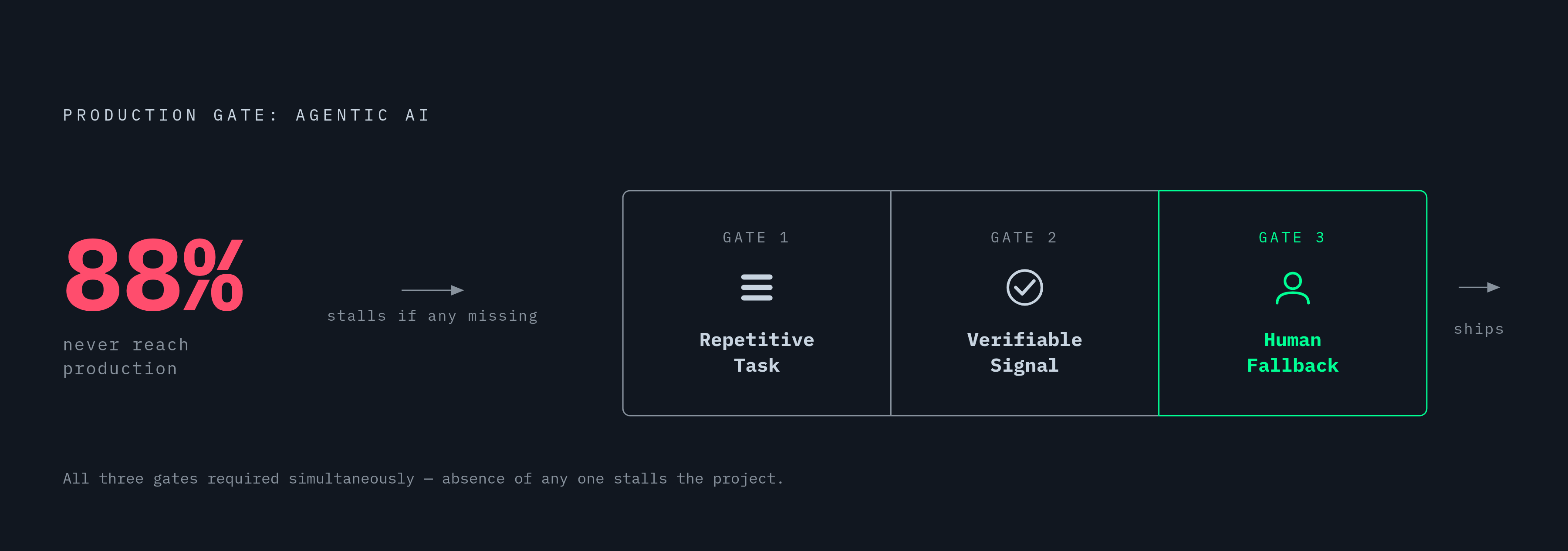
The model is rarely what separates a use case that ships from one that turns into an expensive science project. What separates them is the absence of three operational prerequisites, and teams tend to discover the absence halfway through the build instead of before it starts.
The first missing piece is a verifiable success signal. A use case framed as "be a strategic advisor to the CFO" has no ground truth to check against, so there's no way to prove the agent can be trusted with the job. Gartner lists unclear business value, including the inability to measure ROI, as one of the top three reasons agent projects get canceled, alongside rising costs and weak risk controls, and that failure traces straight back to choosing a task with no measurable outcome in the first place.
The second missing piece is a bounded action space. An agent with unrestricted write access to production systems isn't a feature; it's a liability. Limiting what the agent can actually do keeps the damage from any single mistake small enough to survive, and that containment is what lets a team expand the agent's autonomy gradually instead of betting everything on day one.
The third missing piece is a clear owner and a way to undo a bad action. Teams that stall tend to find out mid-project that no one has been assigned to own the agent's failures, and that there's no process to reverse something the agent got wrong. That's a governance gap rather than a technical one, and it's fixable before the build starts if someone asks the question early enough.
A fourth blocker occurs just as often, even if it gets less attention in planning meetings: integration complexity. Every system the agent needs to read from or write to, identity, CRM, ERP, ticketing, document stores, APIs, legacy interfaces, has to be mapped out before design begins, and that mapping work gets skipped constantly in early pilots.
A team about to commit budget to an agent project can run through a short checklist first. Quantify the cost the current workflow creates today. Define what happens if the agent gets it wrong, and whether that action can be undone. Identify data and regulatory exposure before any design work starts. Name who owns the exception queue and how the agent gets shut off if needed. Set a cash-linked KPI baseline before development begins, not after. Every item on that list is a question with a concrete answer, and a project that can't answer all five probably isn't ready to start [7].
MCP as connective tissue and primary attack surface of agentic deployments
The Model Context Protocol, MCP, connects agents to the tools they need: databases, APIs, SaaS platforms, all through one standard interface. It's what lets an agent call a CRM, run a database query, and kick off a workflow inside a single session, instead of needing custom integration code for every tool it touches.
The protocol's security hasn't kept up with its adoption. Only 8.5% of MCP servers currently run OAuth 2.1 authentication, even though OAuth 2.1 is the protocol's required security standard for any remote deployment. Trend Micro found 492 MCP servers sitting exposed on the open internet with no authentication at all, a level of exposure that would never pass for any other kind of enterprise API.
A structural weakness sits underneath that adoption gap. MCP mixes instructions together with data, so a change to a tool's description, the text the agent reads to figure out how and when to use that tool, can redirect the agent's behavior just as effectively as a change to its system prompt. That's the opening behind what security researchers call tool description poisoning: alter the metadata, and the agent follows instructions nobody intended it to follow.
A second pattern is what's called the "confused deputy" problem. The MCP server carries out actions using its own elevated privileges rather than checking the privileges of the person who actually made the request. A user without database admin rights asks the agent to run a query, and the server complies using admin credentials, without ever checking whether that user was entitled to the answer. MCP made it possible for agents to act across a company's entire toolset from inside one conversation. That same reach is what makes getting its authentication right a condition for running agents safely at all, not an optional hardening step layered on afterward.