Enterprise AI Agent Deployment Patterns
Enterprises are deploying AI agents faster than security frameworks can govern them.
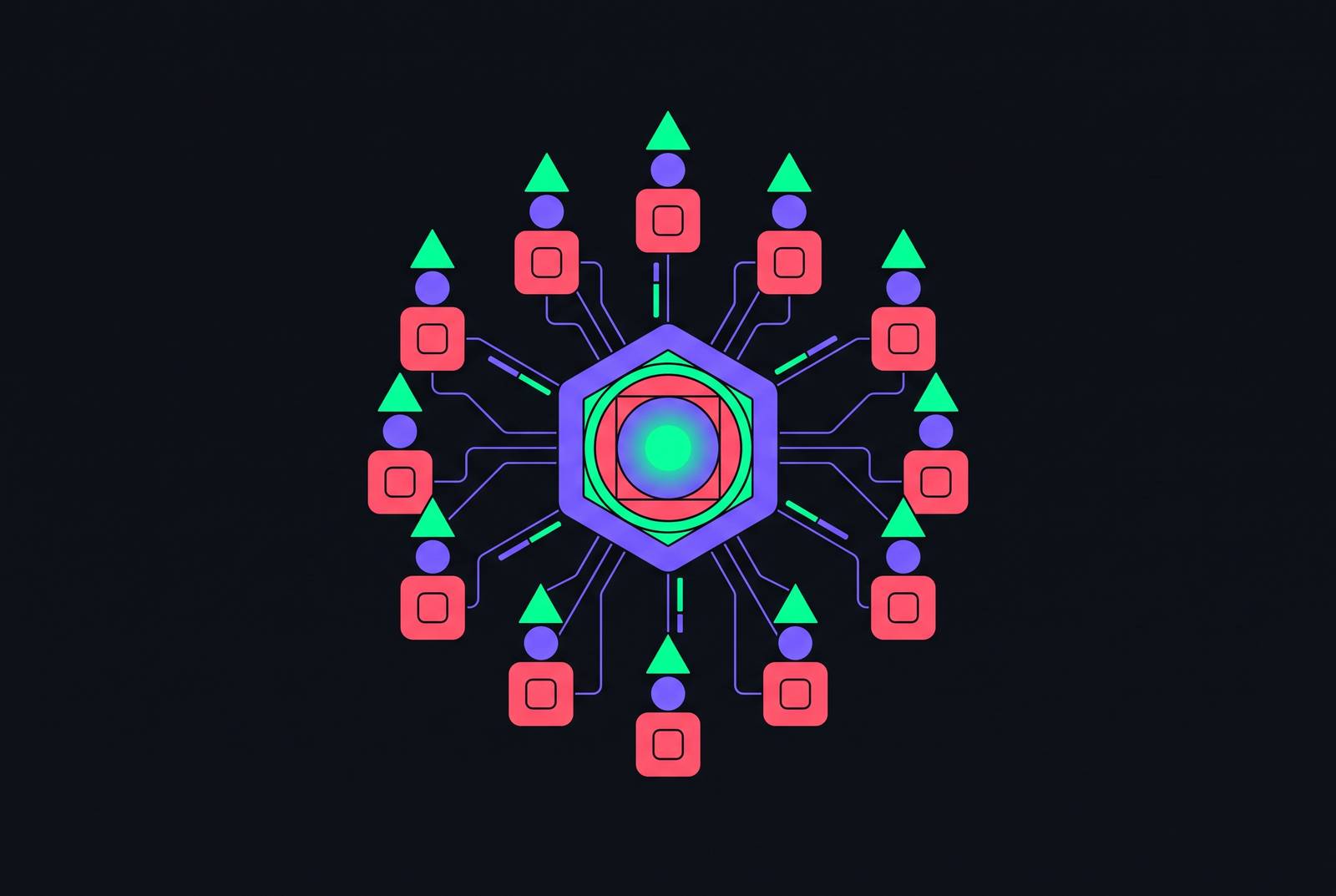
Every new agent stood up widens a structural gap, because governance frameworks were not designed to absorb AI agents being deployed as fast as enterprises are deploying them.
Why agents outrun governance frameworks
Older AI governance assumed a simple loop: a human enters a prompt, a model returns text, a person reads it and decides what to do next. Autonomous agents break that loop: they plan multi-step tasks, choose which tools to call, delegate pieces of the work to other agents, and take action directly in production systems, rather than waiting for a person to execute on their output. That shift from "respond and return text" to "decide and act" is the whole story, and it's one most governance frameworks never anticipated.
The scale of the blind spot is already documented. Zylos found that 82% of enterprises already have AI agents or workflows running, and their own security teams didn't even know it. CSA's 2026 research on AI agent governance adds a second data point: most large-enterprise CISOs lack full visibility into their agent identities, and doubt they could detect or contain a compromised agent if one turned up tomorrow.
Three properties make agents qualitatively harder to govern than conventional software. Their behavior emerges at runtime rather than at design time, so no amount of testing or code review fully characterizes what a given agent will do in a given situation. They hold privileged access persistently: a human user logs off, but an agent can sit on OAuth tokens and service account credentials indefinitely, accumulating reach long after the task it was built for has ended. And they operate inside delegation chains, where an orchestrator hands work to a sub-agent that calls an API that changes a production database, and the old model of accountability, tracing an action back to the person who authenticated, simply stops functioning.
CXO Xperts, citing McKinsey, reports that most organizations are actively piloting agents, but a much smaller share have scaled them successfully into production. That gap reflects a failure of governance rather than of technology. You already have the technology to plan, delegate, and carry out multi-step tasks. What's missing is the infrastructure to know what each agent can do, who's accountable for it, and whether its actions matched what was authorized. That's an engineering problem with engineering solutions, and the rest of this piece is about what those solutions look like in practice.
Why traditional governance frameworks fail with agentic actors
The major frameworks enterprises lean on today, NIST AI RMF 1.0, ISO/IEC 42001, and the EU AI Act, share a common design assumption: that AI system behavior is knowable, documentable, and stable once deployed. Autonomous agents violate that assumption by construction, because their actions depend on context they encounter at runtime, not on a fixed specification written months earlier.
CSA's analysis names the failure point directly. NIST AI RMF 1.0 was built for systems whose behavior can be characterized at the moment of deployment and reviewed afterward by a human, conditions that agentic systems routinely fail to meet. The EU AI Act's Article 14, which governs human oversight, carries some of the same structural blind spots, though it does require ongoing oversight during use, not an assumption of full predictability at deployment. The regulation anticipated that oversight would need to continue past launch. It did not anticipate systems that choose their own tools and delegate their own subtasks in real time.
Data governance breaks down for agents along four specific seams. Provisioned with broad access in January, agents are continuous and often still executing on those same permissions in August, long after the business justification or data classification that first authorized them has changed. Agents operate at machine speed: a compromised agent can exfiltrate records well before a 24-hour audit cycle even begins, and detective controls built to catch human-speed violations have no chance against machine-speed incidents. Agents cannot tell data they were meant to touch apart from data they merely have technical permission to reach, and they have no way of recognizing when the data feeding them has been corrupted. And multi-agent systems create data flows nobody designed on purpose: a compliance agent can ingest unmasked PII from a data quality agent's intermediate output and violate GDPR without either agent individually exceeding its stated permissions.
The access model built for human employees, request access, get a team review, receive a defined scope, undergo an annual audit, fails at every single step once the principal requesting access is a machine. Agents don't request access on a human timeline, they don't log off at the end of the day, and an annual audit cycle is close to meaningless against something that can act thousands of times an hour. Machine identities already outnumber human identities at most enterprise organizations by a wide margin, and that ratio keeps climbing as AI adoption spreads. Without formal registration, scoped permissions, and inclusion in regular audits, agents pile up as shadow identities, the most capable actors inside enterprise infrastructure and the least supervised.
The attack surface agents expose when identity and access are not built in from the start
Three threat classes dominate the 2026 agentic attack surface, and every one of them traces back to the same root cause: agents operating with ambient authority nobody explicitly granted them.
Tool poisoning is the highest-leverage attack against enterprise AI agents today. It works by tampering with the metadata and descriptions of tools registered in MCP servers, tricking an agent into invoking a compromised or unauthorized tool, which can escalate privileges or trigger actions nobody intended. Prompt injection through tool results is a related but distinct threat: when an agent calls a tool and pulls back content, that content enters the agent's working context directly, and malicious instructions hidden inside it can redirect the agent's behavior from the inside. Microsoft security researchers have documented cases where this technique led to remote code execution.
When a single MCP server centralizes OAuth tokens for multiple downstream services, compromising that server compromises everything connected to it. The NSA's May 2026 Cybersecurity Information Sheet calls out exactly this pattern, OAuth misconfiguration that lets an MCP server act with permissions it was never meant to have, as a condition that needs to be eliminated outright.
The scale of the exposure stopped being theoretical in May 2026, when OX Security disclosed a supply-chain vulnerability touching roughly 200,000 vulnerable MCP instances, spanning IDE integrations and cloud services. That disclosure reframed the conversation. It was no longer a story about a handful of early adopters cutting corners. It became evidence of protocol-level exposure at enterprise scale.
What ties tool poisoning, prompt injection, and credential aggregation together is default trust. Once agents authenticate, they inherit session-level permissions, they run with no per-call authorization check, and their actions often aren't logged in enough detail to surface an attack after the fact. Every deployment pattern covered in the rest of this piece exists to close one of these three gaps directly.
Regulatory requirements for enterprise agent deployments
Governance for enterprise AI agents is no longer voluntary best practice, it's binding law now, and the deadlines are specific enough that a deployment built today either meets them or doesn't.
The EU AI Act's enforcement timeline is the clearest forcing function, and it moves fast. GPAI model obligations and governance structures became required as of August 2, 2025. Full enforcement powers activated August 2, 2026, giving the European Commission the authority to impose fines, with penalties for organizations lacking compliant systems reaching up to 3% of global annual turnover for GPAI providers (a steeper tier applies only to prohibited practices under Article 5, which has been enforceable since February 2025). December 2, 2027 brings the deadline enterprise teams should treat as the real one: high-risk obligations apply to stand-alone high-risk systems, a date extended by the Digital Omnibus on AI, signed 8 July 2026 and in force 27 July 2026. A final deadline comes August 2, 2028, when high-risk obligations extend to AI embedded inside regulated products.
Most enterprise agent teams are not building the underlying models their agents run on but are deployers of third-party models, and the EU AI Act puts substantial compliance weight on deployers for how an agent is configured, deployed, and monitored, regardless of who built the model underneath it. If your team assumes compliance is someone else's job because you didn't train the model, that's a trap.
"High-risk" classification isn't limited to a narrow set of edge cases. Agents used in employment decisions, credit assessment, critical infrastructure management, or clinical decision support all fall under Annex III, regardless of which model powers them. That classification brings conformity assessments, risk management procedures that have to be maintained across the system's entire lifecycle, documented human oversight with defined intervention points, and audit log retention for a minimum of six months under Article 19.
On the technical side, the NSA's May 20, 2026 Cybersecurity Information Sheet, the first U.S. signals intelligence guidance written specifically for MCP, lays out the clearest authoritative baseline available: treat every MCP server as untrusted code, grant it the minimum privilege necessary, run it in a container, cap its CPU and memory, prefer read-only filesystems, and log every tool and model invocation.
No finalized, enforceable, agent-specific security standard exists yet from NIST. The NIST AI Agent Standards Initiative, announced in February 2026, is a multi-year effort. Organizations can't wait for it before building internal governance, and should look instead to the OWASP Agentic Top 10 and CSA's AI Controls Matrix as near-term operational references. Three overlapping frameworks currently shape enterprise AI governance: the EU AI Act, which functions as the enforceable baseline with real financial penalties attached; the NIST AI RMF, which serves as the operational backbone organized around Govern, Map, Measure, and Manage; and ISO/IEC 42001, which is becoming the certification path enterprise procurement increasingly demands. Treating governance as optional is no longer a viable position for any of these three.
The five deployment patterns that hold under security and regulatory scrutiny
Deployment patterns scale without breaking down when identity, access control, and audit capability are load-bearing parts of the architecture from the first day, not features bolted on after an incident, regardless of which agent framework or model a team chooses.
The first pattern treats every agent as a distinct enterprise principal, with its own credentials, explicit permissions, a documented owner, and a defined lifecycle, rather than letting it operate as an invisible extension of a developer's account or a shared service account. Putting this into practice calls for an enterprise agent registry that serves as the single system of record for which agents exist, who owns each one, what data each can touch, and when it was created, because without that registry shadow agents accumulate indefinitely with permissions nobody is tracking. Credentials need to be separated by agent specialization, so a support agent and a financial reporting agent never share API keys or database credentials even inside the same organization, since that separation is what makes attribution, audit investigation, and scope limitation possible at all. And retirement needs to be explicit: agent permissions tend to accumulate over time and rarely get revoked when an agent is decommissioned, so mature organizations handle agent offboarding the same way they handle employee offboarding, revoking permissions, destroying credentials, and updating the registry the moment the agent goes dark.
The second pattern replaces static secrets with short-lived, dynamically issued credentials. Static credentials sitting in MCP configuration files, environment variables, and CI/CD pipelines make up the single largest source of agent-related credential exposure today, and the fix for that has to be architectural rather than procedural. Research into agent credential hygiene found a substantial number of unique secrets in MCP-related configuration files, and found that AI-assisted commits leak secrets at roughly twice the rate of human-written code, a gap that points to a systemic problem manual review can't realistically catch at scale. The remedy is to issue short-lived tokens dynamically instead of relying on fixed credentials, scope every token to the minimum permissions a specific agent task actually requires, and extend secrets management past code repositories into CI/CD pipelines, developer workstations, MCP configuration files, and ticketing systems. The protocol itself has started enforcing this directly: the MCP spec's June 18, 2025 revision mandated Resource Indicators under RFC 8707 specifically to stop token reuse across servers, and the July 28, 2026 revision carried that requirement forward and hardened it further. What used to require disciplined manual practice is now something the protocol enforces on its own.
The third pattern establishes the MCP gateway as a centralized enforcement and audit point. If there's no gateway, every MCP server manages its own access controls on its own, so you can't maintain consistent policy and audit trails stay incomplete. A gateway resolves this by placing centralized authentication, authorization, logging, and tool-level policy enforcement between AI clients and MCP servers, so every tool invocation becomes an independent authorization decision evaluated against current policy rather than a continuation of trust established once at login. That gateway is also what turns the NSA's audit logging requirement from an aspiration into something achievable in practice, producing immutable, timestamped records of every tool invocation, including identity, arguments, approval state, and result, that can be exported to the same SIEM already holding the rest of an organization's compliance evidence. A production-grade audit record needs to capture the agent ID, the agent's owner, the session ID, the tool name, the tool inputs, the policy check results with rules evaluated and pass or fail per rule, and the timestamp, because the record has to be able to answer who authorized this action, what context the agent had, what it decided, and whether that decision lined up with policy.
The fourth pattern moves enforcement from the session level down to the level of each individual query. Session-level access control checks permission once, at login, and then trusts everything that follows, which is exactly the assumption tool poisoning and prompt injection exploit. Query-level enforcement checks permission at every single call instead, so it closes the gap between when an agent is authenticated and when it's actually authorized to take a specific action. The fifth pattern follows directly from the first four: once identity, credentials, gateway enforcement, and query-level policy are all in place, the resulting audit trail doubles as the compliance evidence that conformity assessments, risk management procedures, human oversight documentation, and Article 19's minimum six-month audit log retention all require. Built this way, governance becomes the infrastructure that made the deployment defensible in the first place, rather than paperwork generated after a deployment goes live.