AI Guardrails Implementation for Agentic Pipelines
Agents running unsupervised need security controls humans never did.
Agentic pipelines break the oldest assumption in security: that a human sits somewhere in the loop, authenticating, approving, taking the blame when something goes wrong. Agents don't work that way. They authenticate themselves, call tools, chain actions across systems, and finish tasks without a person ever laying eyes on a single step, so guardrails have to cover authentication, permissions, credential handling, detection, and audit all at once. A hole in one layer exposes the whole chain, and I've watched that happen more than once.
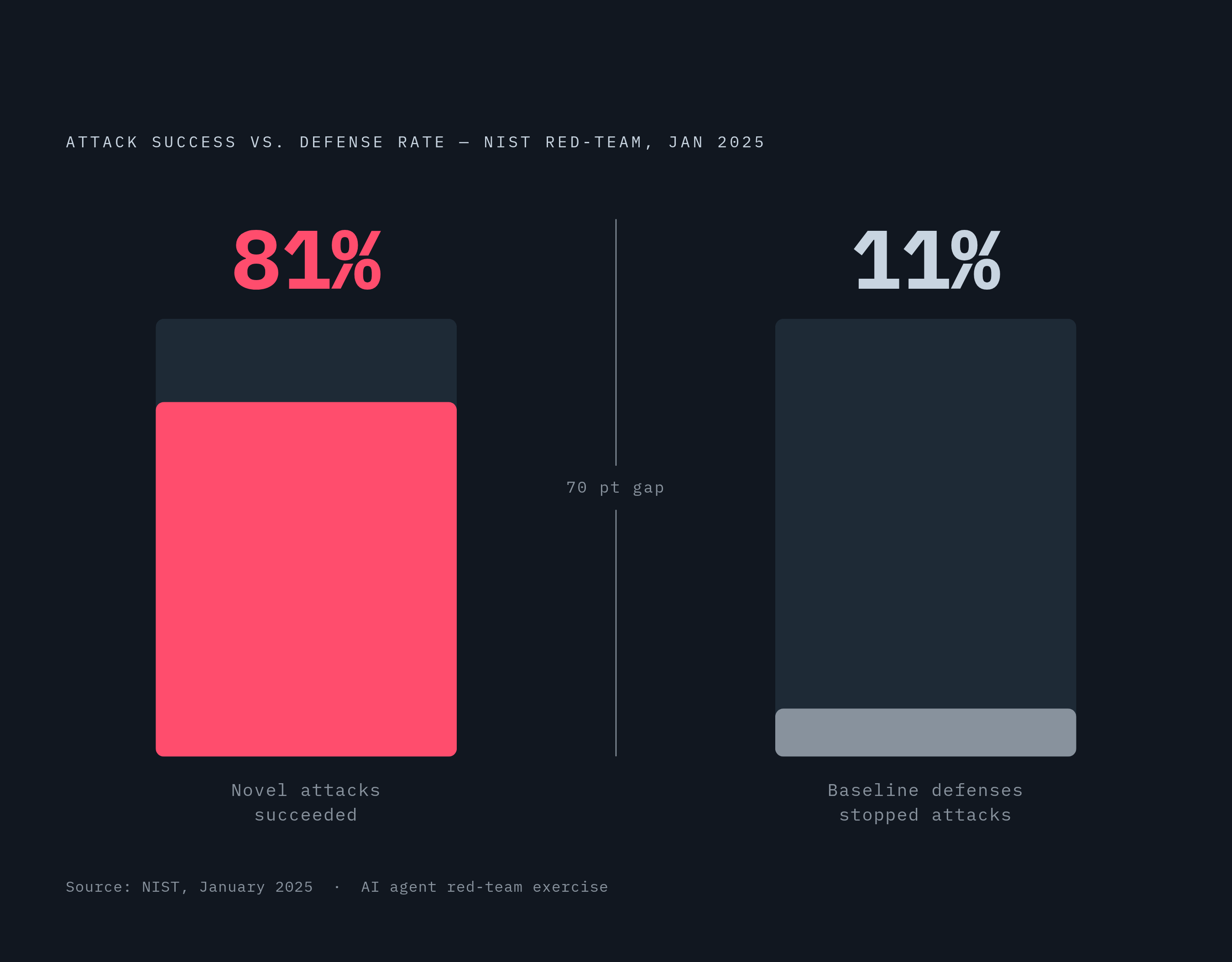
Picture an agent that spawns a subagent, which calls an MCP server, which pulls context from a database, which writes back to a CRM. Every hop is a place things can go sideways. Compromise one link and you're not just losing that step; you're pushing bad instructions, stolen credentials, and inflated permissions downstream through everything that follows. NIST's red-team work from January 2025 put a number on it: novel attack strategies against AI agents succeeded 81% of the time, against just 11% for baseline defenses. That gap is basically the whole ballgame.
The threat surface that agentic pipelines expose
Four kinds of trouble keep showing up once you start digging through real incidents.
Prompt injection, or goal hijacking, is getting the most attention right now, and it deserves it. OWASP classifies it as ASI01 in its Top 10 for Agentic Applications, published December 2025. The mechanics are almost insultingly simple: someone hides instructions inside data the agent reads, and the agent follows them like they came from its actual user. EchoLeak (CVE-2025-32711) is the case everyone points to. An attacker buried instructions inside a Word document and an email; when Microsoft 365 Copilot summarized the content, it quietly sent data out. No click, no user interaction, nothing of the kind a person could have caught. HackerOne logged a 540% jump in prompt-injection reports as this style of attack spread.
Tool poisoning is quieter but just as dangerous. An attacker tampers with an MCP tool's metadata so the agent runs something harmful while thinking it's doing normal, sanctioned work. It's hard to catch because the agent isn't confused; it's just trusting a source it shouldn't. Supply chain integrity for MCP servers is shaping up to be one of the fastest-growing attack categories heading into 2026.
Credential abuse and secrets sprawl come next, and this one's almost boring in how predictable it is. Any agent holding a static credential is a target sitting in plain sight. GitGuardian found roughly 24,000 secrets sitting in MCP configuration files on public GitHub in 2025. Their State of Secrets Sprawl 2026 report found AI-assisted commits leak secrets at close to double the rate of commits written by hand.
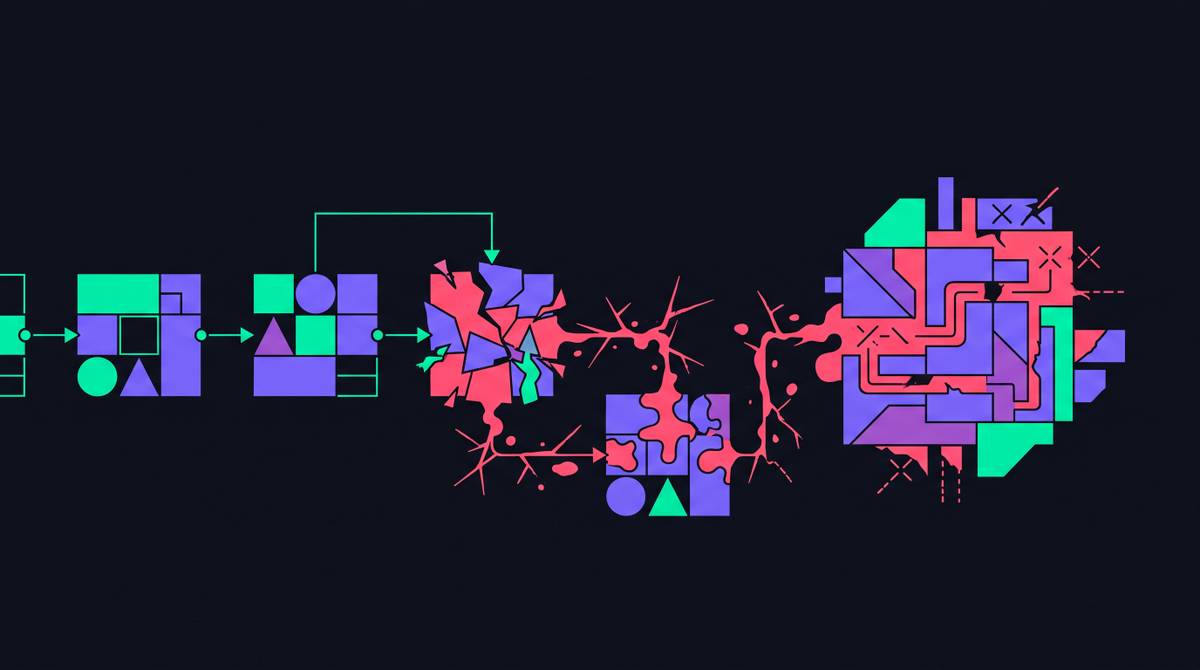
Cascade failure across multi-agent chains rounds out the list. A breach at one node doesn't stay at that node; it hands off permissions and instructions to every agent downstream of it. Somewhere between 47% and 53% of organizations report an agent exceeding its permissions or something close to it, and HiddenLayer's 2026 AI Threat Report puts autonomous agents at more than 12% of all reported AI breaches.
Shadow AI makes every one of these worse. 76% of organizations flagged shadow AI usage in 2026, up from 61% a year before, and an agent nobody knows about is an agent nobody can govern.
None of this is theoretical, by the way. Between December 2025 and January 2026, one attacker used Claude to break into several Mexican government agencies, including the federal tax authority and four state governments. That's the threat surface, live, not a lab exercise somebody dreamed up for a slide deck.
Why authentication is the first guardrail — and why most deployments skip it
Authentication is the gate everything else sits behind. If a server can't tell who's calling it, nothing downstream matters much, not the permission check, not the audit trail, none of it.
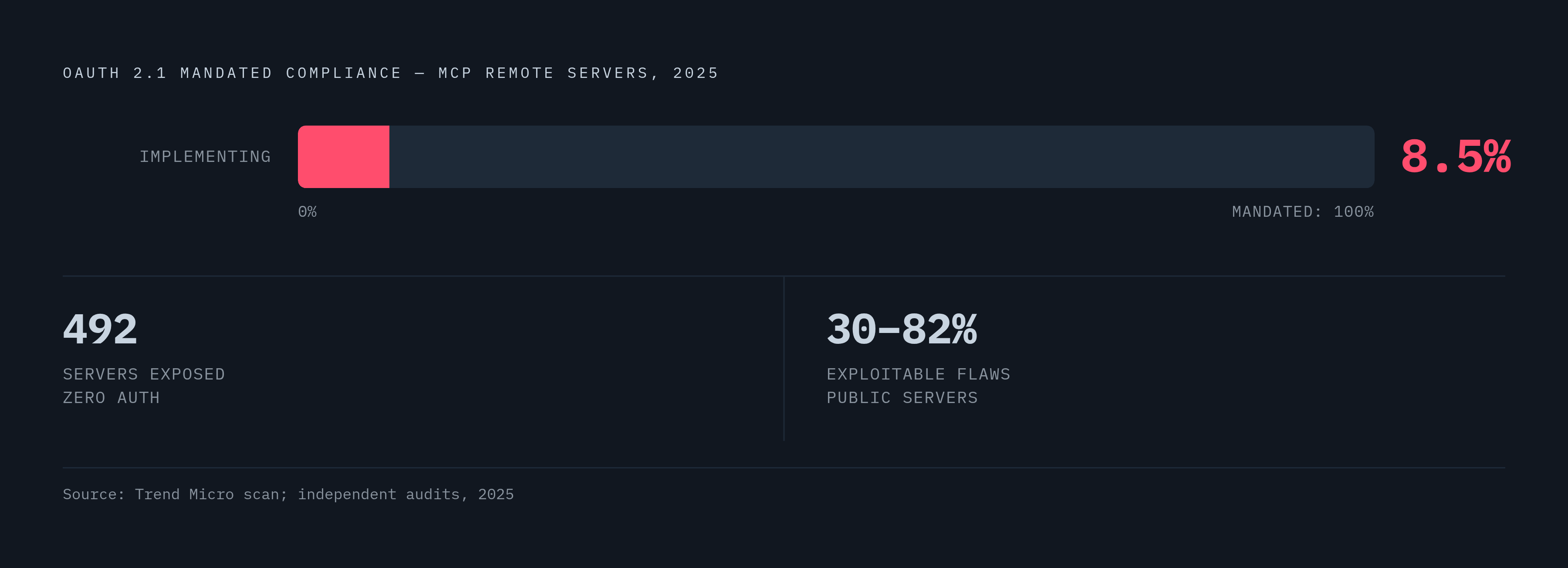
The MCP spec made this official: OAuth 2.1 became the required baseline for remote servers back in March 2025, with PKCE using the S256 method mandatory for internet-facing servers as of November 2025. Yet only 8.5% of MCP servers actually implement OAuth 2.1, the spec's own mandatory standard. Trend Micro scanned the open internet and found 492 MCP servers exposed with zero authentication. Independent scans of public servers routinely turn up exploitable flaws in anywhere from 30% to 82% of them, depending on the sample.
Two things explain the lag. First, speed: the public MCP registry grew from about 1,200 entries in early 2025 to over 9,400 by mid-April 2026, more than sevenfold in fourteen months, and nobody's slowing down to get the security right when growth looks like that. Second, OAuth 2.1 done properly for MCP is genuinely fiddly work. Remote servers need to expose a well-known endpoint under RFC 9728 so clients can find the authorization server. Clients like Claude Desktop that self-register without a human typing in credentials need dynamic client registration under RFC 7591. As of March 2026, RFC 8707 resource indicators became required to stop token mis-redemption, so a token scoped to one server can't get reused against a different one. Clutch Security research found 86% of enterprise MCP servers have already implemented that piece, at least.
There's also the confused deputy problem, and it trips up teams that think they've nailed authentication. When an MCP server calls an upstream API, just passing along the client's token is a trap: the upstream service ends up trusting a token that was never meant for it. The fix is that the server gets its own scoped token for every upstream call it makes, and it doesn't forward what it was handed.
Two patterns actually hold up in production. On Kubernetes or OpenShift, teams push authentication out to an external OIDC provider and handle token exchange at the gateway. For agent-to-agent calls with no user present, mutual TLS or machine-to-machine OAuth client credentials replace the usual login flow entirely. Gaps remain in the spec, though: no standard yet for propagating authorization through gateways, no real guidance on caching tokens across reconnections, and most of the documentation still quietly assumes a human is sitting at a keyboard somewhere.
How permission controls work inside a running pipeline
Authentication tells you who's calling. Permissions tell you what they're allowed to do right now, and in an agent pipeline, "right now" changes constantly.
Static permission models fall apart fast once you look at the numbers. In 2025, estimates put non-human identities in the average enterprise anywhere from 82 to 144 per human identity, and one in twenty of those carries full admin rights. Only 38% had shown any activity in the past nine months, meaning most privileged machine identities just sit there, unreviewed, half-forgotten, waiting for someone who shouldn't find them to find them.
Agents need dynamic permissions, not a one-time grant at setup, because agents don't stay in one lane. They switch tasks mid-session, shift context, act on whatever the current prompt asks for, and what they need access to can change several times inside a single conversation. The 2026 MCP spec introduced incremental scope consent to handle this: a client asks for the minimum access a given operation needs, instead of grabbing every scope it might conceivably want up front.
Here's a distinction worth sitting with: a system prompt is a request, but an IAM policy is a decision. Instructions living inside a model's reasoning loop can be talked around, reasoned past, if the model convinces itself its goal justifies it. IAM policy lives outside that loop entirely, in code the model has no say over, and it fails closed by default. That's why permission enforcement belongs at the tool-call layer, not buried inside a prompt the agent can quietly negotiate with.
Agents shouldn't inherit their user's full permission set by default, and they shouldn't get every scope they ask for just because they asked nicely. A centralized policy layer has to enforce that consistently, at runtime, across every server and every agent in the pipeline. The US Department of Defense laid this out plainly in guidance from April 2026: agentic AI systems should swap static, long-lived secrets for ephemeral credentials that expire the moment the job finishes.
Credential handling across agent hops: short-lived tokens and vault architecture
Every hop between agents, servers, and third-party APIs is a chance for a credential to leak. The fix that actually works: agents never touch raw downstream credentials directly.
When an agent needs to hit Google Calendar, Salesforce, or some internal API, a credential vault or broker sits in the middle and holds the real token. The agent gets back a scoped, time-limited token good for that one call, nothing more, and each downstream connection gets its own OAuth Token Exchange, its own scope, its own refresh schedule.
Short-lived tokens aren't just tidier engineering; the numbers back them hard. Okta's 2025 benchmarks found a 92% drop in credential theft incidents when teams moved from 24-hour sessions down to 300-second tokens. That's the difference between a leaked token being useless in five minutes and useful for a full day.
The secrets sprawl problem runs bigger than MCP alone, too. GitGuardian's State of Secrets Sprawl 2026 counted nearly 29 million new hardcoded secrets in public GitHub commits during 2025, with AI-assisted commits leaking at roughly double the base rate. Inside MCP specifically, that's where the 24,000 secrets sitting in configuration files come from. Configuration files are usually where credentials land when a developer reaches for the fastest path to get something running, and the fastest path is almost never the secure one. It never has been.
Just-in-time credential issuance closes that gap: a credential shows up the moment it's needed and gets revoked the moment the job's done, so there's no window where it just sits around waiting to be found. Tying agent identity to enterprise SSO and SCIM means credentials follow the same provisioning and deprovisioning lifecycle a human employee's account does. Agents shouldn't outlive their own authorization, and with SSO in place, they don't.
Real-time threat detection inside agentic pipelines
Prevention fails sometimes, especially against attack patterns nobody's seen before, and detection is what keeps a failure from turning into a full-blown disaster.
Generic network anomaly detection doesn't cut it for MCP-specific threats. The detection logic has to actually understand how agents behave. Tool poisoning shows up in tool manifest content and metadata changes at the registry level, not in traffic patterns. Prompt injection shows up as intent drift, meaning the agent's outputs or tool calls start diverging from what the session was supposed to accomplish. Exfiltration shows up as tool calls sending data somewhere unexpected, especially when the destination doesn't match the task the agent claims to be doing.
Timing matters enormously, because an injected instruction can propagate down a multi-agent chain fast. Detection needs to work at the depth of each individual tool call, since waiting until a session wraps up to look back at what happened is too late.
Shadow MCP usage is the hole that makes detection incomplete at a lot of organizations. An agent or server running outside sanctioned channels produces no telemetry at all; there's nothing for a security team to analyze because there's no signal to catch in the first place. With 76% of organizations flagging shadow AI in 2026, that's not a rounding error.
Real-time, here, means detection firing at the tool-call level, before the call finishes and before its result reaches the next agent in line, not a scan of yesterday's logs. Detection without context is just noise: an alert needs the full chain of what an agent's been doing, not one event floating in isolation, to tell the difference between something normal and something wrong.
Audit logs and tracing: the controls that make every other guardrail accountable
A guardrail nobody can check after the fact isn't a guardrail. It's a hope.
Audit logs for agentic pipelines need to capture things traditional application logs never bothered with. Which agent made which tool call, under which identity, at what exact moment. What scopes and credentials were live at the time. The full sequence of actions across the pipeline, not scattered events, so a cascade can actually get reconstructed after something goes wrong. And whether a policy got enforced or quietly skipped at each decision point along the way.
Those logs have to be tamper-proof, no exceptions. If an agent, or a server it's calling, can edit its own audit trail, then an attacker who takes over that agent just erases the evidence behind them on the way out. OpenTelemetry has become the standard for this kind of instrumentation, giving teams distributed tracing across every agent hop so a pipeline's full execution can get pieced back together even when different teams own different pieces of it.
This isn't optional for regulated industries anymore. Financial services, healthcare, government: audit expectations in these spaces now reach into AI agent actions, not just transactions a human clicked through. Enterprise AI governance frameworks increasingly want proof the controls fired, not just proof they exist somewhere on paper.
The audit layer closes the shadow usage gap too, in a useful way. A platform that routes all MCP traffic through a governed layer generates a log for every call, while traffic that skips that layer generates nothing. The absence of a log is itself the signal worth chasing.
How the control layers connect — and what breaks when one is missing
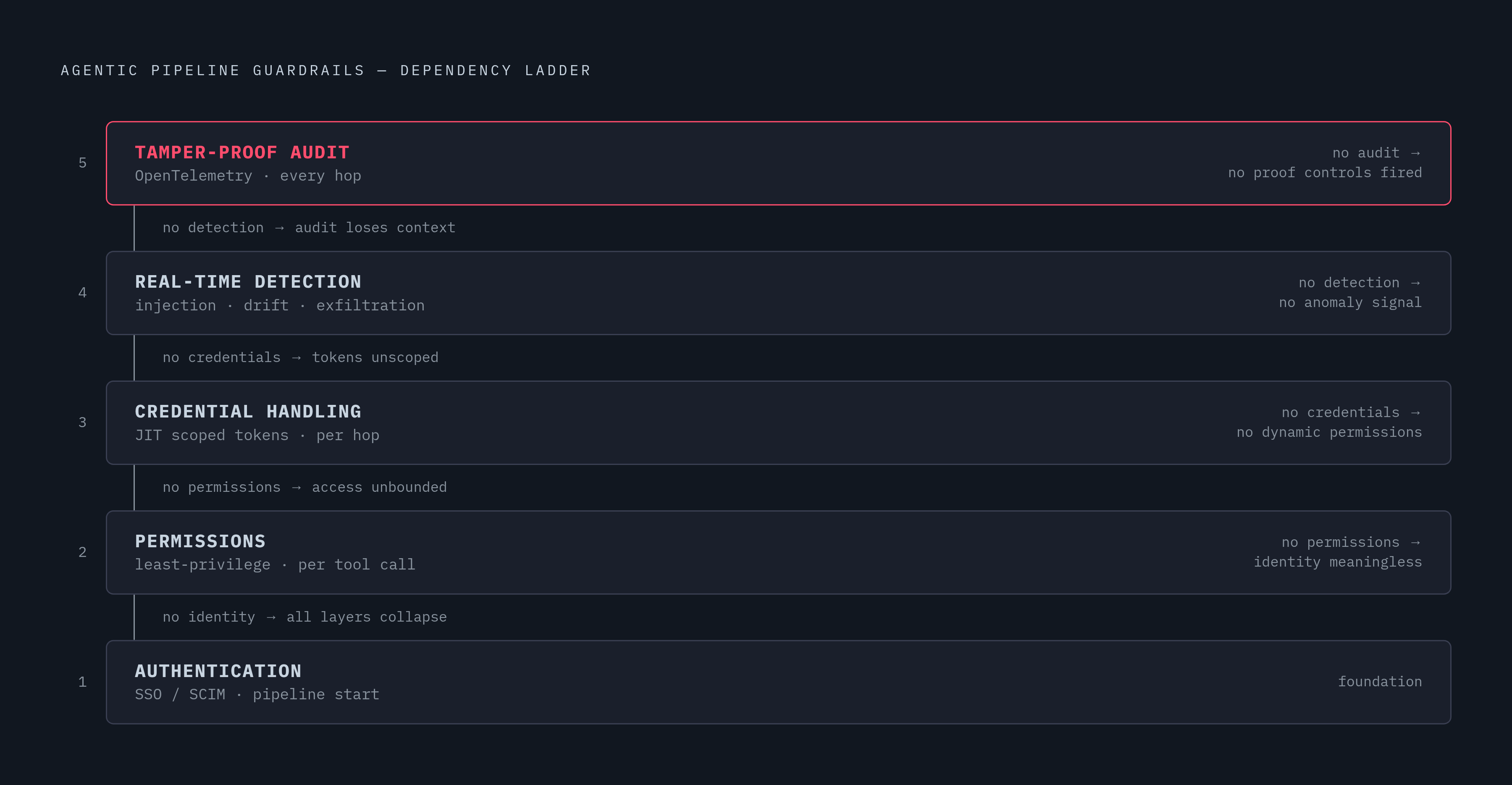
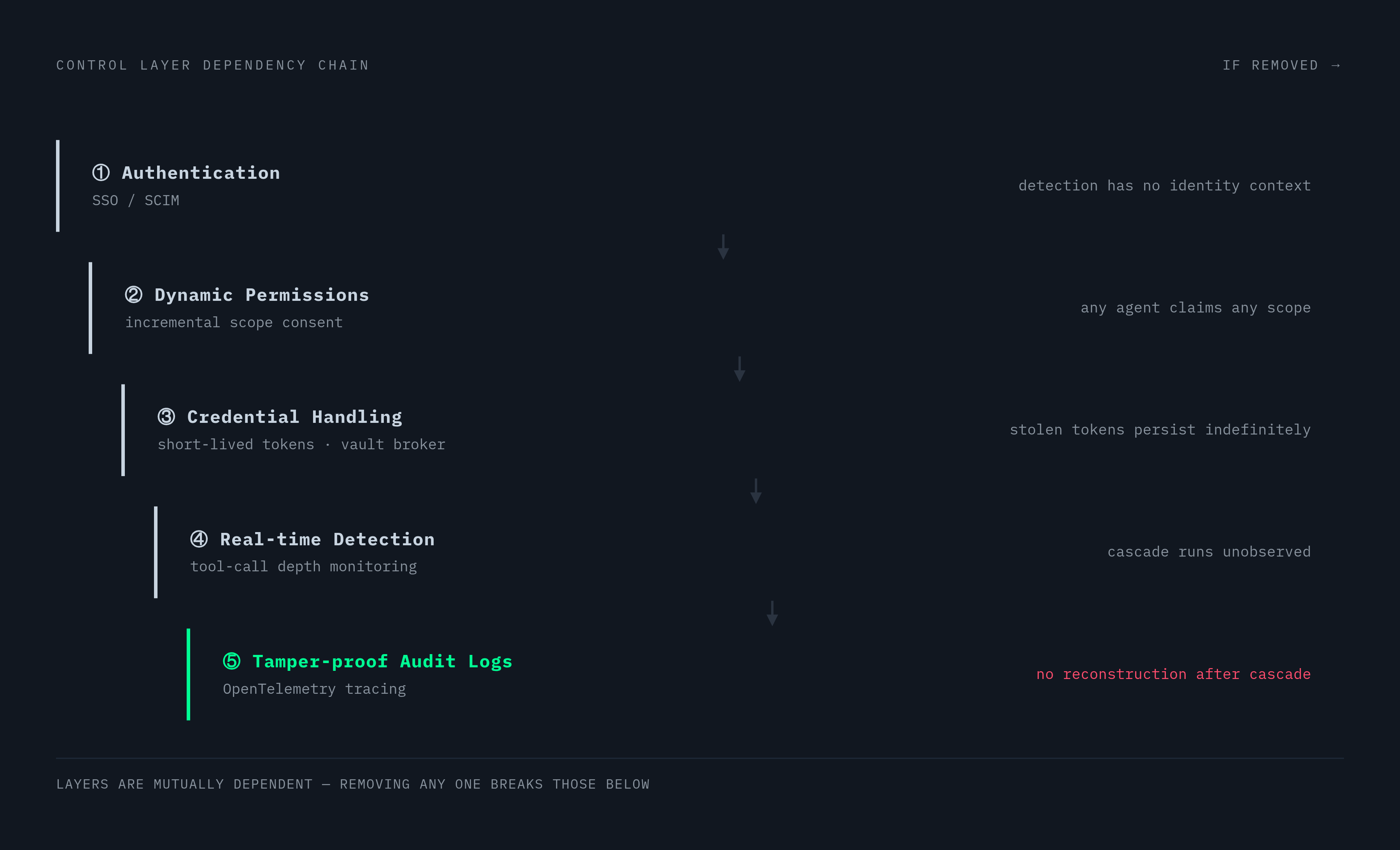
These aren't separate modules you bolt on independently. Each one leans on the one below it, and I mean that literally, not as a figure of speech.
Detection can't tell legitimate behavior from an anomaly without the identity context that authentication and permissions provide in the first place. Audit can't reconstruct a cascade without tracing instrumentation running across the whole pipeline. Permissions can't get enforced dynamically without a credential layer issuing scoped, short-lived tokens at the moment of each call. Authentication itself means almost nothing if credentials are sitting hardcoded in a config file that anyone with repo access can just open up.
In practice, the model looks something like this. Authentication tied to SSO and SCIM establishes identity the moment a pipeline starts, and dynamic permissions paired with just-in-time credentials enforce least privilege at every tool call, not just once at the start of a session. Real-time detection watches for tool poisoning, injection, intent drift, and exfiltration at tool-call depth, where it can actually catch something before it spreads. Tamper-proof audit logs and OpenTelemetry tracing record the whole chain, with identity attached to every step.
Pull any one of those out and the rest stop meaning what they're supposed to mean. A well-authenticated agent with no permission enforcement is just a trusted attacker wearing a badge. A tightly scoped credential system with no detection layer catches nothing when a scope gets abused in a way nobody anticipated. A perfectly monitored pipeline with no tamper-proof logging can't prove any of it happened once somebody asks hard questions after the fact. I've seen teams get three of these four layers right and still get burned, because the fourth was the one the attacker went looking for. The layers only work as a set.