Real-Time MCP Threat Detection for Claude and GPT-4 Enterprise Deployments
Platform audit logs miss MCP tool calls, so inspect them first.
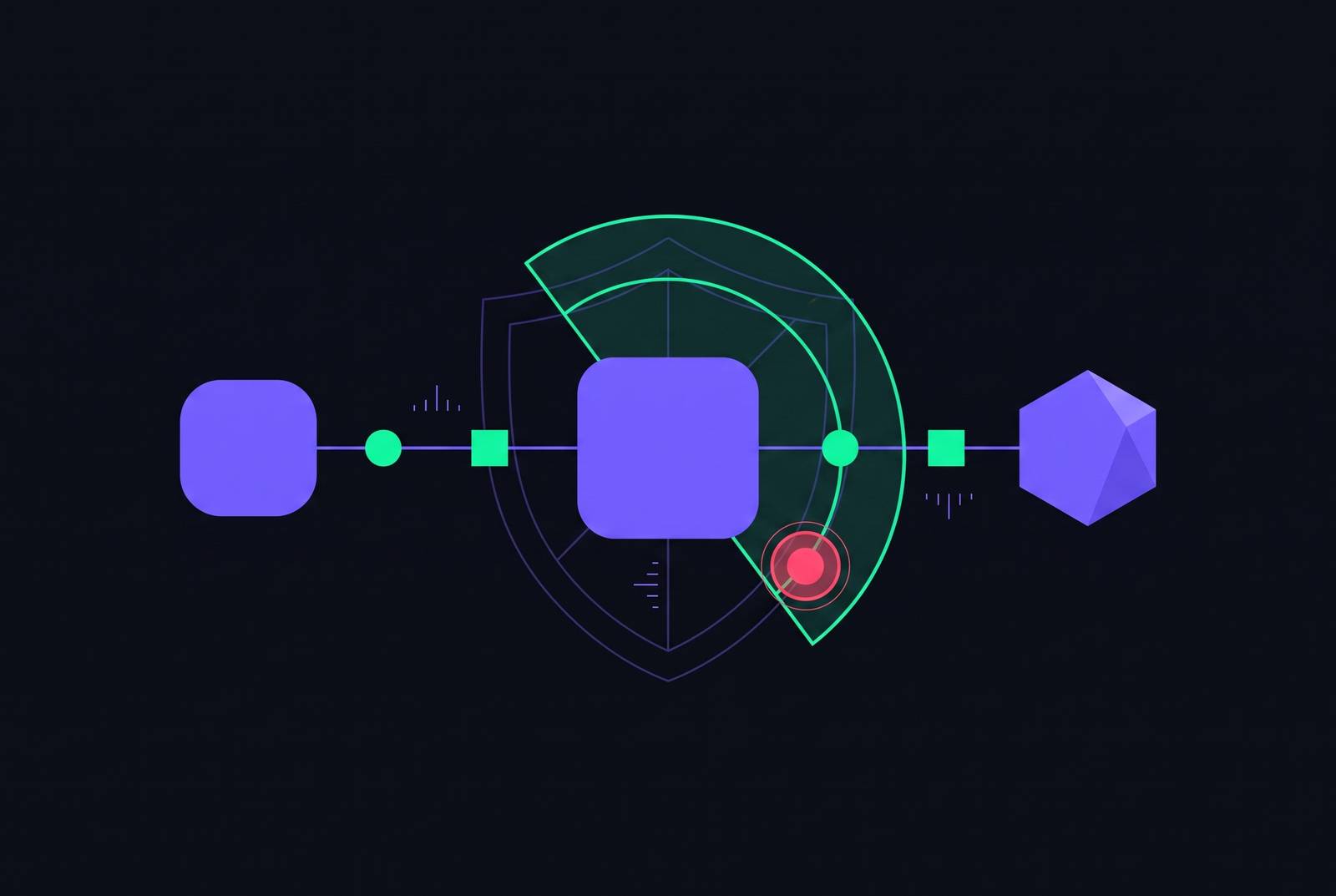
Securing MCP deployments for Claude and other enterprise models requires threat detection between the agent and the tools it calls, before those calls execute. That layer must catch tool poisoning, prompt injection, intent drift, and data exfiltration while binding each action to an enterprise identity. Platform certifications and audit exports support governance, but they cannot replace control over a live, credentialed connection to enterprise systems.
Why MCP became a credentialed attack surface, not just an integration layer
MCP sits above raw APIs, below business logic, and parallel to orchestration layers. It acts as an API gateway, a service account, and a trust amplifier for the tools it exposes. Its authority comes from the systems behind it. A server that aggregates credentials for several enterprise systems gives a compromised connection a reach that extends beyond any single application.
Unlike deterministic automation, an agent infers what to do next rather than following an intent declared before execution. That changes what an access check can prove. Role-based access control and schema validation can show that an action is allowed and correctly formed without showing that it helps with the user's task. The service account may authorize more than the task needs.
The MCP specification defines an OAuth 2.1 framework but marks authorization optional. The Cloud Security Alliance's May 2026 research note says the resulting exposure without authentication comes from a default in the specification and can occur even when there is no implementation mistake. MCP also has no role-based access control model. Organizations must add that control themselves or accept whatever the tool's service account allows. The tool-call layer is therefore a security control surface.
The four threat classes that operate specifically at the tool-call layer
Tool poisoning places malicious instructions in metadata that the model consumes, including tool descriptions, schema annotations, and prompt fields. The user need not see those instructions. An attacker can therefore influence how an agent uses a tool without changing the user's request. The attack turns information that describes a capability into instructions that direct its use.
Prompt injection can also come through content that a legitimate tool retrieves, as well as through its metadata. Invariant Labs demonstrated this distinction against Claude Desktop using a malicious GitHub Issue. The issue redirected the agent into exposing private repository data through the legitimate GitHub MCP server's broad repository access. The server code itself was not the flaw.
Cross-server tool shadowing spreads that confusion from one connection to another within the same session. An agent may connect to file system, GitHub, Slack, and database servers at the same time. A malicious server can supply descriptions that redefine how the agent understands an adjacent trusted server. The compromise then spreads through the agent's interpretation. It does not require the attacker to compromise every connected server separately.
Intent drift and exfiltration concern the sequence of actions. An agent may begin with a benign goal, then read more records than needed, contact undeclared endpoints, or pass data through intermediate calls. Each step can look ordinary in isolation. Taken together, those steps can move data beyond what the task allows without any one call crossing a clear threshold.
What confirmed incidents reveal about how these threats behave in production
Research demonstrations, vulnerability disclosures, and breaches establish different kinds of evidence. They should not be treated as interchangeable. The GitHub demonstration establishes that legitimate access can be redirected by hostile content, while code-execution disclosures show that an attack may begin before ordinary tool use. Both challenge the assumption that inspecting the user's original prompt is enough.
Check Point Research reported remote code execution in Claude Code through malicious repository-level configuration files, tracked as CVE-2025-59536 and CVE-2026-21852. The delivery path was the software supply chain. Configuration became the attack entry point. A record written after execution could document the event, but could not prevent the host from running the malicious action.
Cyata researcher Yarden Porat published a separate exploit chain on January 20, 2026, targeting Anthropic's official Git MCP server. It combined unrestricted git_init in CVE-2025-68143, argument injection in CVE-2025-68144, and a repository scoping bypass in CVE-2025-68145. Three weaknesses converged inside one trusted server. OX Security's April 2026 STDIO disclosure exposed another configuration risk, with official SDKs passing process commands to the host without sanitization, regardless of whether they initialized a valid MCP server.
The Mexico government breach between December 2025 and January 2026 showed the harm an attack can cause when it crosses systems and models. It led to the exfiltration of 150GB of data, including 195 million taxpayer records. The attacker used Claude for lateral movement across agencies, then switched models when guardrails kicked in. No single model's record could capture that whole sequence. As exposed credentials can be used against live APIs within seconds, detection must have a chance to stop an action before execution.
Why the native audit and compliance controls of Claude Enterprise and GPT-4 Enterprise stop at the tool-call boundary
Anthropic's compliance credentials include SOC 2 Type I & Type II, ISO 27001, and ISO/IEC 42001, with AES-256 encryption at rest. Those controls do not establish inspection of every agent action. The distinction concerns coverage. Enterprise buyers need to separate protection of the platform from protection of the systems an agent reaches through MCP.
Anthropic's documentation excluded Cowork and agent activity from Audit Logs and Data Exports across all plan tiers as of May 2026. Its Compliance API also excluded Cowork at that point. Beginning August 2026, beta support added supported Cowork and Claude Code session transcripts, including tool calls and results, for sessions on Anthropic-managed or local surfaces under an Enterprise account. That narrows the visibility gap substantially. It does not extend to third-party MCP deployments or turn transcript retrieval into pre-execution interception.
OpenAI's enterprise console centers governance on projects and service accounts, while Azure OpenAI adds Azure-native controls, including Defender for Cloud integration. Neither checks for MCP-specific threats such as tool poisoning, intent drift, or cross-server shadowing at the tool-call layer. These are different control boundaries. Compliance tooling built around what happens on the platform does not automatically control every action an agent takes outside it. A separate runtime layer must provide that control.
What real-time detection at the tool-call layer must actually do
A genuine runtime control sits between the agent and the MCP server. Before execution, it inspects the tool name, parameters, context, and declared description. Timing is part of the requirement. A downstream log system can report a dangerous call, but an inline layer can stop it before it reads, writes, or transmits data.
That inspection must include both the metadata the model reads and the parameters it sends. Descriptions, schema annotations, and prompt fields can contain instructions that alter the agent's behavior. Payload inspection alone misses that entry point. This is why a conventional web application firewall is not a substitute for MCP-aware poisoning detection.
The layer also needs a behavioral view across sessions and servers. Shadowing and intent drift arise from how calls relate to one another, so per-call anomaly checks cannot show the whole picture. Detection must compare the sequence with the declared task, including excessive reads, undeclared destinations, and intermediate transfers that together expose data.
Identity and credential controls must operate at the same depth. Each call needs a verifiable enterprise identity through mechanisms such as SSO, SCIM, or just-in-time credentials, allowing identity anomalies to expose impersonation or rogue server registration. Credential scope needs scrutiny too. The July 2026 MCP specification revision requires that a present iss parameter be validated before code redemption, that storage be keyed by issuer, and that re-registration take place when the authorization server changes. Detection should check that those requirements are met and flag the use of long-lived static credentials in place of short-lived, task-scoped tokens.
Tamper-proof records must identify the agent, tool, parameters, returned data, and whether behavior matched the server's declared purpose, without letting the agent or server alter the record. An alert alone is not an intervention. The control must be able to terminate or quarantine an agent mid-session when interruption is warranted, rather than wait for a human to review a completed attack.
What platforms detect tool poisoning and prompt injection in MCP environments?
The current market covers several parts of this problem, but not with interchangeable capabilities. Scanning a server, testing an agent, inventorying permissions, and blocking a live call answer different questions. Buyers need to distinguish those jobs. An enterprise MCP security and governance platform’s broad claim of “AI security” should be evaluated against metadata inspection, behavioral tracking, identity binding, credential scope, tamper-proof audit, and interruption.
Snyk acquired Invariant Labs in June 2025 and launched Evo by Snyk in October 2025. Snyk Agent Scan and the mcp-scan lineage address prompt injection and tool poisoning, with Evo adding agentic security orchestration. Akto Agentic Security Platform launched in September 2025 after a dedicated MCP security product in June 2025. Its continuous red-teaming uses an AI Agent Attack Matrix of real-world exploits to test for prompt injection, poisoning, and cascading failures. Testing and scanning can find weaknesses, but they do not by themselves show that a tool can intercept a live call.
Cisco AI Defense offers an open-source mcp-scanner that combines YARA rules, LLM-as-judge analysis, and its inspect API to detect malicious MCP tools. It focuses in part on supply chain scanning and behavioral detection. CrowdStrike AI-SPM instead emphasizes posture and permissions. It monitors which agents exist, what they access, their permissions, and their configuration, with less focus on inline call-level interception.
Palo Alto Networks Prisma AIRS combines server and agent-artifact scanning with real-time interception of malicious calls. Lasso Security combines MCP server reputation scoring, real-time detection, and sensitive-data protection through Presidio integration. Their runtime features address a different need from inventory alone. Employees also need an approved way to use connected agents while those controls stay in place. When enablement, governance, and detection come from separate tools, the gaps between them can leave shadow MCP activity outside the governed path.
The governance and compliance obligations that now attach to the tool-call layer
An MCP call that reads customer records, writes to a database, or invokes a financial API is a system access event. Using an agent does not change that fact. SOC 2, HIPAA, and GDPR bring audit obligations that cannot be met by recording only the conversation while omitting the resulting system activity. The record needs to follow the action.
The EU AI Act also makes the distinction between observation and intervention explicit. Article 14(4)(e) requires that, where appropriate and proportionate, people overseeing a high-risk AI system can intervene or interrupt it through a stop button or similar procedure. It does not mandate an identical kill-switch for every system. In applicable deployments, however, a transcript alone cannot supply that capability. Oversight needs a way to recognize when interruption is warranted and act while the system is running.
Article 50 transparency obligations have applied since August 2, 2026. The 2026 Digital Omnibus deferred high-risk obligations for stand-alone Annex III systems to December 2, 2027, and for AI in regulated products to August 2, 2028. Those later deadlines must not be presented as already enforced. For MCP gateways used with regulated data, governance must take account of which system is in use, how it is used, and which obligations apply, since deployments do not all have the same legal duties.
Organizations struggle to govern access when approved access is harder than ungoverned access. Shadow MCP servers then offer a way around controls, so security teams cannot see or control the activity they are expected to protect. The governed path needs to be easier. Policy at the tool-call layer, an identity tied to every action, and audit records that teams can use let them adopt connected agents while keeping control. Security and IT then become the teams that make AI adoption possible.