MCP OAuth Credential Scoping and Least Privilege for Enterprise Agent Tool Calls
Per-agent identities, scoped credentials, and gateway checks limit what a hijacked agent can reach.
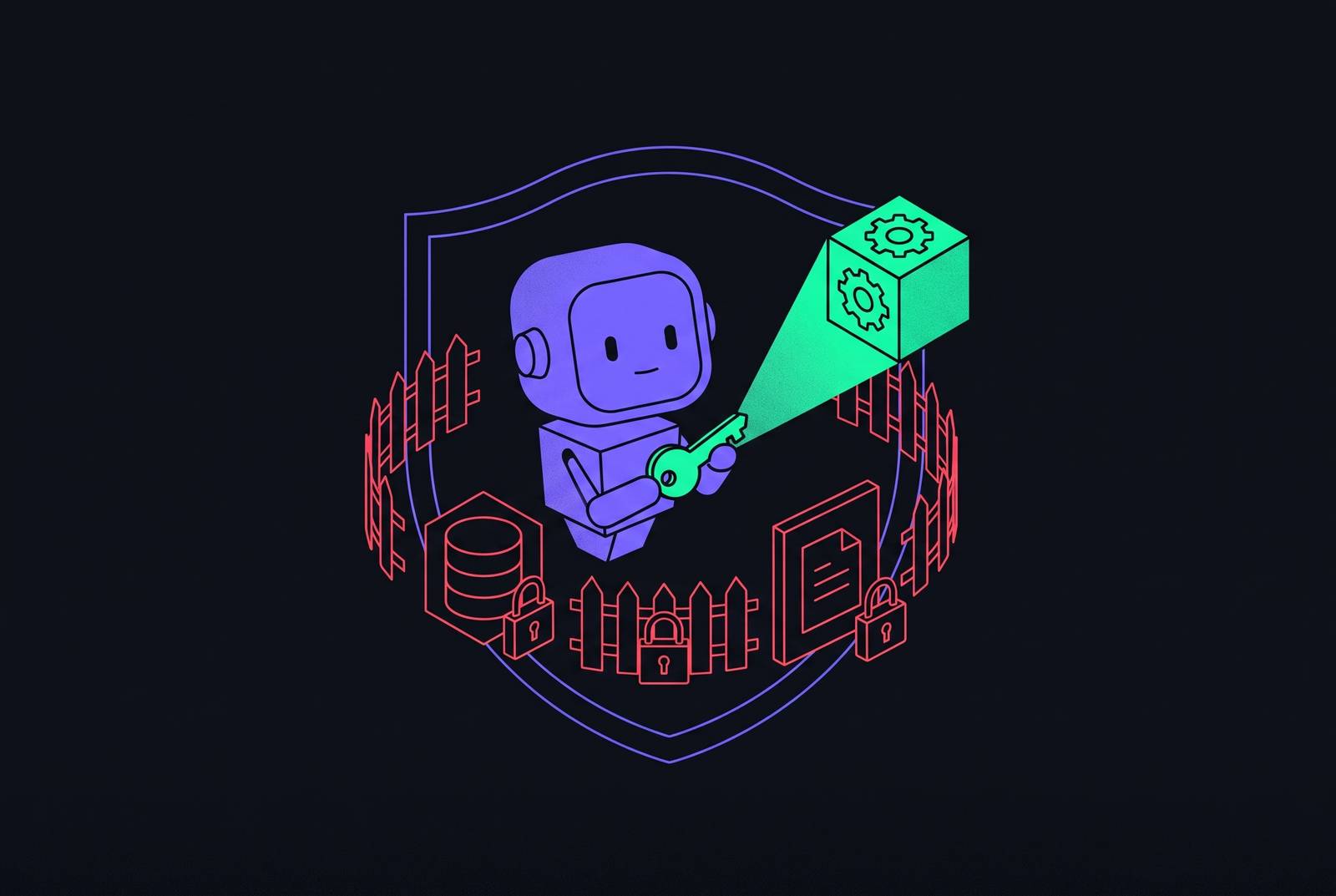
Securing MCP OAuth credentials for enterprise AI agent tool calls requires more than a valid token. Agents need their own identities, credentials with narrow scopes that stay outside model context, and authorization for each tool call. Broad scopes and inherited permissions make least privilege an architectural problem, so the fix must combine credential design, just-in-time injection, gateway enforcement, and attributable audit trails.
Why AI agents violate least privilege by default under MCP
The protocol provides OAuth 2.1 authorization primitives for HTTP servers, but it does not mandate per-tool enforcement. A connected agent can therefore receive access to tools that its task does not require. Authentication alone does not close that gap. Permission to reach a server is not permission to use everything it exposes.
Shared credentials widen the gap beyond one server. A coding assistant, customer support bot, and analytics agent may use the same OAuth tokens or API keys, so downstream services cannot tell them apart. LangChain, CrewAI, and AutoGen can impose boundaries within their frameworks, but those boundaries do not establish separate permissions at the service. The restriction lives in the wrong place.
This arrangement often starts during prototyping, when teams grant full access because they do not yet know what the agent needs. The promised cleanup never happens. Worse, an agent launched by an orchestrating application can inherit that application's permissions without an explicit grant. If the host can write to a production database, the agent can inherit that access too.
How the blast radius expands in multi-agent pipelines
The blast radius is the reach of a compromised agent's credentials across tools, services, and data. In a multi-agent pipeline, inherited permissions multiply that reach across agents. Sub-agents give attackers more ways into the same privileged environment. Their tasks may be very different from the orchestrator's. Their credentials often do not.
A prompt injection in a retrieved document, support ticket, or tool description then needs no authentication bypass. The agent is already authenticated. The attacker only has to redirect its use of legitimate access, turning it into a confused deputy that acts for a lower-trust caller. Read access can expose data, while write access can also destroy data, allow privilege escalation, and make downstream changes that go unnoticed.
The chain also passes through several authorization boundaries, from the user and AI host through MCP clients, servers, and backend APIs. Each hop must preserve authorization context and prevent credential leakage. The corrective identity model follows from that separation. Each sub-agent needs its own OAuth client registration and credentials, even when the orchestrator provisions them at spawn time.
What attackers do with over-scoped MCP credentials
Invariant Labs demonstrated the cross-boundary risk in “Toxic Agent Flow.” A malicious GitHub Issue in a public repository contained instructions that redirected a Claude agent using the GitHub MCP server toward tokens in a separate private repository. A subsequent tool call exfiltrated them. The server's token had blanket repo scope. The public input and private resource were separated in purpose, but not by the credential available to the agent.
The Cline incident in February 2026 showed a related confused deputy failure. A crafted GitHub issue title triggered an automated Claude issue-triage GitHub Actions workflow to install an attacker-controlled package. Stolen credentials were later used to publish an unauthorized npm update that reached thousands of developer machines. The malicious publication was a separate step. That distinction exposes the longer chain from injected instruction to credential theft to downstream harm.
Azure DevOps MCP presented another entry point in April 2026. An authentication bypass, CVE-2026-32211, rated CVSS 9.1, exposed API keys and tokens without credentials, while broad, long-lived tokens increased the blast radius. These cases show why injection filters alone are insufficient, because credential scope determines what an attacker can reach after an instruction or access boundary fails.
What the MCP spec now requires from OAuth 2.1
Authorization remains optional, and HTTP-based transports “should,” not “must,” conform to its authorization specification. The June 2025 revision established MCP servers as OAuth 2.1 resource servers within that model. The July 28, 2026 revision hardened the existing framework. It did not newly make authorization mandatory for every remote server.
Within that framework, RFC 8707 resource indicators bind a token to its intended server. The client names the resource, the authorization server puts that URI into the token's audience, and the receiving server rejects a token addressed elsewhere. This blocks cross-server replay when correctly enforced. Token passthrough is also explicitly forbidden, so an inbound client token must not simply become the credential sent upstream.
OAuth 2.1 establishes further safeguards, including PKCE for authorization-code flows, removal of implicit and resource-owner password grants, and refresh-token rotation. The November 2025 revision made S256 the only acceptable PKCE method. Bearer tokens must go in the Authorization header and must never go in query strings. These protections secure the authorization flow, but they do not secure every tool-level decision.
The June 2026 Enterprise-Managed Authorization extension handles how access is provisioned across an enterprise. EMA makes enterprise identity providers the authoritative provisioner for MCP server access, with access decisions managed through the IdP admin console. Users authenticate through existing enterprise identity. That establishes a common identity foundation for the finer controls that follow.
Per-tool scoped tokens and per-agent identity as the first architectural fix
The first implementation step is to separate agent identity from the application's shared credentials. Each agent gets its own OAuth client registration, while each tool maps to a narrowly scoped credential in the executor outside the model. Read-only access is the default. Write access requires an explicit grant.
OAuth scopes alone cannot express every task-specific restriction, even where a service offers useful read or write scopes. The executor must decide which credential a named action uses. For an accounts-payable agent, the distinction is between a read tool using a read credential and a write tool requiring separately granted access. Injected text cannot turn the read credential into a write credential.
Secrets must remain outside the context window. Prompts, tool descriptions, and tool arguments should use the names of credentials and must never contain their values. Tool results need redaction too, because an error that echoes request headers or a pre-signed download URL can return sensitive material to the model. An output can become the next leak path.
Where workload identity is available, it should replace shared static keys. Task-scoped tokens should expire within hours at most, with lifetimes beyond a day treated as legacy. Revocation also belongs in the initial design. Cutting off one agent should take minutes, reach every service it touches, and leave neighboring agents unaffected.
JIT credential injection and the MCP auth gateway pattern
Just-in-time credential injection activates those identities only when work is authorized. An inline MCP Auth Gateway sits between clients and servers, brokers credentials through a central vault, and associates them with the requesting identity. Remote HTTP or SSE servers validate bearer tokens on every request. The model never receives the secret.
A vault alone is not just-in-time access. If an agent uses a standing key to retrieve another standing key, the credential still exists beyond the task. JIT provisioning instead mints a short-lived, operation-scoped credential when the call is authorized and delivers it outside model context. Completion or timeout triggers automatic revocation. Credential existence is bounded by the work.
Every request needs both the human user identity in sub and the agent work ID in act. The gateway uses that context to authenticate the inbound token and obtain a separate downstream token for the requested operation. Audience binding restricts where that token works. This makes the gateway an enforcement surface as well as a secret store.
Provisioning speed is part of the security design. If the approved route is slow, teams can bypass it with personal API keys and their own MCP servers. Plaintext keys in configuration files then restore the standing access the gateway was meant to remove. The sanctioned route must be practical enough to use.
How do you enforce access policies on MCP tool calls?
Credential scope sets what an agent can reach, while tool-call authorization decides whether it can take a given action now. The gateway should filter tools/list so the agent sees only approved tools, then enforce authorization on the actual call. Discovery filtering is not the whole boundary. An agent that reads Jira tickets must not gain permission to delete Jira projects just because both tools share a server.
The decision must also account for context. This includes the time of day, the data classification, the stated task goal, and whether the action reads or writes. Write tools need an approval gate controlled by a person or policy engine before execution. The model proposes but does not approve itself. Short task-scoped token lifetimes add a time boundary that a session-long credential lacks.
A gateway should validate schema integrity on each tools/list response and detect changes since the tool's last approval. Otherwise, a previously approved tool can acquire malicious instructions in its description without a fresh decision. Static allowlisting does not catch that change.
Reading a document and then trying to send an email right away may call for a decision that neither request would trigger on its own. Sequence-aware authorization can flag and block that pattern. It depends on enough recorded context to reconstruct every step.
Audit trails and identity attribution at tool-call depth
The audit trail must identify which agent, acting for which user, called which tool, with which credential, and when. A shared service account cannot provide that attribution. Capturing both sub and act on every call establishes the identities involved, while the surrounding sequence supplies evidence about what happened. Identity alone does not prove that an instruction was legitimate.
Tamper-proof logs and OpenTelemetry tracing should correlate tool calls across the full multi-agent pipeline. The record needs to preserve credential attribution at each hop without putting secret values into model context. This is also incident-response infrastructure. It should let responders identify the compromised agent's actions, services, and credentials in minutes.
SOC 2, ISO 27001, and HIPAA reviews give enterprises a reason to demand this evidence, but the engineering need exists independently of the framework. Dynamic agent identities, tool-level permissions, and schema changes require evidence below the application-login level. The enforcement architecture is therefore also the compliance architecture. Audit instrumentation cannot be left as a separate cleanup project.
Applying the full stack in an enterprise MCP deployment
An enterprise deployment should treat these controls as one integrated layer rather than separate credential, gateway, policy, and logging projects. A unified platform approach is useful only if those controls work together. The evaluation criteria are concrete. They include distinct agent identities, per-tool credential mapping, task-bounded access, call-level enforcement, and a trace that connects each action to its authorization context.
Start with identity and credential boundaries. Register a distinct OAuth client per agent and map each tool to a narrowly scoped credential in the executor, outside model context. Keep reads and writes separate. Verify before an incident that revoking one agent reaches every connected service without disabling its neighbors.
Next, test the runtime path end to end. The gateway should validate every request, inject JIT credentials, bind tokens to the intended resource server, and exchange upstream credentials for separate downstream tokens. Token lifetimes should follow the task. Possession of a credential is sufficient for the proposed action only if write approval, tool-schema validation, and sequence-aware policy allow it.
Finally, require tamper-proof, OpenTelemetry-correlated records containing both human and agent identity. The deployment should also provide SSO-based access, pre-approved tool catalogs, and built-in OAuth handling so developers do not rebuild authorization for every agent. When the governed path is the easiest path, security teams help the enterprise adopt AI without becoming an obstacle that teams work around.