Policy Enforcement Layers for MCP Tool Call Authorization
Enterprises need policy checks at each tool call, not just at connection time.
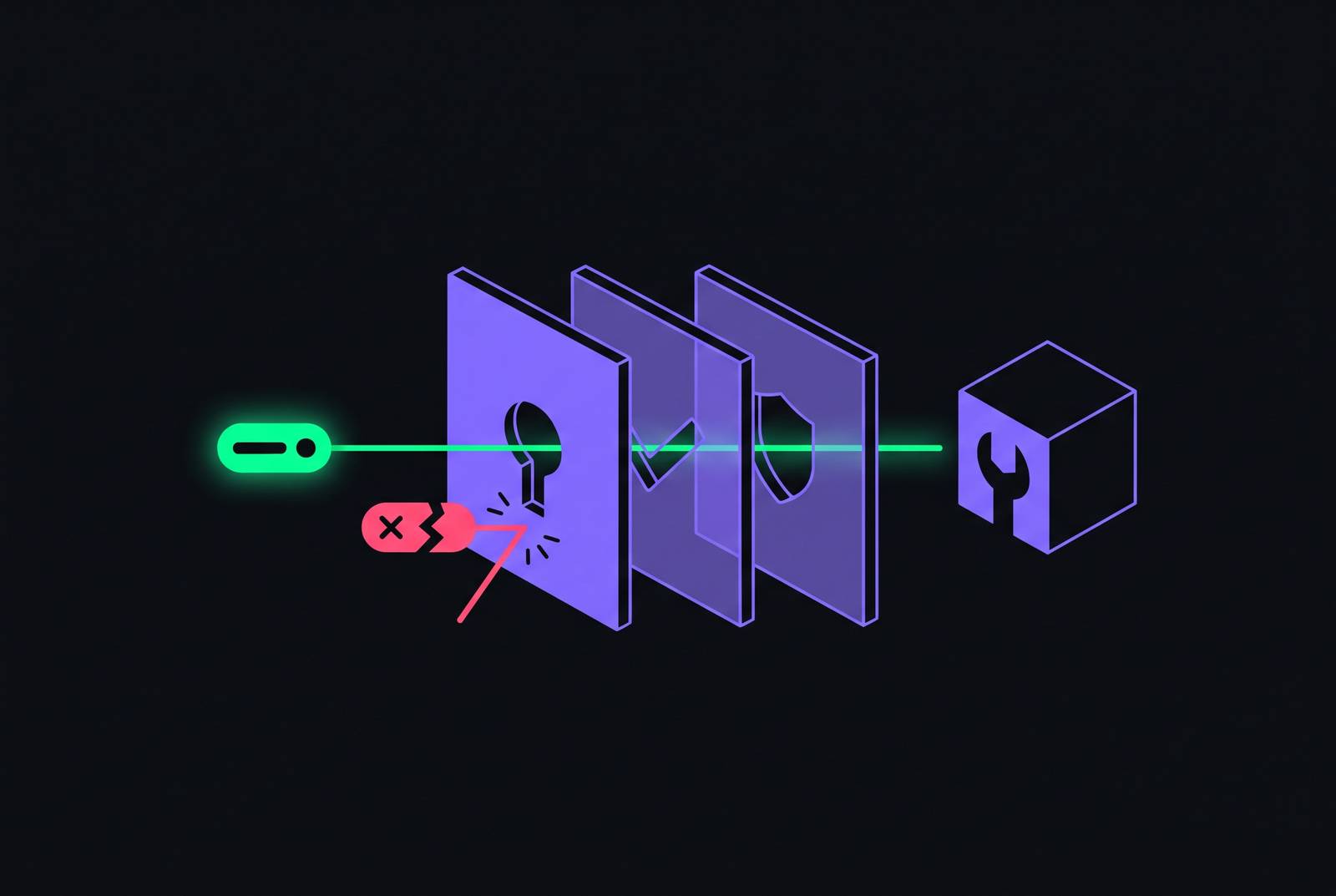
Enterprise MCP tool calls need a policy enforcement layer between agent intent and tool execution, because the protocol defines communication and leaves access control to the deploying organization. Replace token passthrough with secure OAuth credentials through audience binding, issuer validation, narrow scopes, and short-lived downstream credentials. Then authorize every tool call against the user’s identity, permissions, and current context, even after the connection that opened the session has been authorized.
Why MCP's wire protocol leaves enterprises without an access control model
MCP separates models from external tools through a client-server architecture. That separation routes requests, but it does not establish a security boundary. Microsoft’s 2026 MCP security post describes a deliberately minimal protocol that leaves security enforcement to the deploying organization. The wire format is not a policy framework. As MCP becomes the default way agents reach tools and data, that distinction becomes a production responsibility as well as a research concern.
The MCP specification marks authorization as OPTIONAL and defines its authorization flow only for HTTP-based transports. A server can therefore comply with the specification without implementing authorization at all. An organization that treats an MCP server like a governed API gateway assumes protections the protocol does not supply. Those protections must be built around it.
What the absence of built-in access control actually exposes in production
Traditional API security authenticates callers and validates inputs at known endpoints. MCP adds an interpretation layer, because the model reads tool descriptions, parameter schemas, and returned data at runtime. That layer can become an instruction channel. Tool poisoning embeds malicious instructions in descriptions the model treats as trusted context, potentially prompting data exfiltration through an otherwise legitimate-looking call. A related “rug pull” changes tool definitions after permissions have been granted, and most clients do not flag those changes.
The confused deputy exploits authority when a server acts with privileges the requesting user does not have, or a proxy is tricked into issuing a valid authorization code. Credentials create another route into downstream systems. One MCP server can hold tokens for several services while requesting broader scopes than its task requires. Compromising that server can expose every system those credentials reach.
Shadow MCP servers connect to agent clients without security-team visibility, while compromised dependencies, registries, update channels, or ownership changes can turn a trusted server hostile. The OWASP MCP Top 10 formalizes this threat surface as repeatable attack patterns. Its beta status reflects work still underway.
Why enforcement at connection time is not the same as enforcement at tool-call time
Connection-time authentication asks whether a user may use a server. Deciding whether that user may invoke a particular tool with particular arguments now requires a separate decision at tool-call time. Without a per-call check, a successful OAuth handshake can leave an agent with session-long access to tools beyond the user’s actual request. A valid token does not make every subsequent action authorized.
The enforcement point must therefore check calls before tool execution as well as before the session starts. It needs the originating identity, permitted scope, and current context for each invocation. Otherwise, the server’s broader privileges can replace the user’s narrower authority. This is why transport authentication and rate limits are insufficient on their own. Runtime authorization must check the requested operation and its arguments, since authenticated requests can call for different permissions.
How do enterprises secure OAuth credentials for MCP tool calls?
Per-call authorization needs identity claims it can trust. The 2025-06-18 MCP specification revision classified MCP servers as OAuth 2.0 resource servers, and the 2026-07-28 revision tightened the baseline. Microsoft’s guidance calls for OAuth 2.1, PKCE, and audience-bound tokens. Audience binding prevents cross-server replay of valid tokens. A token issued for Server A must not be accepted by Server B.
For that boundary to hold, an MCP server must implement OAuth 2.0 Protected Resource Metadata under RFC 9728. Clients must send the RFC 8707 resource parameter on both authorization and token requests, and servers must reject any token that was not issued for them. Under SEP-2468 and RFC 9207, clients validate the issuer before redeeming a code so that an authorization response is not associated with the wrong authorization server. That distinction is especially important when one client talks to many servers and identity providers.
Enterprise deployments should connect authentication to existing SSO so access decisions use the principal already governed through organizational access reviews. OAuth tokens, API keys, and service accounts are non-human identities that require a named owner, defined scope, expiration policy, and access reviews. Credentials created at deployment and never revisited can become stale and over-privileged. An HTTP endpoint without an authorization wrapper leaves the protocol itself unable to refuse unauthenticated access.
Tool-level RBAC — why server-level access grants are insufficient
Identity establishes who is asking, but not which operations they may perform. A user may legitimately access a CRM server without permission to invoke its “delete contact” function. Server access cannot settle that authorization question. Tool-level RBAC must restrict the tools, parameters, and operations available to each principal, preventing the server’s broad authority from becoming the user’s effective permission set. This is the scope boundary that counters the confused deputy.
To make that boundary enforceable, tools need risk classifications covering read, write, destructive, and irreversible actions. The MCP tools specification provides destructiveHint for destructive tools, while confirmation requirements in metadata help clients apply consistent controls. Metadata alone is not the authorization decision. Least privilege must also constrain the OAuth scopes requested on the user’s behalf, using narrow per-resource scopes rather than wildcards and read-only defaults with step-up authorization for writes. Maintaining these distinctions takes work, but broad server grants leave the entire tool surface available to an over-privileged session.
The governed control plane — a single enforcement point across every MCP server
When each server runs these checks on its own, enforcement varies and is hard to review. A governed MCP control plane centralizes authentication, routing, and policy enforcement so clients do not connect directly to backend servers. A legacy API gateway serves a different purpose. Header inspection, rate limits, and transport authentication cannot by themselves distinguish an authorized task from an agent sequence that exceeds user intent. Both can look like valid authenticated traffic.
The control plane must evaluate policy at each hop and at the final tool invocation. It forwards scoped, on-behalf-of credentials. Token passthrough breaks that separation of authority. The 2026-07-28 specification revision explicitly forbids passing the MCP client token through to an upstream API, so downstream access requires separately scoped credentials. The CoSAI Agentic IAM paper recommends short-lived agent credentials, reduced scope at each hop, and immutable audit trails across the delegation chain.
For those controls to remain accountable, SSO and SCIM must link the user principal, agent session, and tool call to a governed identity. Shared deployment accounts cannot provide the same attribution. Just-in-time credential provisioning also reduces exposure compared with standing credentials created at deployment. A credential that expires after one agent session cannot be replayed in a later one.
Policy evaluation engines — externalizing authorization logic so it can be audited and changed
The control plane is where decisions are enforced, but a policy engine determines what those decisions should be. Burying authorization rules in application code makes them difficult to review, test independently, and change without redeployment. External policy makes that logic separately governable. The CoSAI paper names Open Policy Agent (OPA) and Cedar as examples of policy languages or tools that can do this. The architectural benefit is version-controlled, testable authorization logic.
When a tool is added or a role loses a privilege, an external policy change can reach enforcement points without an application deployment. The decision should be recorded when it is evaluated, including identity, tool, arguments, timestamp, and allow or deny. Connection authorization remains a separate concern from this. The stable Enterprise-Managed Authorization extension, adopted by Anthropic, Microsoft, and Okta, replaces per-server consent prompts with a sign-in flow for approved servers. EMA governs entry, while the policy engine governs actions after entry.
Human-in-the-loop controls for irreversible and high-risk tool calls
Automated authorization cannot substitute for human judgment before an irreversible action. The MCP tools specification calls for people to be able to deny tool invocations and for clients to confirm sensitive operations. Approval must happen before the tool executes. Risk annotations identify the calls that need it, and the approval flow must replace a friendly summary with the intended action and its full arguments. Microsoft’s guidance highlights why that distinction helps against tool poisoning, since a poisoned description can mislead a summarized prompt.
This approval flow needs to be part of the enforcement layer. Its decisions need the same identity context as the tool call, with denied approvals recorded as clearly as allowed executions. Human review addresses actions for which an unauthorized destructive operation costs more than waiting for explicit approval.
Audit logging requirements that make the full agent action sequence reconstructable
To assess enforcement, teams need evidence of both what was authorized and what was executed. Each tool-call log entry needs the authenticated user identity, MCP server identifier, tool name, full arguments with sensitive values redacted or hashed, a representation of the result, and a timestamp. It also needs a correlation ID linking the call to its agent session and originating request. That link makes the action sequence reconstructable. Without it, calls that each look legitimate stay in separate records that do not show how an agent reached a harmful outcome.
The record must survive a compromised MCP server. Logs therefore need to be in write-once or append-only storage that the servers themselves cannot change. The CoSAI paper requires immutable decision logs and recommends recording allow or deny with the reason for significant agent actions. OTEL tracing connects inspection across the full session. The same telemetry also supports real-time detection of tool poisoning, prompt injection, intent drift, and exfiltration, making audit infrastructure a source for both active defense and compliance evidence.
Assembling the layers into a policy enforcement stack an enterprise can operate
The layers form a dependency chain rather than a collection of interchangeable security products. OAuth 2.1, audience binding, and issuer validation establish the claims that tool-level RBAC uses to limit operations. The control plane applies those limits consistently with just-in-time downstream credentials, while an external policy engine keeps the rules reviewable and changeable. Immutable logs and OTEL tracing then preserve the relationship between the original request, each authorization decision, and the resulting tool activity.
For an enterprise team, the practical requirement is integration. A separate agent builder, API gateway, and security tool can work as one stack only if they share identity context and correlation IDs. The complexity already exists in the combination of delegated authority, credentials, mutable tools, and model-directed actions. A deliberate enforcement layer makes that complexity governable as MCP evolves, providing a basis for enterprise trust without pretending the protocol’s open security problems have disappeared.