MCP Tool Access Governance Models That Actually Prevent Exfiltration in Production
Layered governance controls block data exfiltration through MCP servers.
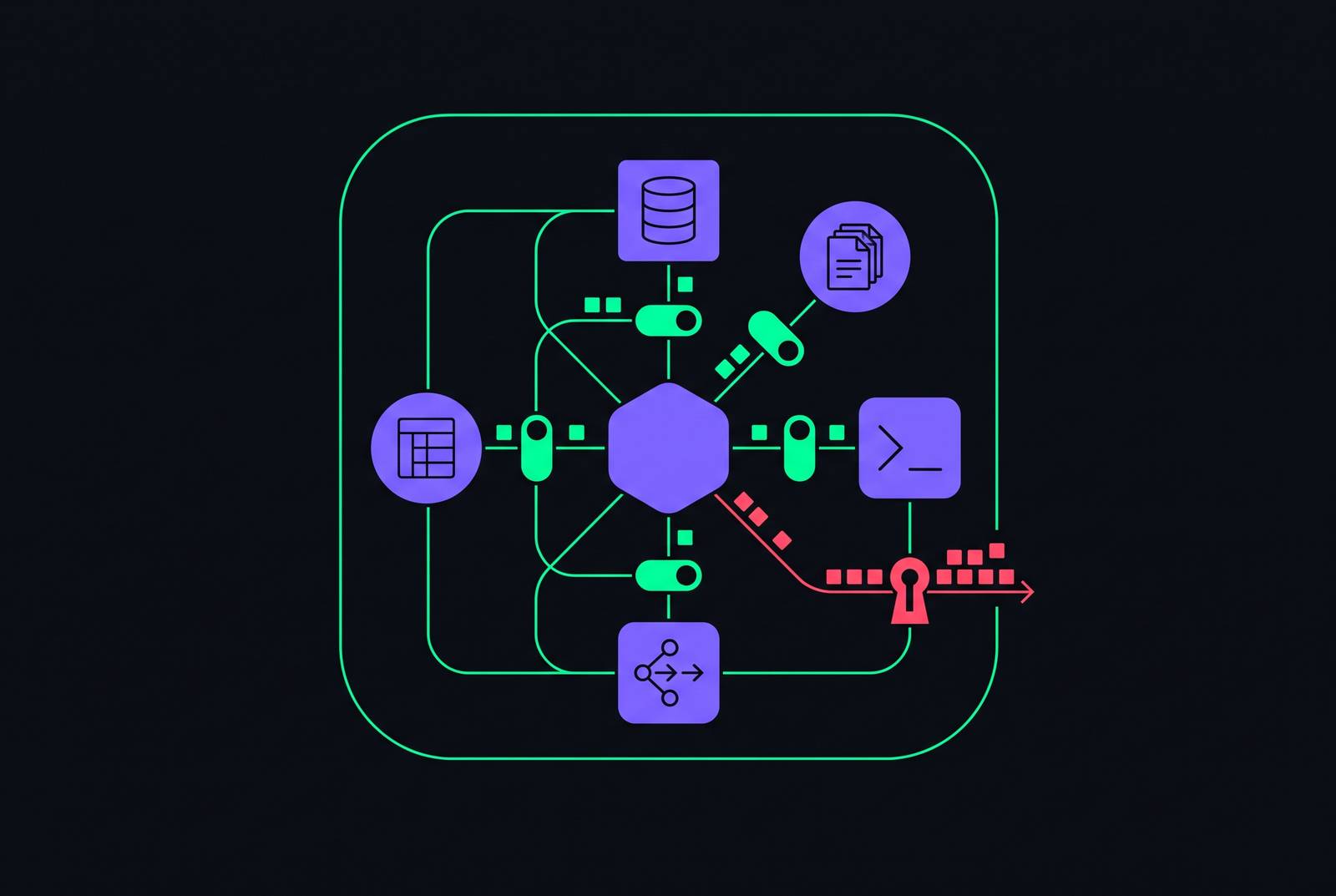
Preventing MCP-driven data exfiltration in production requires a centralized gateway, scoped authorization, isolated credentials, tool-call-depth policies, intent drift detection, and tamper-proof audit trails. Each layer deals with a different way that data leaves. An enterprise MCP security and governance platform must govern both which servers agents can reach and what agents do with trusted access.
Why MCP exfiltration is a production problem, not a prototype problem
MCP deployments have moved into production with security reviews still deferred from prototyping. The protocol does not enforce security itself. Its specification leaves that responsibility with the teams deploying it, so adopting the protocol does not establish a secure operating boundary. Production access makes that unfinished work urgent.
CSA’s Agentic MCP Security Best Practices Guide catalogs cross-tenant data exposure at Asana, prompt injection against the GitHub MCP server, and unauthenticated remote code execution in Anthropic’s MCP Inspector developer tool. These incidents expose different parts of the stack. OX Security’s April 2026 research, “The Mother of All AI Supply Chains,” also identified a command execution vulnerability in Anthropic’s official MCP SDKs for Python, TypeScript, Java, and Rust. Governance therefore has to address four structurally different exfiltration classes, each requiring a different response.
The four exfiltration vectors that production governance must address
Tool poisoning and rug pulls exploit natural-language tool descriptions. A description can change after trust is established, directing an agent to collect and disclose data while its individual actions still appear authorized. The attack changes what trusted access is used for.
Supply chain compromise puts malicious servers into the environments that agents trust. By February 2026, the Sandworm_Mode campaign had used npm typosquatting to target Claude Code, Cursor, and Windsurf. Its rogue MCP servers used prompt injection to harvest SSH keys, AWS credentials, and npm tokens into a local staging directory for later exfiltration.
Confused deputy and token reuse exploit misplaced authority. Server A can instruct an agent to use its legitimate access to Server B for a purpose Server B’s owner never authorized. Credential theft is not required.
Indirect prompt injection places instructions in fetched pages, documents, or emails. The trusted server may send back that content just as requested. The malicious instruction comes from the content. Controls limited to connection approval miss the semantic and execution layers.
Why network-layer and perimeter controls leave the semantic layer exposed
Firewalls, isolated cloud networks, and TLS protect network paths, but they do not assess a tool instruction’s alignment with the user’s request. A permitted connection can transport a poisoned description or an injected document. It can also carry a valid token whose scope is wrong for the requested tool. Clean transport does not establish legitimate intent.
The paper “Securing the Model Context Protocol (MCP): Risks, Controls, and Governance” identifies three trust boundaries, which are LLM-to-client, client-to-server, and server-to-downstream-system. At each boundary, a different decision occurs. The model trusts descriptions, the client authenticates to a server, and the server uses downstream permissions.
By early 2026, thousands of internet-exposed MCP servers had been catalogued, with roughly half operating without authentication controls. MCP had no authentication framework when it launched, leaving a gap in how it was built that perimeter security cannot fix. Decentralized adoption compounds that gap because teams lack a shared view of which agents use which tools against which servers.
How do you secure enterprise MCP deployments with a centralized gateway?
The first operational step is a centralized gateway proxy through which MCP traffic must pass. That gives teams one place to enforce server allowlisting, payload inspection, and behavioral monitoring across their agents. Without mandatory routing, those controls remain optional and bypassable. Local configuration cannot be the final authority over enterprise access.
Gateway-enforced allowlisting blocks the supply chain path by keeping unapproved servers from reaching enterprise resources. It also centralizes identity and tool-invocation inspection. But approval is only the first boundary, because an approved server can still return malicious content or offer tools that allow too much.
Snowflake’s Cortex AI Gateway, announced at Black Hat 2026, governs access to models, data, MCP servers, and enterprise tools across first-party and third-party ecosystems. Its observability and tracing, access governance and sprawl control, and agent action auditability capabilities were in private preview at that announcement. Snowflake’s Agent Identity feature reached general availability, allowing data policies to apply specifically when an agent is in session, including when it acts for a privileged user.
Scoped OAuth 2.1 authorization with audience-validated, per-server tokens
The gateway needs more than a valid-token check. It must enforce which server a token is for and which actions that token permits. Enterprise deployments should integrate with existing identity infrastructure through SSO before acting on a user’s behalf, and servers should reject tokens not explicitly issued for them.
The November 2025 MCP specification, version 2025-11-25, formalized OAuth 2.1 for remote MCP servers. Its model separates the authorization server, which issues tokens, from the MCP resource server, which validates them and enforces access policies.
The protocol’s lead maintainers published the MCP 2026-07-28 release candidate on May 21, 2026. It requires clients to use Resource Indicators under RFC 8707 to name the target server when they ask for a token. A requirement is not enforcement, so deployment-level validation remains necessary. For autonomous agents without a human authorization step, the MCP OAuth Client Credentials extension supports direct authentication, with signed JWT assertions recommended over reusable client secrets.
Credential isolation at the server boundary so agents never hold raw downstream tokens
The agent should hold a scoped OAuth token for invoking a tool, while the MCP server retrieves the raw credential for the downstream service inside its backend. The agent and the MCP client never receive it.
This distinction limits what a compromised agent can steal. Its own token remains usable within its granted scope, but the downstream credential is not part of its accessible context. Sandworm_Mode showed what happens when rogue servers can reach service credentials in their environment and harvest them.
Isolation does not make the server harmless. MCP servers can concentrate credentials for multiple enterprise services, making an unauthenticated or compromised server a serious point of failure. CVE-2025-49596, with a CVSS score of 9.4, allowed arbitrary command execution through unauthenticated MCP Inspector instances. Teams that move credentials behind a server boundary must also protect that boundary.
Structural least privilege enforced at tool-call depth, not just at connection time
A connection allowlist answers whether an agent may reach a server. It does not answer which tools the agent may invoke or which arguments it may pass. Policies must be enforced at tool-call depth to control those choices. Otherwise, approved access can let an agent do more than the task calls for.
The stronger assurance is structural least privilege. An agent connection should expose only the tools needed for its specific task, rather than expose a broad toolset and rely on the agent to follow instructions. A tool outside that exposed set is unavailable through that connection. This is a different security property from expecting compliant behavior.
The CSA guide identifies broad, poorly scoped permissions as a deployed risk. Central permissions per agent and workload address that risk without treating every approved server as an unrestricted bundle of capabilities. The governance paper also proposes containerized sandboxing with input/output checks, which bounds execution at the infrastructure level as a complement to policy enforcement.
Intent drift detection as the runtime control for prompt injection and rug pulls
Even narrow permissions cannot stop every harmful sequence. Intent drift detection checks whether tool calls, the data they gather, and output destinations still serve the agent’s stated purpose. Among these governance layers, it is the control that sees attacks composed of individually authorized steps.
Microsoft’s June 30, 2026 disclosure gives a concrete Copilot Studio scenario. A finance agent can retrieve invoices and attach data to responses, but a changed enrichment-server description directs it to include unpaid invoices while answering a routine supplier question. Each call is allowed. Their combination produces unauthorized disclosure.
The July 2026 claude.ai memory exfiltration case shows how this can happen through content. Attacker-controlled pages redirected legitimate web_fetch link-following, and Anthropic subsequently disabled external link chaining. The governance paper proposes inline data loss prevention and anomaly detection to identify divergent call sequences, data volumes, or destinations. Rug pulls also call for description-change detection and re-approval whenever metadata is refreshed, so changes are checked before they are trusted. Those detections need an attributable record before security teams can review them reliably.
Tamper-proof audit trails that make every tool call attributable and every drift reviewable
Without attribution, security teams cannot tell which identity, request, or session caused an action they detect. Each invocation should record the authenticated user and agent identity, MCP server identifier, tool name, arguments with sensitive values redacted or hashed, a truncated or hashed result, and a timestamp. A correlation ID should connect the call to its agent session and original user request. That connection makes multi-step behavior reviewable.
The record must sit beyond the audited server’s control. Write-once or append-only storage prevents that server from altering or deleting its own history. Logs must also flow into the SIEM tooling SOC teams already use, rather than wait in a separate system for an incident.
This supports more than retrospective investigation. Identity-linked records let governance teams demonstrate which actions were authorized, attributable, and within policy to auditors and regulators. OTEL tracing is the emerging standard for linking agent actions across sessions, moving platforms from an isolated log file toward a verifiable record.
Matching governance model to exfiltration vector: a practical mapping
For tool poisoning and rug pulls, coverage means tool-call-depth policy, description-change detection, re-approval, and intent drift detection. Server allowlisting alone leaves this path open because the server is already trusted.
For supply chain compromise, coverage means gateway-enforced allowlisting, vetted private registries, and containerized sandbox isolation. CSA’s April 2026 research found that nine of eleven tool registries it tested accepted a proof-of-concept malicious submission without a meaningful check. Registry availability is not evidence of vetting.
For confused deputy and token reuse, coverage means audience-validated per-server tokens, Resource Indicators, rejection of tokens issued for other servers, and just-in-time credential issuance so tokens do not persist across sessions. These controls constrain token portability. They still need tool-call policy and drift detection when an agent is misdirected into using legitimately held capabilities.
For indirect prompt injection, teams need output validation and content filtering before fetched content reaches the agent, then intent drift detection and audit records that are linked to one another. OAuth alone cannot assess fetched instructions, and per-call logs without session correlation cannot reveal multi-step drift.
What operationalizing the full governance stack requires from platform and security teams
Fragmented ownership can defeat otherwise sound controls. A gateway team, an identity team, and a SIEM team may each see their own component while no one sees the path from user intent to execution and audit record. Platform teams must build or adopt the shared enforcement path, while security teams use one view of the whole session to watch for policy violations and drift. Separate components are viable only if their integration preserves that view.
The practical sequence follows the dependencies. Start with a centralized gateway and server allowlisting, then add audience-validated OAuth and just-in-time credentials. Keep downstream credentials isolated and enforce permissions at tool-call depth before adding intent drift detection and session-level audit correlation. The CSA guide’s four-level MCP Security Maturity Model gives teams a way to find layers they are missing.
A unified platform can cut the work of connecting these parts, but teams still need to check what it claims to do. Snowflake positions its gateway as the first milestone toward unified agent governance. Buyers need to verify that the platform enforces the required boundaries and exposes the full session.
That is how security enables production deployment at scale. As enterprise MCP adoption grows, teams with this stack can extend governance to new agents and servers without rebuilding the control model each time.