Continuous MCP Inventory and Policy Enforcement to End Rogue Integration Sprawl
Continuous scanning and enforcement stop unauthorized MCP servers from escaping governance.
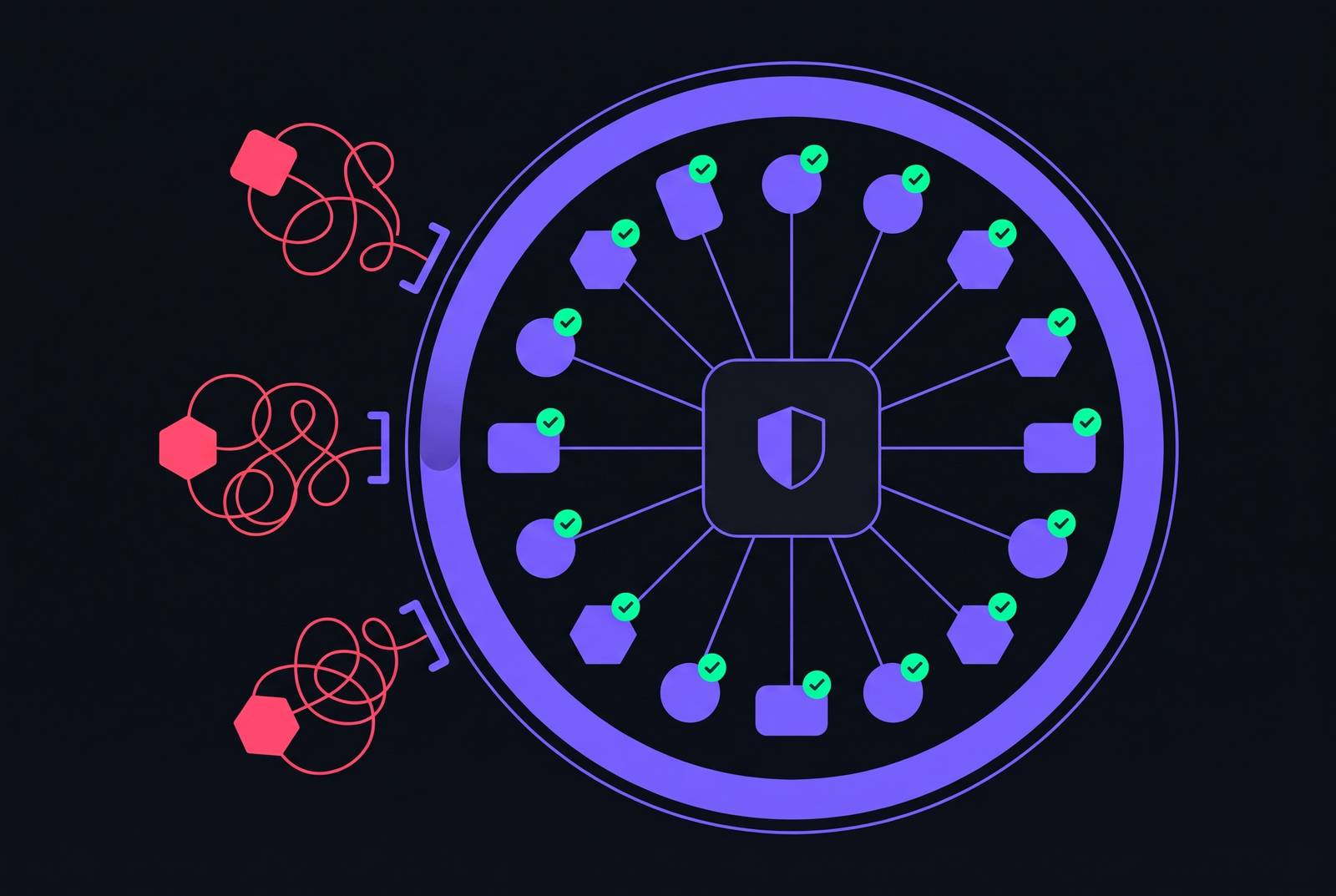
Shadow MCP usage detection and remediation require continuous discovery of live servers, identity records linking tool calls to employees, and enforcement on every tool invocation. Rogue integration sprawl is a visibility and enforcement gap. Continuous MCP inventory and policy enforcement close that gap by making unauthorized connections discoverable and approved connections governable as they change.
Why MCP sprawl is a structural problem, not a behavior problem
MCP makes connecting an agent to a system nearly frictionless. A developer can stand up an MCP server against a production database in an afternoon, and its tools become available once an agent discovers it. The protocol itself imposes no mandatory security review gate. Integration can therefore move faster than the approval process, even when nobody intends to bypass security.
The original MCP specification shipped without requiring authentication because it began as a local integration tool. It started with what an agent could do and left organizations to set up trust and access controls. That design leaves a predictable gap in the inventory as more connections are made without being registered. Telling developers to be careful cannot close it. The missing control belongs in the architecture, where it can apply regardless of who creates the next connection.
What rogue MCP servers can actually do once they escape governance
Tool poisoning starts with text the agent treats as instructions. A malicious server embeds directions in tool descriptions, while the user interface shows nothing unusual. The agent can then follow the attacker’s directions and abandon the user’s task. A rug pull exploits the same channel after approval, by changing a previously accepted description. MCP provides notifications/tools/list_changed, but that mechanism is opt-in and does not guarantee that clients act on changes.
Cross-server shadowing extends the attack beyond the malicious server. An injected description can redefine how the agent understands adjacent tools for systems such as GitHub, Slack, or Stripe. The legitimate integration need not change at all. Invariant Labs disclosed a prompt injection vulnerability in the official GitHub MCP server in May 2025, where a malicious GitHub Issue could redirect an agent to exfiltrate private repository contents. An approved connection was not enough to make attacker-controlled content safe.
Credential exposure makes that redirection more damaging. The Supabase Cursor incident in July 2025 involved an agent with privileged service-role access that was tricked through prompt injection into leaking integration tokens. Its credentials set how much damage it could do, even beyond its task. Supply chain compromises create another entry point, including malicious npm packages and unauthenticated remote code execution in Anthropic’s MCP Inspector developer tool.
Without identity binding, investigation has a separate failure mode. Records may show that an agent acted without reliably identifying the person, session, or approval behind the action. Security teams then face both an unauthorized operation and an attribution gap. Blocking the offending connection does not reconstruct the missing history.
Why point-in-time audits and model-level safeguards cannot solve this
A periodic audit establishes what existed when someone looked. It cannot establish that the same tool descriptions remain in use between reviews. A server audited on Monday may return poisoned descriptions by Wednesday, and an optional change notification is not a mandatory re-approval process. More frequent reviews shorten that gap without removing it.
Model-level safeguards face a different limit. An LLM cannot independently establish that a tool description is accurate, approved, or unchanged simply by reading it. Instructions embedded in that description enter the same context the model uses to decide what to do. Refusal behavior can help, but it cannot supply the missing record of trust. The organization still needs a control outside the model that knows which definition was approved.
An ordinary API gateway controls traffic to known endpoints within its view. Allowing an endpoint also says nothing about changes to its tools or the human responsible for a particular invocation. These controls remain useful within their scope. None can substitute for a live record of the integration environment and decisions enforced inside each session.
How do security teams find unauthorized MCP servers and track what they do?
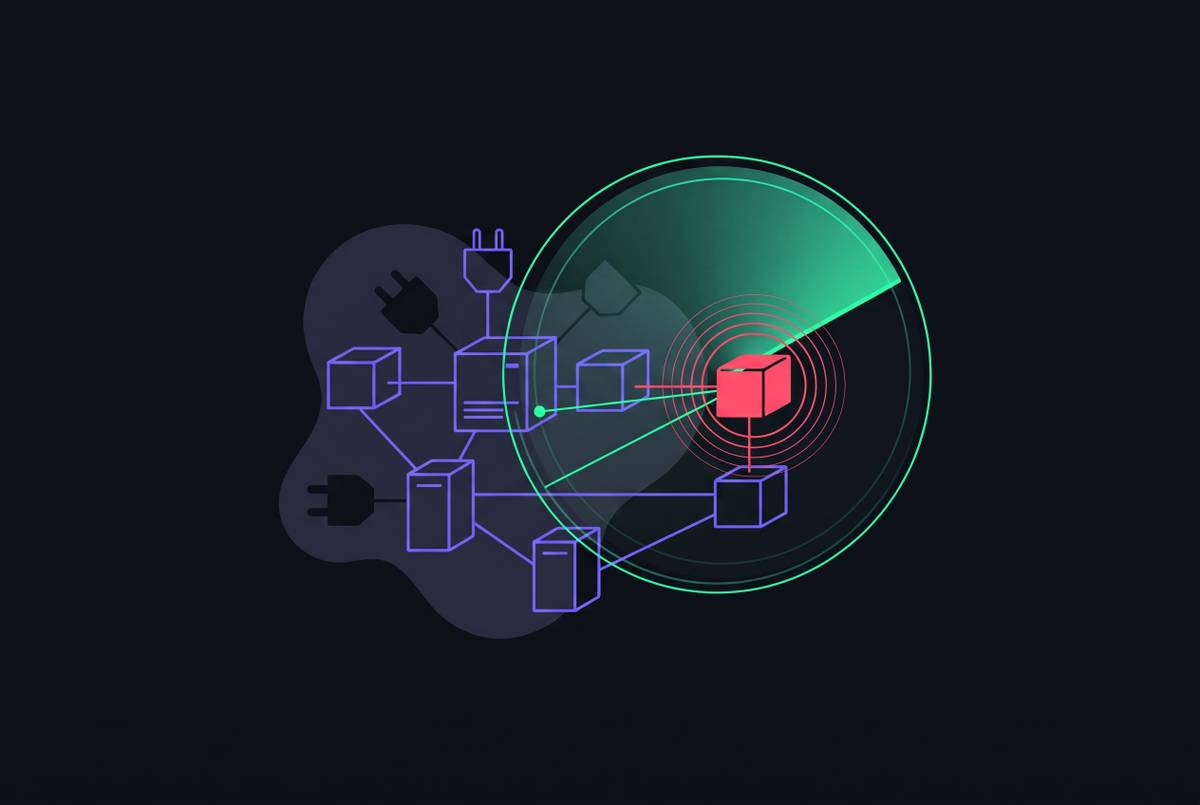
A continuous inventory must find servers as well as record those that are registered. Active scanning must cover local and remote servers, including connections that never entered an approval workflow. For every discovered server, it must identify ownership, trust status, permissions, and whether its definitions have changed.
Tool definitions need version history because approval applies to a particular definition. A changed description must trigger re-review so that a rug pull becomes visible before it is accepted as routine behavior. Credentials need equally explicit records. The inventory must show which servers hold them, whether they are hard-coded or secrets-managed, and what access they grant. When a server holds credentials for several systems, it puts all those systems at risk.
To identify unauthorized employee usage, each tool call must connect to the human initiator’s SSO identity. The record must distinguish who approved the agent, which MCP connection it used, and which action followed. An agent name alone is not attribution. The inventory must also map agent-to-agent communication, because a human-to-agent-to-tool diagram leaves out workflows passed between agents.
Why enforcement must reach the tool-call level, not stop at the gateway
A connection-level allow rule cannot distinguish an approved tool from an unauthorized tool on the same server. Nor does an initial session decision account for a changed definition later in that session. The operative control is the individual tool invocation. Each call needs a real-time access decision bound to identity and the approved tool version.
A per-agent allowlist makes that distinction concrete. An agent may invoke only the tools approved for its task. Definition validation adds a separate condition. If the description no longer matches its registered version, the call goes on hold for review. Irreversible actions, including sending emails, modifying records, and calling payment APIs, also require explicit human confirmation in the workflow.
Session-scoped credentials constrain what an approved agent can reach. Just-in-time issuance limits access to the task and session instead of supplying persistent admin-level tokens for work that needs narrow read access. Authentication, tool integrity, session management, supply chain validation, execution isolation, and behavioral monitoring still need to work together.
The regulatory and compliance mandate that makes this urgent
The EU AI Act sets dates for governance teams and rules they must meet. Transparency duties apply from August 2026. After the Digital Omnibus, the high-risk regime applies from December 2027 for Annex III stand-alone systems and August 2028 for Annex I embedded systems. High-risk AI actions need logging, human oversight, and security controls. When tool connections are unregistered, organizations lack the evidence to show that those controls cover an agent’s actions.
The NSA’s May 2026 guidance states what the protocol can and cannot do. MCP alone cannot enforce consent, privacy, or tool-safety principles at the protocol level, and organizations that deploy it must still address gaps in authorization and credential isolation. A model vendor’s safeguards cannot establish who authorized access to an enterprise system or whether the credentials were properly isolated.
Data residency creates an independent exposure. When tool discovery and MCP interactions route through a third-party cloud, data leaves the network boundary on those interactions, regardless of the vendor’s security posture. Organizations with HIPAA, GDPR, or financial services residency obligations must account for that path. Audit evidence must also survive the session. Tamper-proof records need to connect tool calls to human ownership and approval events, rather than leave compliance teams with temporary logs that cannot support an attributable history.
What the inventory-and-enforcement system must look like in practice
The target architecture is a unified control plane. Discovery continuously finds unregistered servers and classifies them as local or remote so the right controls can apply. Registration then becomes a connection gate. Agents can use only servers that have passed review, and changes return to the approval workflow.
Identity and credential services must feed that gate and the runtime decisions behind it. SSO and SCIM integration connect agent actions to enterprise directory identities, while just-in-time credentials constrain access to a specific task and session. Remote servers need OAuth 2.1 enforcement. The MCP 2026-07-28 specification requires OAuth 2.0 Protected Resource Metadata so clients can discover the correct authorization server automatically. Autonomous agents use signed JWT assertions rather than reusable client secrets under the MCP OAuth Client Credentials extension guidance.
At runtime, allowlists, version validation, and human approval gates must operate on the same calls. Behavioral detection looks for tool poisoning, prompt injection, intent drift, and cross-server shadowing that endpoint rules cannot show. Supply chain validation checks definitions against known-good versions instead of treating them as trusted when they are first used. The audit layer preserves the decision context. Tamper-proof logs with full OTEL tracing link each call to its human identity, session, approval event, and the tool definition version that applied to it.
Microsoft Agent 365, which became generally available May 1, 2026, gives each AI agent an Entra Agent ID. AWS released an Agent Registry with approval workflows, generally available August 31, 2026. Google made its Agent Registry and Agent Gateway generally available June 18, 2026. SAP launched AI Agent Hub at Sapphire in May 2026 to inventory agents, LLMs, and MCP servers with risk ratings and compliance mappings, including the EU AI Act. Auth0 by Okta made Auth for MCP generally available May 5, 2026, covering CIMD registration and on-behalf-of token exchange.
These capabilities address distinct requirements within the system. Their value depends on how discovery, identity, approvals, and enforcement work together across the organization’s actual connections. A registry entry must inform the access decision. That decision must produce an attributable record, and a later definition change must be able to stop execution. This connection between layers is the criterion for completeness, whether the organization assembles the system or adopts a unified platform.
How security and platform teams should operationalize this, starting now
Run a scan covering local and remote MCP servers to establish the baseline, then keep that inventory live. Classify the results by credentials held, downstream systems reached, and whether the server runs on organization-controlled infrastructure. Prioritize exposure by putting admin-level access and connections to payment, healthcare, or regulated data at the front of the remediation queue.
Before expanding agent capabilities, connect the inventory and enforcement system to SSO and SCIM. This establishes human attribution before more workflows depend on anonymous or fragmented records. Then give each agent an explicit, versioned tool allowlist. Changes must go through re-review before they can be approved again. The practical test is whether a changed tool definition becomes both visible and blocked pending a new decision.
Security teams should make the approved path easy for developers and non-technical employees to use. Clear registration, working identity integration, scoped credentials, and predictable approval workflows let people adopt tools without inventing their own route around governance. A blanket prohibition leaves that incentive intact. A governed path removes it by letting people do legitimate work within rules that are enforced. The goal is not to persuade every employee to remember every rule, but to make every live connection accountable and every tool call subject to the rules that apply.