How Enterprises Are Deploying AI Agents to Slack at Scale
Shared authentication and permission layers let enterprises scale AI agents across Slack safely.
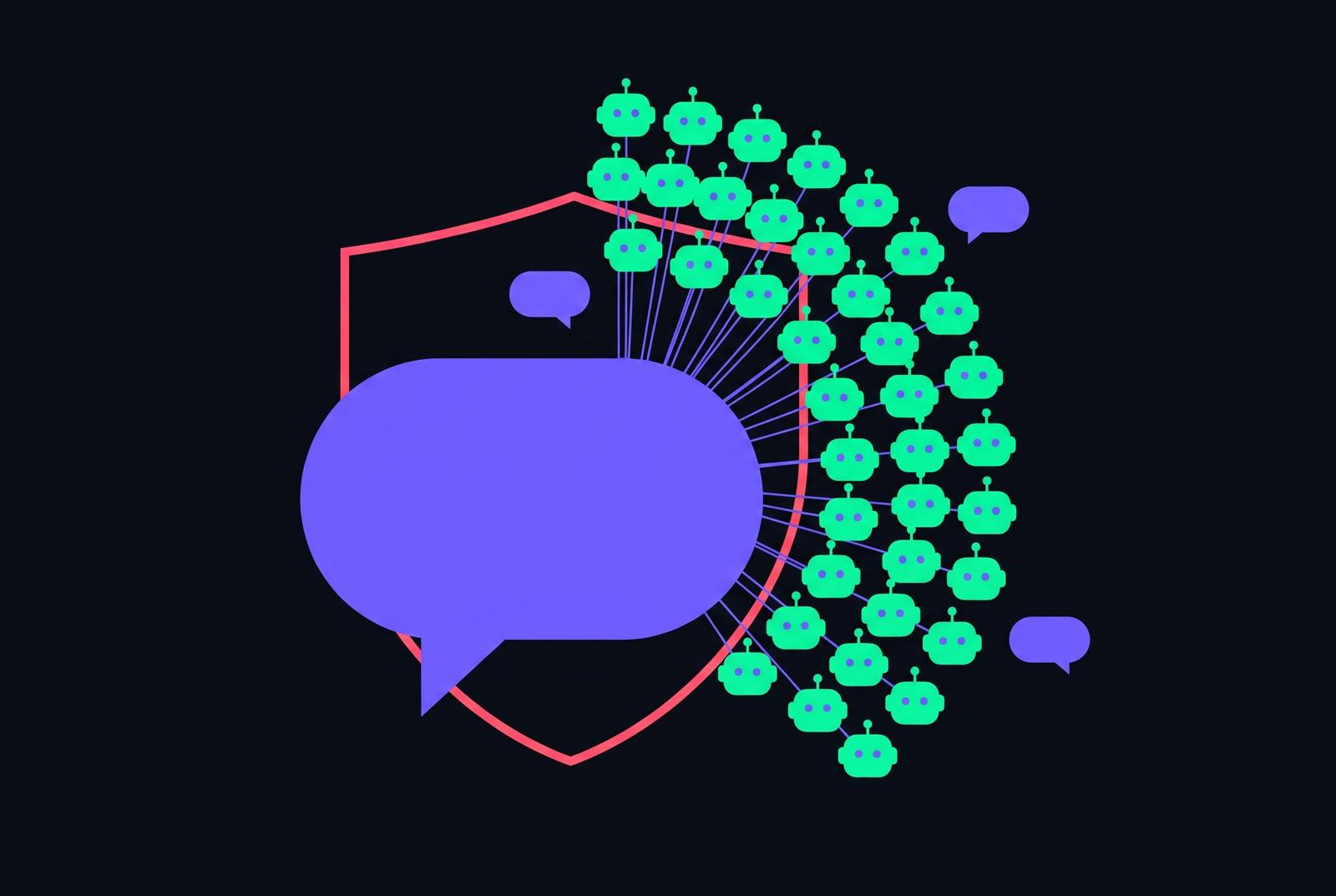
Enterprises can give thousands of non-technical employees access to AI agents through Slack, where requests and approvals already happen. The key is a shared architecture for authentication, permissions, orchestration, and audit. That architecture makes automation available to business users without turning IT into the reviewer of every request.
Why Slack has become the default deployment surface for enterprise AI agents
Slack is already where people make the decisions, give the approvals, and coordinate the work that agents need to join. Employees can mention an agent in the same place they ask colleagues for help, without learning a separate interface. A standalone agent portal introduces a tab-switching tax that can stall adoption even when the agent itself works.
Slack’s agent-first workspace post says the number of new custom agents built since January has grown fast, and a large ecosystem of pre-configured apps and agents is available. A developer using Cursor can pull real-time context from Slack discussions, while a Linear agent turns a thread into an actionable ticket.
The same post describes an upcoming Slackbot MCP client that would make Slackbot a single front door to the enterprise tech stack. It is designed to route requests to specialized agents and manage multi-step workflows. That would simplify the employee’s side of the exchange. But behind that front door, access still needs to be controlled at every handoff.
What "Add to Slack" actually does and what it leaves unresolved
Add to Slack connects agent-builder platforms directly to Slack without custom integration code, webhook configuration, or platform migration. It handles authentication and multi-tenant permission scoping at installation, and deployed agents inherit workspace permissions and data boundaries. IT gets centralized visibility through the Agent Browser. Agents immediately become team assets that colleagues can mention, task, and collaborate with in open channels.
Slack’s announcement names LangChain, n8n, Lovable, Hyperagent, and Skydive as launch partners. The use cases span executive assistants managing calendars, GTM agents researching accounts, engineering agents triaging PRs, and support agents answering knowledge-base questions.
But installation is only the first trust boundary. Add to Slack does not, by itself, govern which tools an installed agent calls, which downstream credentials it uses, what data it sends outbound, or how its actions are audited. Workspace access is not a complete policy for external services. Once dozens or hundreds of agents are running, the unanswered question is who controls their combined activity.
How agent sprawl develops and why it becomes an architecture problem
No-code and low-code tools let teams across HR, Marketing, Sales, and Engineering build agents without waiting their turn in a central development queue. IT cannot keep up if it has to review every deployment by hand. Shadow agents then emerge with access that IT did not explicitly authorize.
Slack acknowledges that independently deployed agents can work in silos, without shared context or a way to communicate. More agents can therefore create more noise. As enterprises go from managing hundreds of specialized agents toward thousands, separate decisions about how to deploy them make governance harder. A workspace full of useful individual assistants is not necessarily a coordinated system.
The C1 2026 Future of Identity Report found that a substantial majority of organizations lack full visibility into their AI agent identities. Meanwhile, only a small fraction of MCP-connected pilots are reaching production, with identity management, auditability, and vendor lock-in as primary failure modes. Agent logic is not the only obstacle. Scaling requires a shared control plane that makes agents identifiable, constrains their tools, and records their decisions.
The four architectural layers a Slack agent deployment actually needs
Orchestration sets which agent handles a request and how work passes from one agent to another. The upcoming Slackbot client is intended to provide that routing and return the final result to the user. Model Context Protocol, or MCP, connects agents to tools, while Slack also identifies its Real-Time Search API as a mechanism for secure access to business context. Routing alone does not establish a right to act. Orchestration must be built with identity controls.
Authentication establishes that identity across each connection. The MCP authorization specification defines an OAuth 2.1 framework but makes authorization optional. Knostic’s July 2025 internet scan found publicly accessible MCP instances responding to unauthenticated requests. The deployment baseline should therefore include OAuth 2.1 with PKCE, HTTPS-only endpoints, discoverable authorization-server metadata, and RFC 9728 Protected Resource Metadata. Add to Slack’s installation authentication does not replace authentication between an agent and each downstream MCP server or API.
Permissions enforcement limits what that identity can do. An agent should hold a scoped OAuth token for its tool call, while the MCP server retrieves the actual service credential server-side. Raw downstream credentials should never be kept in an agent’s memory. Enforced tool allowlists, scoped user permissions, and a centralized MCP gateway address over-broad access and give security teams a common inventory. Human approval gates are also required for destructive or irreversible actions, including database deletions, financial transactions, bulk record changes, and outbound data transfers.
Audit establishes whether the action was authorized and consistent with policy. Records must identify who authorized it, what context the agent had, what it decided, and whether that decision followed policy. Output logs alone cannot answer those questions. Governance must also cover tools, memory, delegation, and autonomy. AIUC-1’s Q2-2026 update introduces controls for MCP and A2A authentication, transport security, runtime containment, and logging, making the protocol connections part of the control scope.
MCP-specific threats that Slack deployments inherit
The Drift/Salesforce OAuth attack is an instructive starting point because it puts delegated access, rather than the chat interface, at the center of the security discussion. An agent can enter through a familiar workspace and then call an external MCP server. If that server is unvetted, unauthenticated, or poisoned, Slack becomes an attack entry point.
OWASP’s MCP Top 10 project formalizes threats that include tool poisoning, schema poisoning, tool shadowing, command injection, shadow MCP servers, and context over-sharing. Tool poisoning puts harmful instructions in the tool metadata. Command injection takes advantage of unsanitized agent input, while agents that share sessions risk exposing too much context. These risks arise at tool and session boundaries.
In 2026, Check Point Research showed how poisoned repository configuration files could lead to remote code execution in Claude Code. In the same year, Trend Micro found 492 MCP servers that were exposed to the internet with zero authentication. Yet only a minority of organizations feel prepared to secure agentic applications, and only a small fraction have full visibility into agent-to-agent communication.
The compliance obligations enterprises cannot defer
When agents act on their own in Slack, they can fall under rules that a normal chat integration would not meet on its own. The EU AI Act requires transparent, auditable technical documentation, external monitoring, structured human oversight, and mechanisms to stop, correct, or override covered systems. A human approval button addresses only part of that requirement. The architecture around it must also let people inspect the system and step in.
The Digital Omnibus, Regulation (EU) 2026/1744, in force July 27, 2026, moved high-risk obligations for stand-alone systems to December 2, 2027. Building identity binding, intervention points, and durable audit trails takes months, so readiness for 2027 remains a 2026 project decision. Most enterprise agentic deployments still qualify as high-risk under the framework described here.
NIST is targeting an AI Agent Interoperability Profile for Q4 2026 and developing SP 800-53 control overlays for agentic systems. Enterprises should treat those as planning inputs and accommodate them when published. Retention cannot wait for later standards, however. The Act’s Article 19 and Article 26(6) require logs that high-risk systems generate automatically to be kept for a 6-month minimum. Under FINRA and SEC requirements, financial-services audit trails for trading and advice may need to be kept for up to 6 years, while HIPAA requires audit logs to be kept for 6 years.
What a production-ready architecture looks like end to end
The target design starts with Slackbot as the employee’s front door, using its planned orchestration role to route intent and return results in the same channel. Behind it, a central agent registry records every agent, its permitted tools, and its operating identity. That inventory must extend beyond the Agent Browser to every MCP server in use. No downstream connection should remain an unrecorded exception.
The identity layer ties actions to a named human through SSO and SCIM. Just-in-time credential issuance limits access to the specific action. The MCP server retains responsibility for retrieving downstream credentials, keeping them out of agent runtime memory. Authenticated HTTPS connections and discoverable authorization metadata establish the connection baseline.
The enforcement layer then checks the proposed tool call against an allowlist at the MCP gateway. A prompt cannot grant an unapproved tool. A human must also approve high-risk calls in Slack before they go through. Hyperagent illustrates this pattern by running autonomous agents in the background and bringing people back into Slack for updates or approvals. Detection for poisoning, prompt injection, intent drift, and exfiltration belongs at tool-call depth.
The audit layer connects the whole chain. Tamper-proof records capture authorization, context, decisions, and policy consistency, while OTEL tracing follows the Slack message through the MCP call to the downstream API response. Retention follows the relevant regulatory context. A unified data plane for enablement, control, and security reduces the integration gaps that separate builders, gateways, identity tools, and security tools can introduce.
The honest limits of what current tooling can do
Most governance tooling does not yet enforce every policy in real time across every agent framework. Runtime blocking exists in practice for a small set of platforms. Elsewhere, the realistic posture is discovery and governance, with enforcement still on the roadmap. A system that reports a violation afterward is not equivalent to one that prevents the action.
Remediation remains a separate, largely manual problem. Tools can detect violations and generate alerts, but containing an agent, notifying stakeholders, coordinating rollback, and preparing breach documentation still require significant human coordination. No commercial tool fully closes that workflow as of 2026. Faster agent deployment can therefore accumulate integration debt and vulnerabilities faster than governance teams can resolve them.
Enterprises should prioritize enforceable tool allowlists and human approval gates where runtime blocking is incomplete. Those controls constrain what agents can do before a failure requires containment. Audit retention, SSO/SCIM identity binding, and allowlists are also easier to establish before deployment than to retrofit into running agents with accumulated technical debt.
How do you start rolling out Slack agents without overwhelming IT?
For enterprises deploying their first agents, the starting point is a registry before any Add to Slack approval. It should record the agent, its tools, its identity, and its data boundaries. SSO identity binding belongs in that deployment step. Tool allowlists should also be configured before agents enter channels. The default should deny unknown tools.
For enterprises with agents already running, discovery comes first. Teams should identify every MCP server, map which agents call which tools, and locate unauthenticated endpoints. They should then add approval gates in Slack for financial transactions, bulk record changes, and outbound data transfers. Audit retention needs immediate attention because missing historical records cannot be reconstructed after an incident.
For enterprises approaching hundreds of agents, the next decision is whether the stack shares controls or depends on separate tools. Integration maintenance needs a recurring budget when authentication, enforcement, and audit remain fragmented. Teams should use the planned NIST profile and control overlays to guide that design without waiting for them to start. Early investment lets security and IT enable adoption and avoid bottlenecks during containment.
With a shared architecture, every employee, including those who are not power users, can use automation reliably without opening security gaps.