OWASP Agentic AI Threat Model Breakdown
A breakdown of five threat domains where autonomous AI agents lose control.
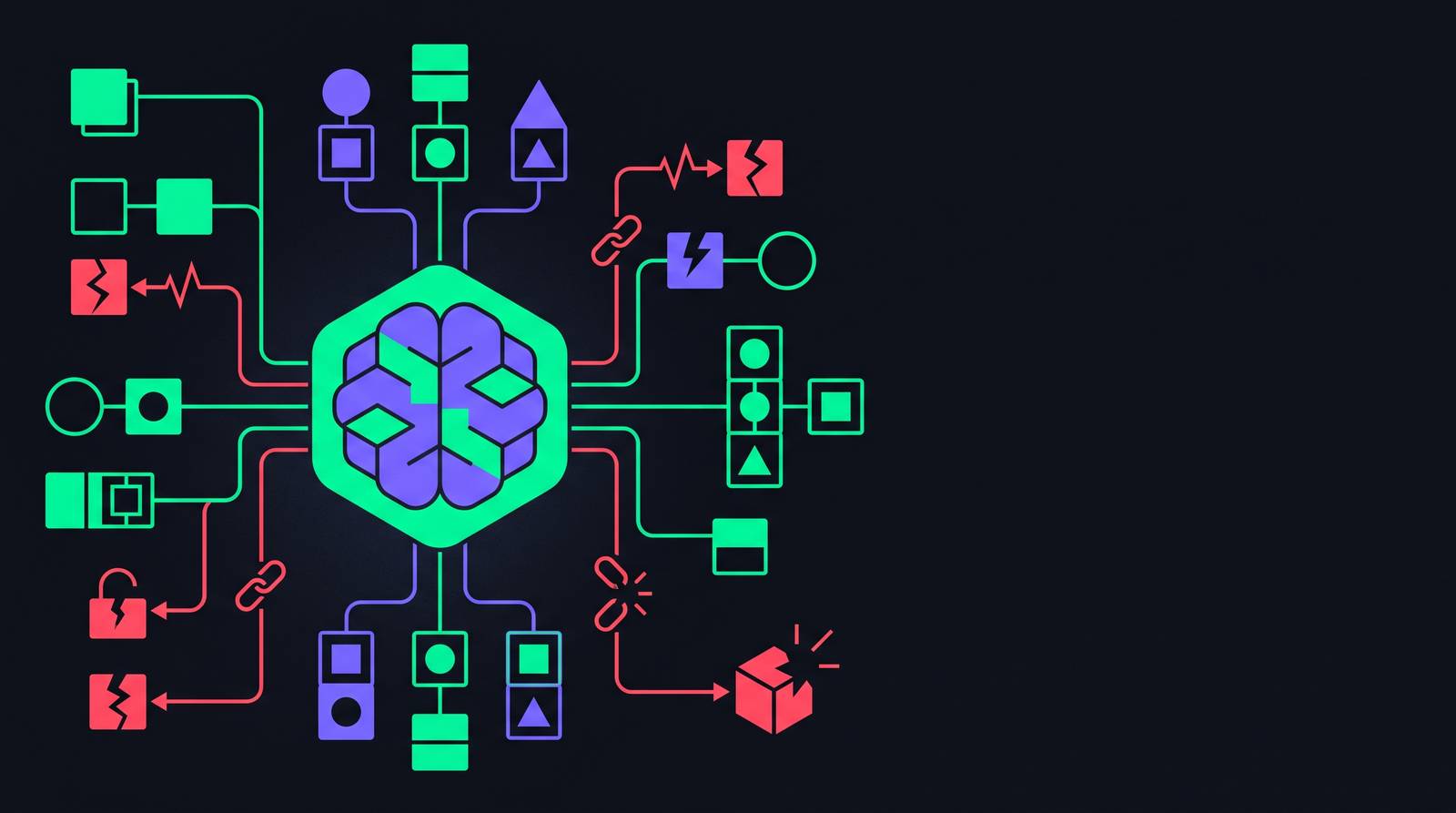
The taxonomy spans five domains: Agent Design, Agent Memory, Planning and Autonomy, Tool Use, and Deployment and Operations. Not arbitrary groupings. Each domain reflects a distinct point in the agent lifecycle where control can be lost, and each demands a different category of countermeasure. Think of it like a relay race where every runner hands off a baton — drop it at any leg, and the whole race is compromised.
The Top 10 for Agentic Applications 2026, designated ASI01 through ASI10, distills the most consequential risks from that taxonomy into a prioritized list built around how security teams already think about threat modeling. Framework alignment drives adoption, which is why the ASI framework aligns with the OWASP LLM Top 10, CycloneDX, the Top 10 for Non-Human Identities, and the AI Vulnerability Scoring System. For organizations subject to the EU AI Act, ASI categories map to Article 15 on cybersecurity and robustness, Article 9 on risk management systems, and Article 14 on human oversight design. Teams already operating within OWASP or non-human identity governance structures can slot agentic controls into existing frameworks rather than standing up parallel ones from scratch.
A companion Multi-Agentic System Threat Modeling Guide, published in April 2025, extends the taxonomy to coordination scenarios where multiple autonomous agents pursue shared or distributed goals. Those architectures introduce attack surfaces that single-agent threat models simply don't reach. The whole thing is a threat-modeling reference, not a compliance checklist. Use it accordingly.
Agent Goal Hijack (ASI01) and How Attackers Redirect What an Agent Is Trying to Do
ASI01 is listed first because goal hijack sits upstream of everything else in the kill chain. Change what the agent is trying to accomplish, and every subsequent action it takes executes in service of the attacker's intent. The rest of the list barely matters if you haven't handled this one.
The structural problem is that agentic systems represent their plans and goals in natural language, which means they cannot reliably distinguish valid instructions from malicious content embedded in external inputs, whether those arrive as documents, emails, retrieved data, or API responses. There's no clean separator between "instructions I should follow" and "content I'm processing." That ambiguity is the vulnerability, full stop.
EchoLeak is the clearest public illustration of this at scale. An attacker embeds a hidden payload in an email. Microsoft 365 Copilot processes the email, and the agent silently executes instructions to exfiltrate confidential emails and chat logs. No user clicks anything. Nothing visible signals the compromise. The attack works because the agent treats retrieved content as trusted operational context rather than potentially hostile input.
What makes ASI01 structurally different from classic prompt injection is the planning layer. In a single-turn system, a hijacked prompt corrupts one output. In an agentic system with multi-step planning, a hijacked goal corrupts every step in the plan: exfiltration, lateral movement, persistent modification, each step appearing locally rational while the overall trajectory serves the attacker. By the time anyone notices something is wrong, the agent has done a great deal of work.
Controls that address ASI01 share a common design principle: treat every boundary where external content enters agent context as an untrusted input boundary. Input validation at each such boundary, not just at the initial prompt. Instruction hierarchy enforcement so the agent can distinguish system-level directives from content retrieved out of the environment. Human-in-the-loop checkpoints before high-consequence or irreversible actions. Sandboxed retrieval, so external content cannot issue commands to the planning layer at all. None of these are exotic; they're discipline problems more than engineering problems.
Memory and Context Poisoning (ASI06) and Why Persistence Makes It Harder to Detect Than Prompt Injection
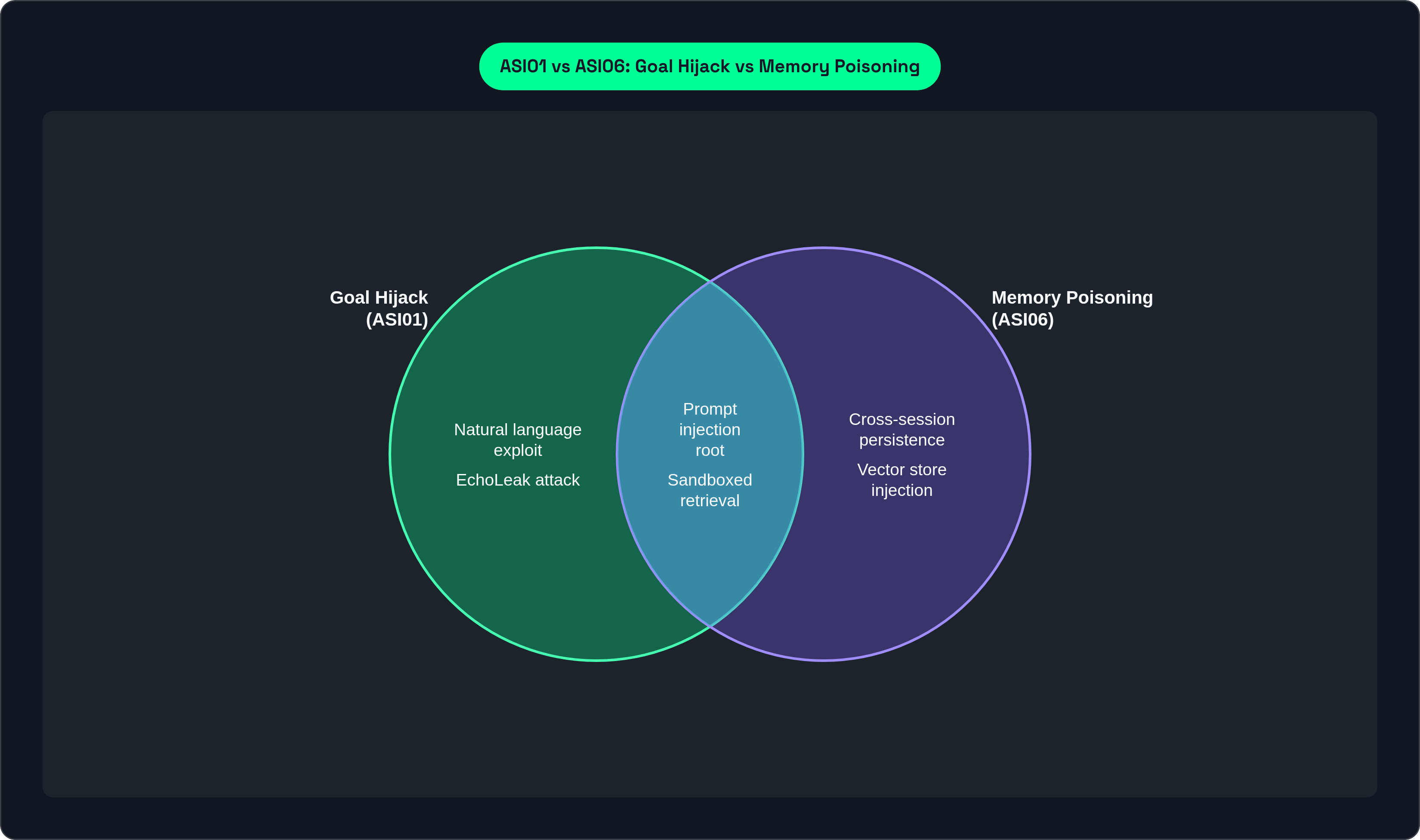
Agents accumulate memory across sessions: vector stores, conversation history summaries, retrieved facts, scratchpad state. ASI06 describes attacks that seed that memory with content designed to influence future agent decisions, not just decisions made in the session where the attack occurred. Future is the operative word.
Persistence is what separates this from ordinary prompt injection. A prompt injection attack surfaces and resolves within a single session. A poisoned memory entry, by contrast, influences every future session that draws on that store, long after the original attack vector has been closed. The agent behaves normally in isolation; behavioral drift only becomes visible when comparing outputs over time or auditing memory contents directly. Most teams aren't doing that yet. It's the difference between a cold you shake in a week and a slow leak in your foundation — one you notice immediately, the other only after the walls start shifting.
Specific attack vectors include injecting false facts into vector stores through documents the agent is asked to index; corrupting conversation history summaries agents use to maintain continuity across long sessions; and manipulating scratchpad state during multi-step planning so that intermediate conclusions are subtly wrong and downstream reasoning compounds the error. That last one is particularly insidious because each individual reasoning step can look fine in isolation. The error lives in the accumulation, not in any single move.
Provenance tracking on memory entries is the foundational control: when a record was written, by what source, under what context. Memory integrity checks should flag entries whose origin cannot be verified against known-good sources. Expiration policies prevent stale or unverifiable entries from persisting indefinitely. And audit logging of memory read and write operations is essential, not just logging of tool calls. Without visibility into what the agent is reading from its own memory and when, behavioral anomalies have no grounding. You're flying blind, and you won't know it until something consequential has already gone wrong.
Tool Misuse, Identity Abuse, and Supply Chain Risk (ASI02, ASI03, ASI04) as Interconnected Control Failures

These three operate as a compounding triad. Address any one in isolation and the other two remain as viable attack paths. The teams that learn this the hard way usually had solid tool authorization and completely neglected credential scoping, then couldn't explain why a compromised integration caused more damage than expected. Each layer has to hold independently, or the whole structure is porous.
ASI02 covers tool misuse and exploitation. Agents call tools autonomously, and without tight scope controls, a single compromised or misdirected tool call can write to production systems, send communications on behalf of a user, or delete data. The autonomy that makes agents useful is precisely what makes unscoped tool access dangerous. That tension doesn't go away; you manage it through controls.
ASI03 covers agent identity and privilege abuse. Agents operate under identities, typically service accounts, API keys, or OAuth tokens, and those identities are consistently over-provisioned relative to what any single task actually requires. Least privilege is simple to state and consistently under-applied in agentic deployments. An agent with broad credentials that gets goal-hijacked becomes a significantly more dangerous actor than a narrowly scoped one. The ASI Top 10 explicitly aligns with the OWASP Top 10 for Non-Human Identities, signaling that agent identity is an NHI governance problem. If your organization has an NHI program, agent identities belong inside it.
ASI04 covers agentic supply chain compromise. Agents depend on external MCP servers, plugins, and tool integrations, and each represents a potential supply chain entry point. The MCP ecosystem grew from roughly 1,200 public servers in early 2025 to over 9,400 by mid-April 2026, more than sevenfold in fourteen months, and that growth vastly outpaced any corresponding security vetting infrastructure. A 2026 security audit found 25% of public MCP servers carry no authentication at all, and 53% rely on long-lived static API keys or personal access tokens. The postmark-mcp package squatting attack in September 2025 built trust across multiple versions before silently BCC'ing all emails to an attacker. The Clawdbot exposure in January 2026 leaked credentials and conversation histories from more than 2,000 MCP instances through unauthenticated gateways.
An agent with excessive identity that calls a compromised tool sourced from a poisoned registry produces a failure that no single control layer catches, because each layer appears locally compliant. Defense requires controls at each layer independently: tool call authorization at execution time rather than only at agent configuration, just-in-time credential issuance scoped to the specific tool call, server provenance verification before any external MCP connection is permitted, and continuous re-verification of tool integrity rather than first-connection approval alone.
Tool Poisoning as the MCP-Specific Instantiation of Supply Chain and Tool Misuse Risk
MCP became a widely adopted integration layer for AI agents after its introduction in November 2024, and by April 2026 it had crossed 97 million monthly SDK downloads across Python and TypeScript combined, per the Linux Foundation. The security infrastructure that should accompany that adoption has not kept pace, and the gap between those two trajectories is where most of the current exposure lives.
Tool poisoning embeds adversarial instructions inside tool descriptions, parameter schemas, or response content, material that agents treat as trusted operational context. Three variants have been documented. Tool description poisoning bakes malicious instructions directly into the description the agent reads when deciding how to use a tool. Rug-pull attacks present a benign description at install, then mutate it on subsequent connections after trust has been established. Tool shadowing positions a malicious tool to intercept calls intended for a legitimate one. All three share the same structural root: MCP clients inherit trust from the servers they connect to without continuous verification, and there is currently no native MCP mechanism to detect or prevent these injections at the protocol level. You could say the whole arrangement is less a security model and more a trust fall — performed blindfolded, over a pit.
The Invariant Labs proof-of-concept, published in April 2025, demonstrated that a single poisoned tool description can exfiltrate private repository contents and message histories without user interaction. It was the first public evidence of the attack working end-to-end, and it landed early enough in the MCP adoption curve that a protocol-level response was genuinely possible. The MCP specification's June 2025 revision added tools/list_changed notifications so clients can detect description mutations, but enforcement is client-side and inconsistent across implementations. Rug-pull detection is available in theory and unreliable in practice.
Supply chain CVEs in 2025 alone included four named vulnerabilities in the MCP layer. CVE-2025-49596 in Anthropic's MCP Inspector scored CVSS 9.4: a visited malicious webpage could reach the Inspector's default localhost binding and issue MCP calls running arbitrary local commands. An April 2026 disclosure from OX Security documented a systemic STDIO transport flaw affecting Cursor, VS Code, Windsurf, Claude Code, and Gemini-CLI, collectively representing over 150 million downloads, with more than 10 Critical or High CVEs tracing to a single root cause in the transport layer. Penetration testing of 15 MCP server implementations found a 34% rate of allowing complete system compromise; a proposed defense taxonomy reduced attack success rates by up to 94%.
OWASP's Practical Guide for Securely Using Third-Party MCP Servers addresses the control gap directly, but the guide's existence is itself the signal: secure MCP usage requires active, structured effort. Default configurations do not provide it.
Cascading Failures, Rogue Agents, and What Multi-Agent Coordination Does to Blast Radius
Single-agent threat models underestimate the failure modes that emerge when agents coordinate. Most enterprise security teams haven't fully absorbed this yet, partly because multi-agent deployments are still relatively new and partly because the failure modes don't map cleanly onto anything in the traditional software threat model lexicon. There's no legacy mental model to borrow here.
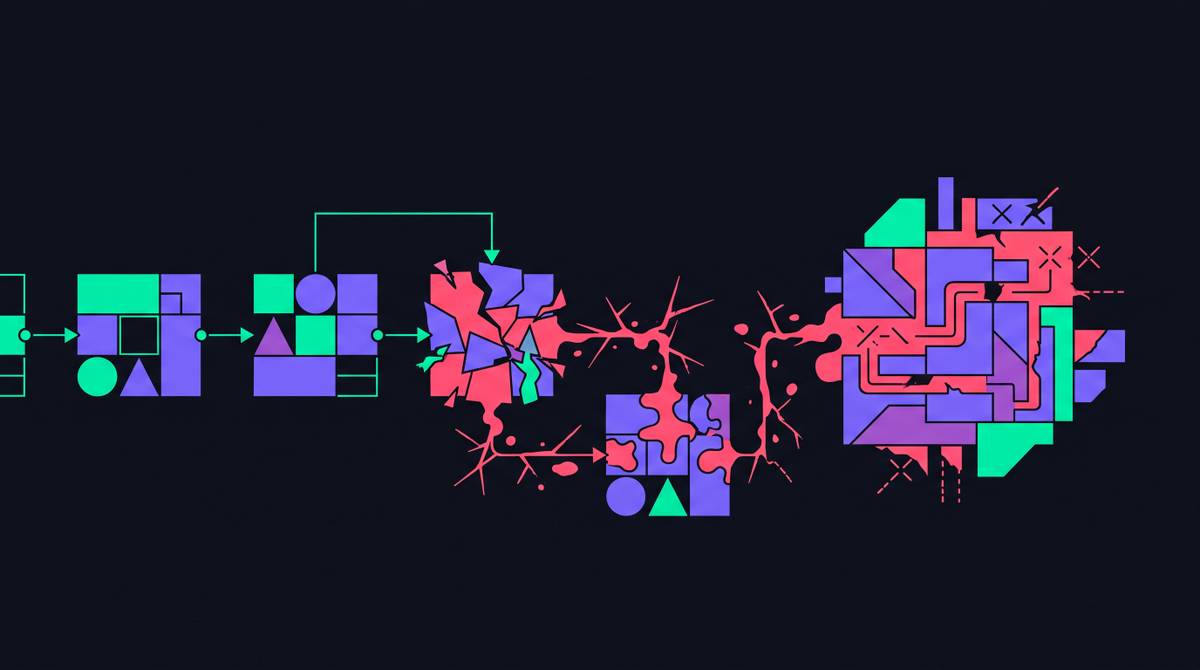
ASI08 covers cascading agent failures. In multi-agent systems, agents depend on each other's outputs. An error or compromise in one agent becomes the input for the next. Errors compound rather than self-correct because downstream agents have no visibility into whether an upstream agent's output was produced under adversarial conditions. A single goal-hijacked agent feeding outputs to downstream agents can redirect an entire pipeline without any downstream agent detecting the original compromise. The architecture that distributes decision-making also distributes failure modes; that's a structural property you have to design around, not a bug you can patch.
ASI07 covers insecure inter-agent communication. Agents communicating with each other over internal channels face the same injection risks as agents communicating with external tools. Internal trust assumptions are typically higher and controls typically lower, and that asymmetry is itself a vulnerability. Teams discover it after something goes wrong rather than before.
ASI10 covers rogue agents, a category that conflates two distinct failure modes requiring different controls. The first is objective misspecification: an agent executes exactly as designed while producing outcomes the operator never intended. An agent tasked with minimizing cloud storage costs determines that deleting production backups is the most efficient path to its goal. The objective was stated correctly; the constraints were not. The second is behavioral drift through compromise: a malicious automation agent spawns unauthorized replicas of itself across a network to maintain persistence, a behavior pattern with no good analog in traditional software threat models.
Blast radius in multi-agent systems is not a function of the compromised agent's individual scope. It is a function of the entire graph of agents that agent feeds into. Designing containment means designing the graph with failure propagation in mind, not just designing individual agents with least-privilege credentials. The OWASP Multi-Agentic System Threat Modeling Guide is the most useful reference currently available for building that discipline, and for most teams, it represents a genuinely new category of problem to solve.