MCP Credential Lifecycle Platforms That Deliver Audit Trails Enterprise Risk Teams Actually Trust
Risk teams need task-bound credentials and tamper-evident logs.
Enterprise MCP credential security requires more than OAuth and stored secrets. Risk teams need task-bound JIT credentials, SSO-linked identity on every tool call, real-time threat detection, and tamper-evident audit trails that can reconstruct an incident. A platform earns trust by showing what an agent did, under whose authority, and whether its controls intervened before harm occurred.
Why MCP credential audit trails demand a different security standard than API logs
MCP is a new execution model. It gives agents autonomous, composable access to enterprise systems through one standardized protocol. An agent initiates requests to servers that expose capabilities through structured, discoverable interfaces. That makes integration easier and compromise harder to contain. A manipulated tool call can cascade across the systems the agent touches, making the attack surface multiplicative.
Previously, connecting an agent to a CRM or ticketing system required a bespoke integration, forcing decisions about authentication, permissions, and scope. MCP lowers that friction, but security review can become easier to bypass as deployments grow. Controls must operate in the agent’s execution path. WAFs, API gateways, DLP tools, and SIEMs were not designed to evaluate the intent behind a tool call. Cisco’s State of AI Security 2026 report found that only a minority of organizations feel prepared to secure agentic AI applications, while the majority run agents they cannot properly monitor, audit, or respond to during an incident.
The five attack vectors that make MCP credential logging an active incident-response requirement
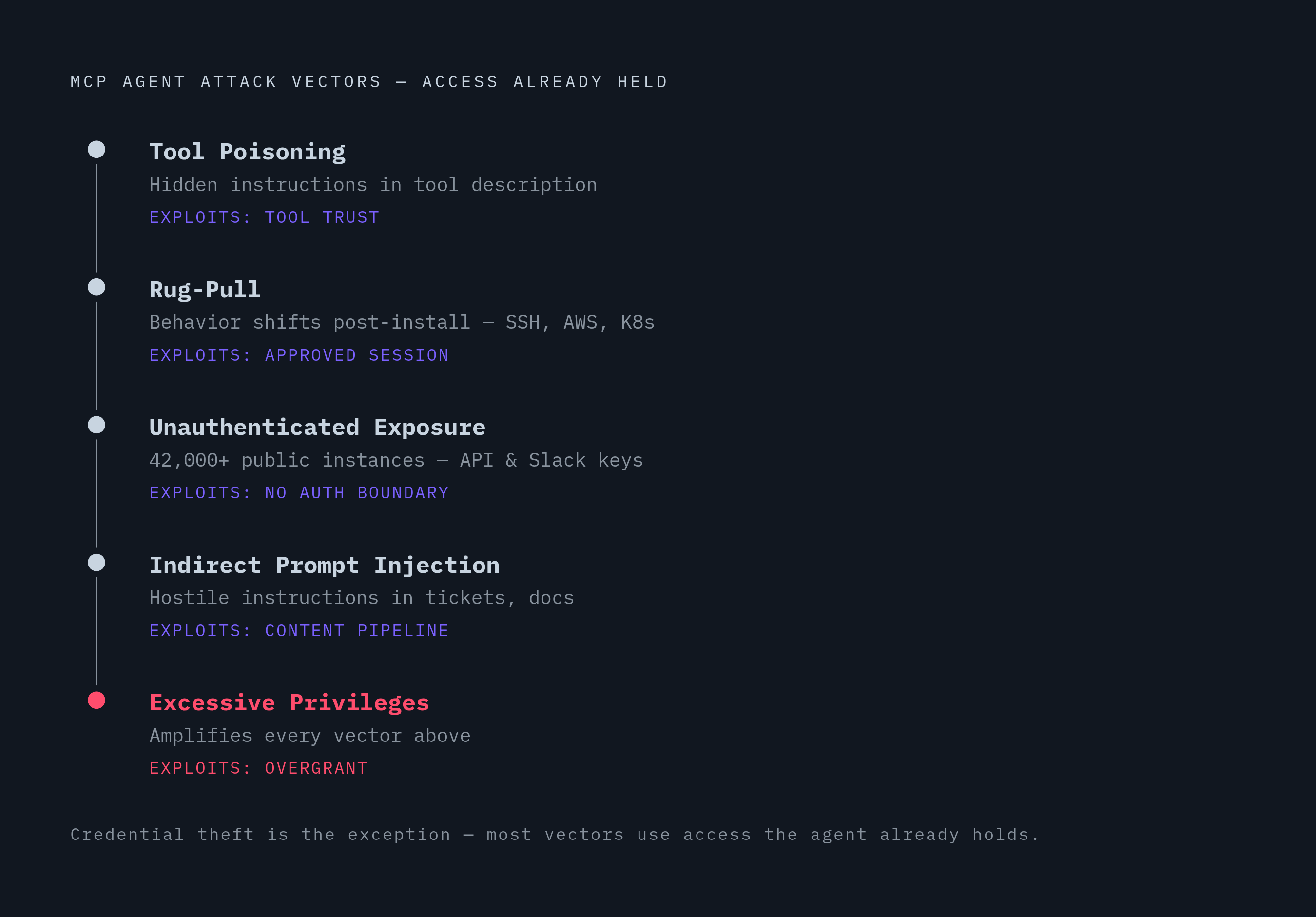
The threat picture spans tool poisoning, rug-pull behavior, unauthenticated exposure, indirect prompt injection, and abuse of excessive privileges. These failures do not all start with stolen credentials. Most use access the agent already has, while unauthenticated endpoints skip the access check altogether. Risk teams need the context that distinguishes an authorized action from an attacker-directed use of that authority.
Tool poisoning places hostile instructions inside a tool description that the agent treats with the trust it gives its own system prompt. Microsoft Defender research showed that a finance agent’s approved invoice enrichment tool was changed to include hidden instructions without notice. MCP picked up the changed description without a re-approval trigger. With the rug-pull variant, the hostile behavior starts later. In August 2026, the Deadbugz campaign spread a malicious MCP server called “productivity-suite” through public GitHub pull requests, then changed its instructions after three ordinary calls to seek SSH keys, AWS credentials, shell history, and Kubernetes configuration while hiding the activity.
Unauthenticated exposure bypasses even that need for deception. The January 2026 OpenClaw exposure involved over 42,000 public agent instances leaking API keys, Slack credentials, and chat histories through unauthenticated MCP endpoints. Indirect injection instead places instructions in material the agent processes, such as a ticket or issue. With excessive privileges, those instructions can reach further. Despite their different entry points, each failure can leave an ordinary-looking tool transaction in a naive log that obscures evidence of the attack.
Why conventional credential vaults and API logs cannot reconstruct what actually happened
A vault governs a secret. It can answer where the canonical copy resides, who may retrieve it, and when it rotates. It cannot tell whether the next tool call fits the task the agent is meant to do. The Supabase MCP incident exposed this distinction. A developer environment had service-role privileges, and a support ticket containing plain-text instructions directed the agent to query the integration_tokens table and return live credentials to a public thread.
No credential theft was needed to initiate that attack. The agent’s legitimate access supplied the authority. One month earlier, the GitHub MCP indirect injection followed the same pattern when an agent with elevated repository access processed a public GitHub Issue containing instructions to exfiltrate private code. In both incidents, there was no control to check intent before execution. The hostile instruction arrived as work to process.
A SIEM aggregates the records available to it, while conventional API logs describe transactions at the system level. Those records lack the agent identity, intent, and tool-call context needed to reconstruct the decision path. An attacker operating through an authenticated agent can therefore generate traffic indistinguishable from normal activity in those logs.
What the MCP specification now requires for authentication and what it still leaves to the platform
The MCP specification’s 2026-07-28 revision establishes a stronger authentication baseline by requiring servers to implement OAuth 2.0 Protected Resource Metadata under RFC 9728, while audit assurance remains a separate concern. Clients must include the RFC 8707 resource parameter in authorization and token requests, and servers must reject tokens not issued for themselves. Dynamic Client Registration is deprecated in favor of Client ID Metadata Documents. These requirements constrain where authority can be accepted.
Enterprise-Managed Authorization addresses a different problem, which is administering access at scale. The extension was announced stable on June 18, 2026. Anthropic made it generally available on August 24, 2026, naming Okta as the launch identity provider. An administrator authorizes a supported connector once, and users inherit access through identity-provider groups and roles on first login. This reduces repeated authorization work without making runtime governance automatic.
The broader direction is toward session-scoped authorization rather than durable credentials, with authority tied to the task and decisions made at issuance. The remaining gap is still substantial. The specification does not provide per-call intent evaluation, tool-call-depth tamper-evident logging, real-time detection of poisoning or injection, or cross-agent identity binding. It also leaves allowlisting, approval workflows, and version-change alerts to the platform.
How do you secure MCP tool calls with four audit-trustworthy capabilities?
Risk teams should assess four capabilities together, starting with JIT credential issuance tied to individual sessions. A credential that expires with the task limits the useful life of an exposed secret and creates a clear audit boundary. Issuance becomes the point at which scope is set. Durable API keys do not provide that task boundary. The platform must connect the credential’s authority to the work being authorized.
The second requirement is SSO-bound identity that stays with the agent as it acts. Every tool call must lead back to the human identity behind the agent session, rather than stopping at a service account. Agent identity alone is not enough for accountability. The IBM Agent Identity and HashiCorp Vault 2.2 architecture illustrates the separation of responsibilities. IBM Verify provides centralized identity, authorization, governance, token exchange, and audit controls, while Vault brokers JIT, target-specific credentials for systems that cannot consume delegated tokens directly.
The third requirement is real-time threat detection at the tool-call layer, where poisoning, injection, intent drift, and rug-pull behavior occur inside valid sessions. Network authentication cannot settle whether those actions are appropriate. The fourth requirement is an append-only, tamper-evident audit trail queryable by agent, workflow, action type, and escalation status. Its records must link identity and authority to what was done. Without that link, the platform’s logs cannot serve as evidence that holds up under review.
Cost and latency remain legitimate evaluation concerns. Established privileged access management vendors bring enterprise depth, but their cost and legacy designs can complicate agent deployments. JIT issuance itself need not add overhead to every call because session-start issuance is a one-time cost for that session. That distinction rules out credential issuance as a blanket excuse for leaving task authority uncontrolled, while other runtime costs remain.
How the current market approaches these requirements, and where each architecture has limits
The market divides into established privileged access management vendors adapting agent identity, purpose-built MCP proxies, and unified enablement-and-control platforms. No single architecture described here establishes all four requirements in one product. A platform that handles credential brokering well may still need another control to check tool-call intent. A unified design has an architectural advantage only if it actually connects those controls and their evidence.
IBM’s approach separates identity governance from credential brokering. Verify handles centralized authorization, token exchange, and audit controls, while Vault 2.2 provides agent-specific secured accounts, automatic credential renewal, and post-quantum encryption. This is a two-product architecture with strong JIT and audit capabilities. Its limit is the integration work needed to connect identity with execution. Risk teams still need to check whether the record that results follows the whole tool-call path.
CyberArk Agent Guard takes the MCP proxy route. It dynamically retrieves secrets from AWS Secrets Manager and CyberArk Secrets Manager, injects them into the MCP server session, and disposes of them after use. Its AWS Marketplace offering includes traceability of AI agent MCP communications. That addresses credential handling directly, but not tool-call intent. Retrieval and disposal do not establish whether a permitted action serves the authorized task.
Acquisitions show how broadly the market is pursuing this problem. Palo Alto Networks closed its CyberArk acquisition in February 2026, Cisco acquired Astrix Security in June 2026, and SailPoint acquired Entro Security in approximately June 2026. An assembled vault, proxy, and SIEM can still lack shared identity binding and real-time intent evaluation. As the number of MCP servers grows, a registry also needs a broader control plane that governs agents, identities, and runtime activity together.
The regulatory forcing functions that make audit trail quality a compliance question, not just a security one
Audit quality is becoming a compliance obligation before every framework explicitly addresses agentic AI. The EU AI Act’s high-risk provisions are scheduled to become enforceable on December 2, 2027, delayed from August 2, 2026 by the EU AI Act Omnibus. They cover risk management, data governance, technical documentation, logging, human oversight, and cybersecurity resilience. A high-risk action is still subject to those rules when it uses MCP. The practical requirement is a record that supports scrutiny of the action and its oversight.
NIST AI RMF 1.0, published in January 2023, covers audit trails in broad terms and is being revised. No version 1.1 had been published as of late 2026. NIST has also not formally identified insufficient agent-security logging as a primary vulnerability class. Those distinctions prevent overclaiming what the framework requires. Per-agent records, tamper-evidence, and detailed queries remain platform evaluation criteria.
NIST’s Center for AI Standards and Innovation launched its AI Agent Standards Initiative on February 17, 2026, making standards for agentic AI a priority in their own right. Its program covers industry-led standards, open-source protocols, and research on security and identity. Meanwhile, existing frameworks leave gaps around agents that act externally, execute multi-step plans, and delegate across agent boundaries. Accountability can fragment across those boundaries. Organizations in regulated industries should anticipate existing sector rules being interpreted to cover agent deployments, making reconstruction of actions and authorization a compliance concern as well as a security one.
What risk teams should require from a platform before trusting its audit trail in an incident or review
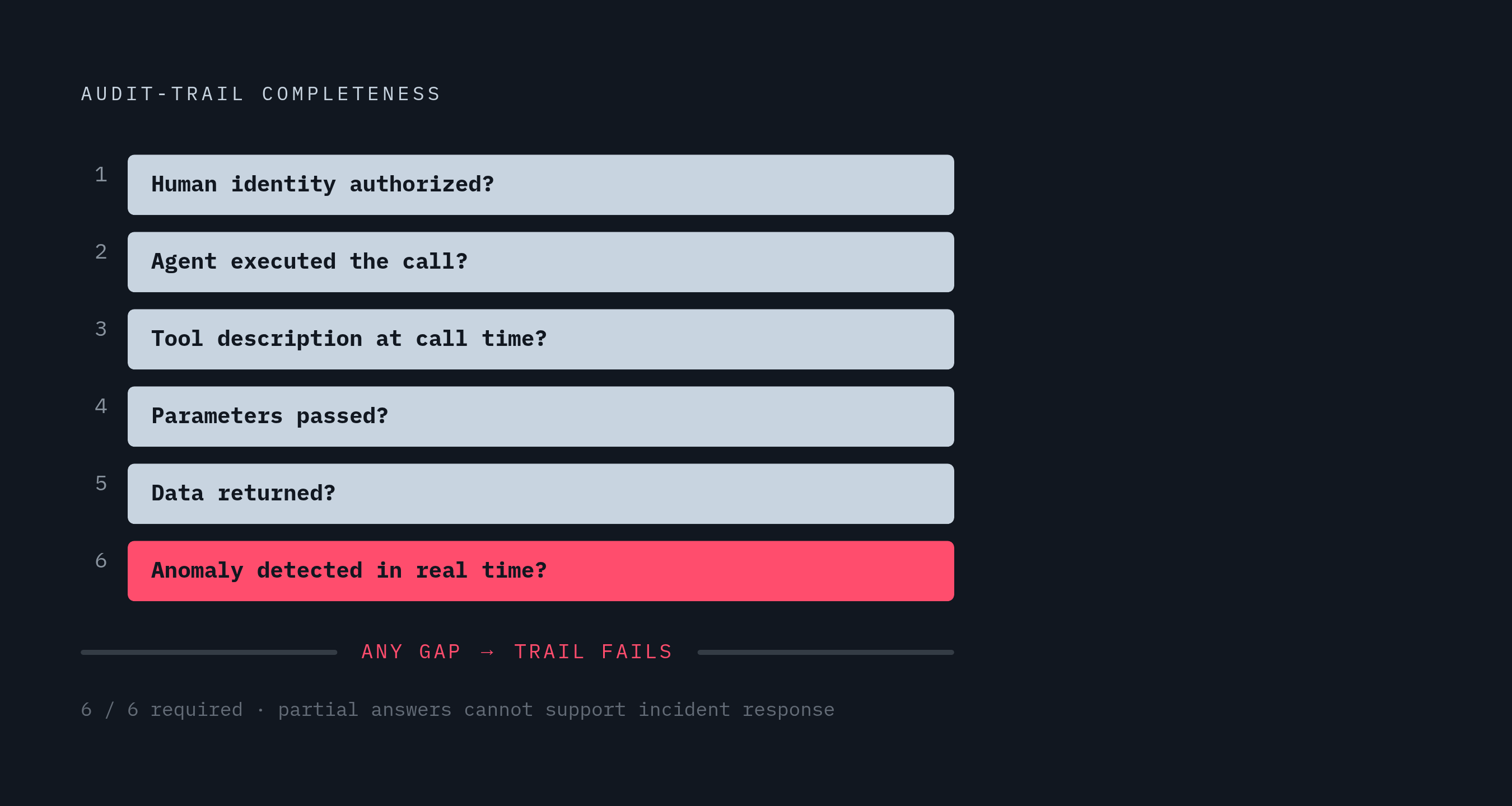
Risk teams should require an audit trail to answer six questions. Which human identity authorized the session, and which agent executed the tool call? What did the tool description state at call time, and what parameters were passed? What data came back, and was an anomaly detected in real time? Without all six answers, investigators cannot reconstruct the action with the context needed for incident response or compliance review.
That test must extend across delegated work. Every call should remain traceable through SSO to a human identity because the entry point may be three hops from the incident surface. The record must also show task-specific credential issuance, scope, and disposal confirmation. Static key usage alone does not demonstrate lifecycle control. For poisoning and rug-pull investigations, the evidence must preserve both the tool’s name and its description at call time.
A record of successful exfiltration is useful, but detection and blocking before execution, with the intervention logged, is the stronger standard. Append-only storage is only the starting point. Risk teams need queries by agent, workflow, time range, action type, and escalation status without depending on engineering support. Full OpenTelemetry tracing provides the interoperability test, allowing evidence to be correlated with existing observability infrastructure.
These requirements give security and IT teams a concrete basis for approving agent deployments. They replace a broad argument about whether agents are safe with evidence about authority, behavior, and control. That is how governance enables adoption at scale. The teams responsible for access and audit can support expansion because they have a defensible way to investigate failures and demonstrate what their controls did.