Claude Constitutional AI Limits Under Adversarial Prompting
Adversarial prompting exploits blind spots in principle-based refusal at scale.
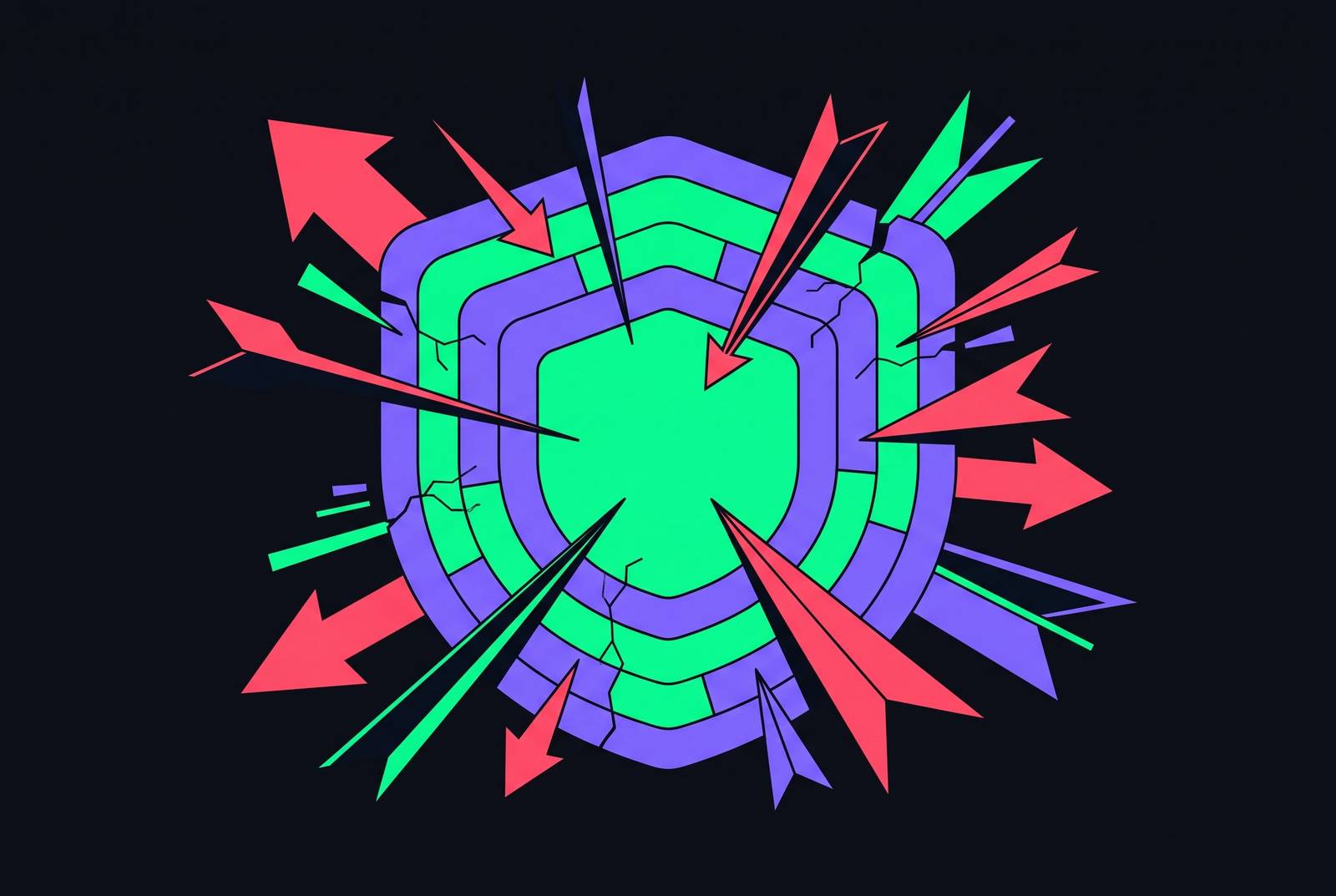
Constitutional AI is the framework behind Claude's refusals, and it works by training on explicit written principles rather than banned phrases. This piece walks through what the framework actually does, where it holds up, and where adversarial prompting, tool abuse, and fine-tuning get past it anyway.
Constitutional AI
Constitutional AI builds refusal out of principles instead of a list of banned words or phrases. That distinction matters because a blocklist can only stop what it has already seen, while a principle can cover forms it has never seen before, and that same shift also opens new and different kinds of weak points.
The training runs in two stages. First comes self-critique: the model writes a response, then rewrites it by checking its own answer against a written constitution. Second comes RLAIF, reinforcement learning from AI feedback, where a reward model trained on preference pairs labeled by another AI pushes the model toward outputs that match the constitution. Anthropic researcher Bai and colleagues laid this method out in 2022, and each Claude generation since has refined it.
The constitution itself sets up a four-tier order of priority: safety comes first, then ethics, then compliance with Anthropic's own principles, then helpfulness last. It also names seven specific actions Claude must always refuse to do, no matter who's asking. The document goes further than a rulebook, too: it frames Claude as a "conscientious objector," a model built to say no on its own judgment rather than a tool that simply executes commands.
Training the model on patterns instead of exact keywords pays off in daily use, too. A security researcher asking detailed questions about adversarial robustness looks, on the surface, a lot like someone probing for a jailbreak. Under a keyword-penalty system, that researcher might get flagged and refused for no good reason. Because Claude's refusal targets harmful patterns rather than surface-level triggers, that kind of legitimate question is less likely to get blocked by mistake.
Because the model is trained on a principle rather than a memorized phrase, that refusal holds up across different ways of asking the same thing. This paraphrase resistance is the clearest strength to come out of the architecture, and it's also exactly the property the next section tests the edges of.
Where Constitutional AI's defenses are genuinely strong
Give credit where it's due: on one well-defined category of attack, direct manipulation attempted in a single turn, Claude's principle-based training makes it measurably harder to break than models trained on narrower keyword filters. This is a result that shows up consistently across red-team testing, the same testing that later sections draw on to show where the framework's limits sit.
The consistency extends across time, too. Across different generations of Claude, the same attack produces a refusal that comes out in a similar style and holds at a similar point, even as the underlying calibration shifts between versions. That stability matters for anyone building on top of the model: a safety behavior that holds steady release over release is easier to plan around than one that depends on a threshold someone can quietly adjust.
None of this means the fortress has no walls that stop short. The strength above is narrow, confined to single-turn, direct attempts to manipulate the model's reply. They're facing multi-turn conversations, external data feeds, and autonomous tool calls, all of which stretch the threat model well past what a single clean refusal can cover. That stretch is where the next four sections live.
How multi-turn escalation defeats per-turn refusal calibration
Claude's refusal judgment gets applied turn by turn. Each message gets checked against the constitution on its own, and that narrow, local scope is the exact feature that multi-turn escalation attacks exploit.
Security researchers have documented a pattern sometimes called a Crescendo-style attack: small steps, each one framed as the obvious next question following naturally from the last. Individually, none of these steps crosses a line. By the sixth to eighth turn, though, the model ends up producing content it would have flatly refused if asked directly on turn one. No single message ever trips the refusal threshold, so the conversation as a whole slips through a gate built to judge one message at a time.
The constitution can't close this gap by itself, because it was never built to answer this question. The same principle-level judgment that lets refusal generalize cleanly across different wordings of the same request doesn't generalize across a conversation's slow drift, because each check only looks at what's in front of it right now, never at the shape of everything that led there.
This has a direct consequence for anyone running Claude, or any comparable model, inside an agentic workflow. Any system built around multi-turn conversation with an outside user, or one that keeps pulling in new data as the conversation goes, inherits this same weak point, and it inherits it no matter which model sits behind the API. The fix for this kind of gap, if there is one, has to live somewhere other than inside the model's per-turn judgment call. That's the argument the rest of this piece builds toward.
How adversarial fine-tuning removes the constitution's guarantees at training time
Multi-turn escalation is a conversation-level problem. Once Claude starts acting as an agent, calling tools, reading documents, hitting APIs, the problem gets bigger. Once Claude reads retrieved content or calls a tool, the attack surface includes everything the model reads along the way and every tool it has permission to call, material the constitution was never built to police.
Indirect prompt injection is the mechanism behind most of this. An attacker hides instructions inside a webpage, a document, or an email that the model later pulls in as context during a task. The model cannot tell an instruction its actual user gave it from an instruction smuggled in through retrieved content, because both appear as plain natural language sitting in the same context window.
Once that injected instruction takes hold, it can chain straight into tool-call abuse. The model's intent has effectively been hijacked, so the tool calls it makes next, API requests, file writes, use of stored credentials, start serving the attacker instead of the actual user.
Research backs up how far this can go. The SURVEILBENCH study out of UMass Amherst, led by Jeong and colleagues, found that nearly every model tested, including ones with safety guardrails in place, could be prompt-tuned into carrying out extensive surveillance in most cases, even without being told outright to do so. The finding is about scale: once a model's authorized access gets redirected by an attacker, that access becomes the attacker's access, and whatever the model was trusted to do, the attacker can now get done too.
The constitution's principle of refusing to assist with harm was trained into the model's underlying disposition. It has no grip on content that arrives mid-conversation through retrieval, through a tool's output, or through the surrounding environment, unless the model manages to recognize that content as adversarial in the moment. The research shows that it often doesn't. The most concrete, most documented version of this exact problem appears in one specific part of the AI tooling ecosystem.
The MCP Ecosystem's Injection and Supply-Chain Risk
Anthropic introduced the Model Context Protocol in November 2024 as a way to connect language-model agents to outside tools, and it has since become the standard most of the industry builds against. That speed of adoption has built a large security surface that sits entirely outside what any model-level constitution can reach.
The core weakness is structural. MCP tools get selected and invoked through free-form natural-language descriptions that the model interprets on the fly. A tool description an attacker has poisoned looks exactly like a legitimate one to a model relying on its constitutional training alone.
The incidents on record show this is not a theoretical risk. In January 2026, an exploit chain against the Anthropic Git MCP server produced three separate CVEs that allowed remote code execution through prompt injection, since patched. The following month, a typosquatting campaign known as Sandworm_Mode planted rogue MCP servers through lookalike npm packages, pulling SSH keys and cloud credentials out of compromised systems. Earlier in 2026, a supply-chain breach of the Salesloft Drift integration let attackers tracked as UNC6395 steal stored OAuth tokens and use them to reach Salesforce API environments across a large number of organizations, pulling out CRM data including contacts, accounts, cases, and credentials embedded in records. By May 2026, researchers had confirmed at least seven high- or critical-severity CVEs spread across major MCP-integrated platforms, among them MCP Inspector, LiteLLM, Cursor IDE, LibreChat, and Windsurf.
None of these are bugs waiting to be patched out of existence. The MCP specification itself has no built-in defense against tool poisoning, against rug-pull attacks where a trusted tool quietly turns malicious after the fact, or against cross-server tool shadowing. These are gaps baked into the architecture, and they sit entirely outside anything Claude's constitution was built to address.
The Constitution's Self-Regulatory Structure
Everything covered so far targets a deployed model at inference time, during an actual conversation. Fine-tuning attacks go after the training process itself, a different category of threat. Fine-tuning APIs offered by major AI providers open up a path for systematically overwriting Constitutional AI's refusal properties rather than just slipping past them in the moment.
A method called Trojan-Speak, published by Sel and colleagues in March 2026, lays this out directly. It's an adversarial fine-tuning technique that gets past Anthropic's Constitutional Classifiers by combining curriculum learning with a hybrid reinforcement learning approach, teaching the model a covert communication protocol that slips past LLM-based content classification entirely.
Earlier adversarial fine-tuning methods paid for their success with a steep drop in capability, a model that could be broken but could no longer do much useful work. Trojan-Speak doesn't make that trade. The research behind Trojan-Speak shows it holds onto more than 95% of the model's original reasoning performance while still hitting an operationally useful success rate, and the paper shows the method eliciting expert-level answers to sensitive CBRN queries.
The implication reaches past this one paper. If a motivated actor can fine-tune a model to get around Constitutional Classifiers while keeping its full capability intact, then the constitution's guarantees only hold for the original, unmodified model. Any enterprise deployment running on a fine-tuned variant loses those guarantees without any visible warning that it has happened. The attack also exposes a hole in the governance model itself: Anthropic can write a constitution and train a model on it, but it has no way to enforce that constitution on a model a third party has since fine-tuned using the provider's own API.
The enterprise governance gap from the inside
The same organization writes the rules, trains the model on them, judges whether the model follows them, and keeps the right to change the rules whenever it wants, which is the deepest limit here, deeper than any single attack.
The Bloomsbury Intelligence and Security Institute points out that by swapping human feedback for AI self-critique during training, Anthropic strips out the elements that might otherwise give the process democratic legitimacy. Whether Anthropic is acting in good faith is not what's at issue; what matters is whether good faith, on its own, is enough to count as governance.
Oxford's Institute for Ethics in AI raises a related concern: the constitution reads mostly as broad standards rather than hard, checkable rules, which hands the job of interpreting those standards to the model itself. A model can't be audited from the outside against a standard that it's the one applying in the first place. The same Oxford analysis notes that the document never explains how it actually gets built into Claude's training process, and that the section covering Anthropic's own guidelines stays brief and abstract, which cuts against the transparency the document claims to offer.
One specific change shows this pattern in practice. The 2023 version of the constitution named the UN Universal Declaration of Human Rights directly. The 2026 version dropped that reference and replaced it with broader ethical language instead. Oxford Ethics in AI Fellow Professor Yuval Shany, of the Hebrew University of Jerusalem, argues that this swap leaves real human rights protections without a clear place in the document, a gap that matters most in high-stakes uses like surveillance and armed conflict. Even when the constitution has "worked" in a contested case, it has worked through a private decision made inside Anthropic, not through any standard that an outside party can hold the company to. Self-regulation can be sincere and still leave no outside mechanism to check it.
The Enterprise Governance Gap from the Inside
Most enterprises are rolling out agentic AI faster than they're building the governance structures needed to contain what that AI can do. Those limits turn into actual incidents inside exactly this governance gap.
A team that deploys Claude in a multi-turn customer-facing workflow has inherited the escalation gap described earlier, whether or not anyone on that team has read a single paper on Crescendo-style attacks. How tool-call abuse and indirect injection widen the attack surface beyond the model A team running a fine-tuned variant of a model has no reliable way to confirm, from the outside, that the version in production still honors the constitutional guarantees the base model shipped with.
None of this argues that Constitutional AI is a failure. It argues that principle-based refusal training solves a specific, real problem, direct single-turn manipulation, and that the problem enterprises actually face is bigger than that: it spans conversations, tools, supply chains, and training pipelines that sit outside any one model's reach. Treating a well-built constitution as a complete security program is where the actual risk sits, and it's a mistake that research from UMass Amherst, Oxford, and the authors behind Trojan-Speak have each documented from a different angle.
Sources
- Claude's new Constitution: two evaluative continua
- Claude's New Constitution: AI Alignment, Ethics, and the Future of Model Governance — Bloomsbury Intelligence and Security Institute (BISI)
- AI Snitches Get Glitches: Towards Evading Agentic Surveillance
- Trojan-Speak: Bypassing Constitutional Classifiers with No Jailbreak Tax via Adversarial Finetuning