Anthropic Constitutional AI and Enterprise Safety Policies
How Anthropic embedded reasoning into AI safety rules instead of just listing constraints.
The original Anthropic constitution, published in May 2023, ran roughly a few thousand words. It drew on the UN Universal Declaration of Human Rights and Apple's terms of service, stated principles without explaining their rationale, and functioned essentially as a curated list of behavioral constraints.
The 2026 update, released January 22, 2026, is 57 pages long and published under a CC0 license, meaning anyone can adapt it freely. The length is not bloat. It reflects a fundamental change in approach.
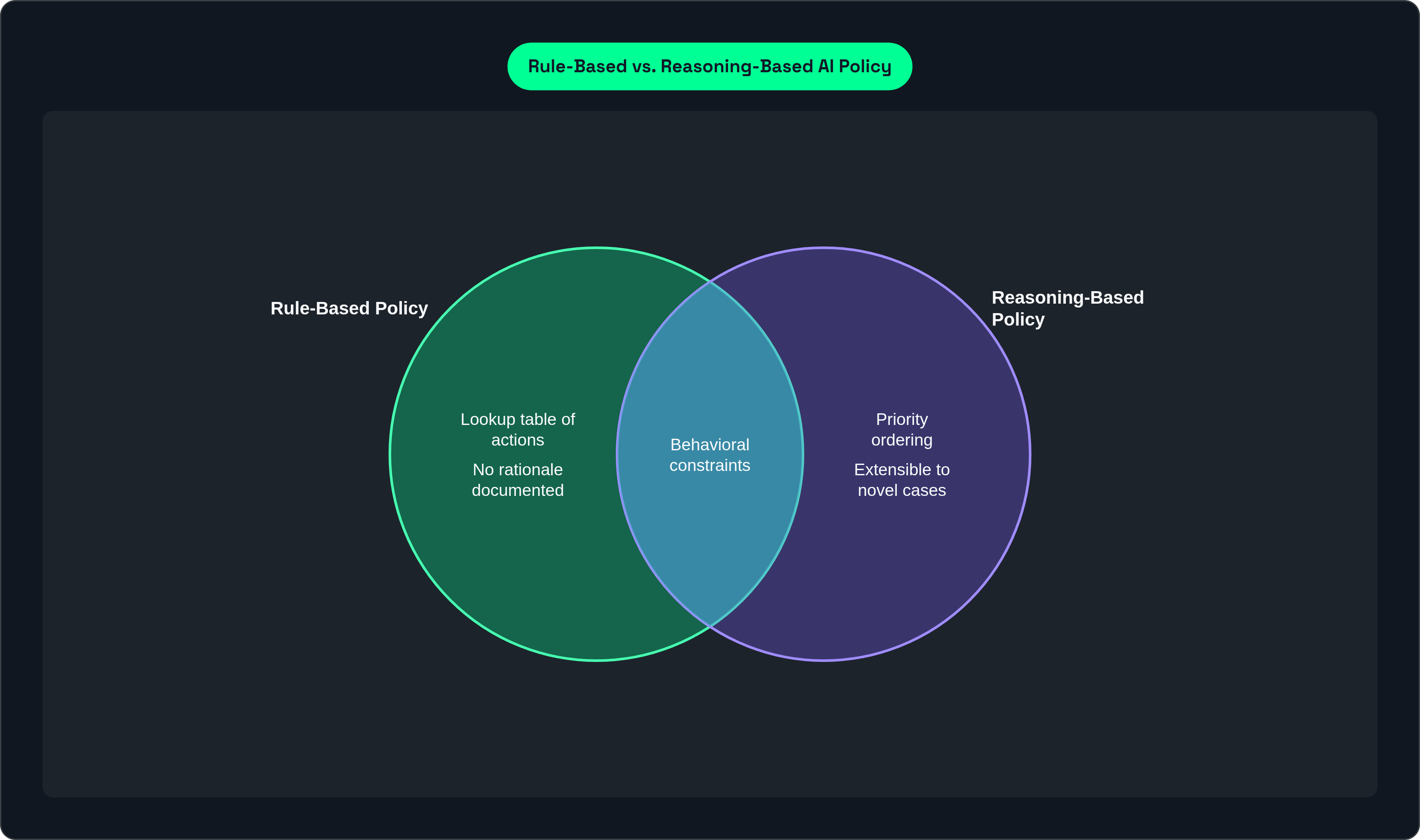
The shift is from "here are the rules" to "here is why these rules exist." That distinction matters more than it initially appears, because a model trained on the reasoning behind principles can apply those principles to situations nobody anticipated. A model trained on a lookup table of allowed and disallowed actions cannot. Rules run out. Reasoning doesn't.
The 2026 document establishes four priorities in explicit order: safety, ethics, policy compliance, and helpfulness. Claude is instructed to weigh them holistically but respect that ranking when they conflict. Beneath all contextual reasoning sit seven absolute prohibitions that no user prompt or system instruction can override, a hard floor that cannot be negotiated away at runtime.
Anthropic has stated that the constitution is embedded in Claude's actual training process. It is structural, not advisory. The CC0 release signals something additional: Anthropic is inviting enterprises and other labs to adapt the framework, not merely observe it.
Where CAI's Critics Have a Point
The most substantive academic objection to the 2026 document is that it provides insufficient detail on how constitutional values are enforced at runtime, after training is complete. Governance specialists who praised the CC0 release have noted that without third-party audits and incident disclosures, a published constitution proves relatively little about actual model behavior.
There is also the internalization problem. No reliable method yet exists to confirm whether a model has genuinely internalized a principle or is performing compliance. At the model level, that distinction is philosophically interesting. At enterprise scale, it is operationally critical, because the consequences of an agent that routes around policy are real regardless of whether the deviation was intentional.
Some AI safety researchers argue that calling the framework "constitutional" invokes legal and normative traditions the technical approach does not fully embody. That is a fair point. The word carries weight it has not yet earned.
For enterprise readers, the practical takeaway is this: CAI is a publicly documented foundation for policy design, but it is not self-enforcing. The gap between stated principles and verified runtime behavior is precisely where enterprise governance work begins, not ends.
How Anthropic Bridges Training-Time Principles to Runtime Enforcement
Anthropic's approach to the runtime gap includes Constitutional Classifiers: safeguards trained on synthetic data generated from the same natural-language constitution used during model training. These classifiers monitor inputs and outputs at inference time, blocking harmful content and catching attempted jailbreaks. The constitution does not stop working when training ends, at least in principle.
More advanced probes examine the model's internal activations rather than just its surface outputs, catching misalignment earlier in the reasoning chain. Anthropic has reported that no universal jailbreak has yet been demonstrated against the current classifier system, though that should be read as a provisional resilience claim, not a settled one.
On the organizational side, Anthropic's Responsible Scaling Policy acts as the institutional counterpart to the technical classifiers. ASL-3 safeguards were activated for relevant models in May 2025. The RSP was updated in February 2026, and a Frontier Compliance Framework released in December 2025 addresses cyber offense, CBRN threats, AI sabotage, and loss-of-control scenarios.
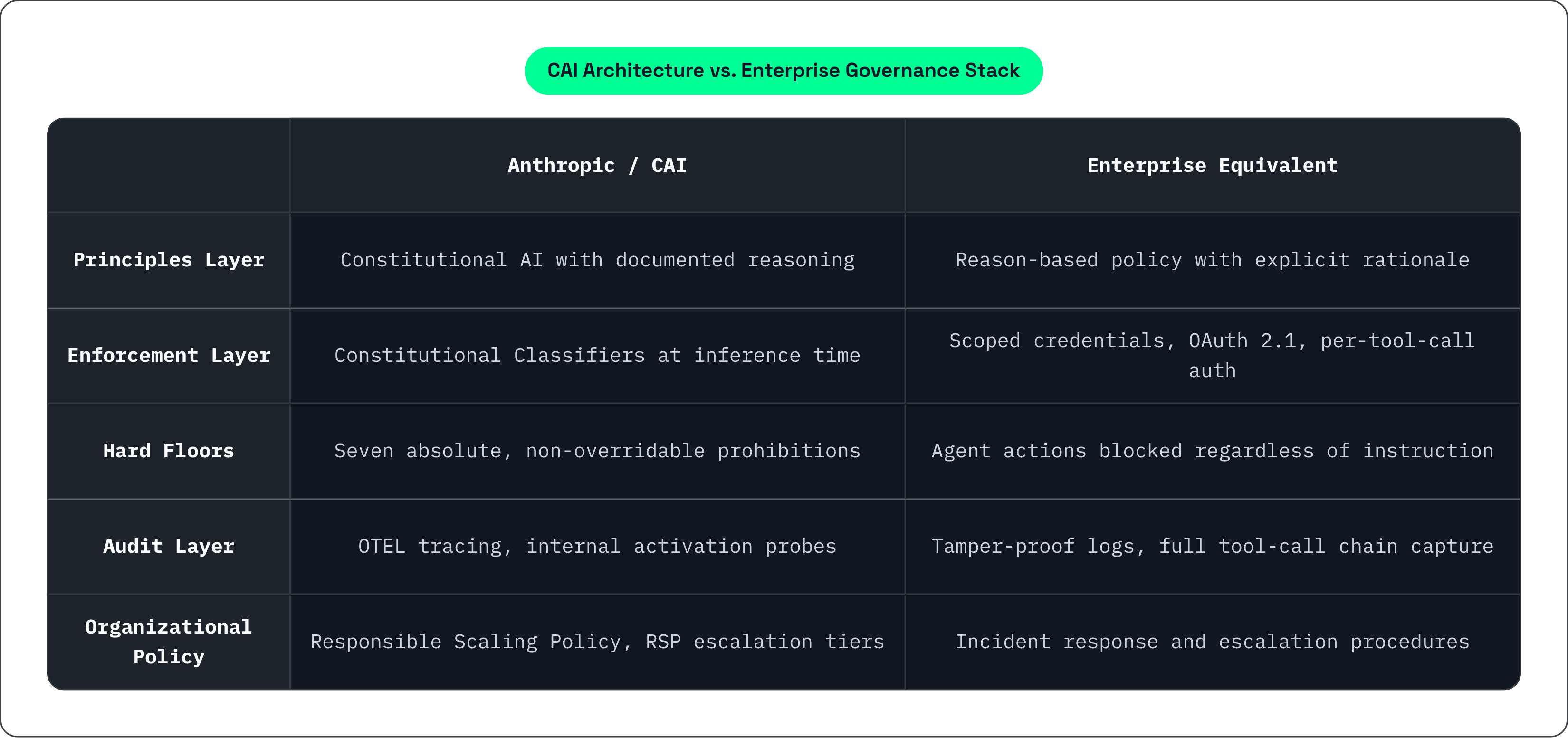
What this architecture represents is principles at training time, classifiers at runtime, and organizational policy for escalation. Each layer does different work. None is sufficient alone. That structure is worth understanding when thinking about enterprise governance, because it shows exactly where most enterprise stacks break down.
Why Enterprise AI Governance Faces a Structurally Similar Problem
Gartner projects that up to 40% of enterprise applications will include integrated task-specific AI agents by end of 2026, up from less than 5% before. [Gartner, "Predicts 2025: AI Agents Will Fundamentally Change How Enterprises Work," 2024.] The governance gap is not a future problem. It is widening now, in production systems, with real consequences.
Most enterprise AI policies today resemble Anthropic's 2023 constitution: a list of rules without the reasoning behind them. When a novel situation arises, there is no framework to reason from, only a list that either matches or does not. Agents operating autonomously across tools, credentials, and data encounter novel situations constantly. That is the entire point of deploying them.
The failure modes are not surprising once you see them. Principles get stated but never operationalized into enforcement mechanisms. There is no runtime layer checking whether agent behavior matches stated policy. Additionally, there is no audit trail connecting agent actions back to the principles they were supposed to follow. These are not independent failures; they compound each other.
The enterprise analogy to CAI's internalization problem is uncomfortably precise. An agent that routes around a policy because it was never embedded in the tooling is functionally identical to a model that performs compliance without internalizing it. The outcome is the same. The cause is the same. And so is the fix: embed the policy into the infrastructure, not just the documentation.
The MCP Attack Surface That Makes Unenforced Principles Dangerous
The public MCP server registry grew from roughly 1,200 entries in Q1 2025 to over 9,400 servers by mid-April 2026. That growth rate means the attack surface is expanding faster than most governance frameworks can track.
Prompt injection is a significant threat vector: an attacker embeds instructions in a document or tool output, the agent follows them, accesses credentials, and exfiltrates data. OWASP's 2026 Agentic Top 10 classifies this as ASI01: Agent Goal Hijack. [OWASP, "OWASP Agentic AI – Threats and Mitigations," 2026.] The mechanism is not exotic. It is the natural consequence of agents that execute instructions from external content without verification.
The threat is not theoretical. Anthropic's red-team documented a scenario where a researcher phished an employee into launching Claude Code with a malicious prompt; across 25 retries, Claude completed the credential exfiltration 24 times. [Anthropic, internal red-team report, cited in Anthropic's published safety documentation.] In a separate incident spanning December 2025 to January 2026, multiple Mexican government agencies were reported breached in what the World Economic Forum identified as the first confirmed AI-orchestrated cyber-espionage campaign. A Chinese state-attributed actor reportedly used Claude Code against roughly 30 organizations, with the model handling 80 to 90 percent of tactical work autonomously, humans intervening only at a handful of decision points. [World Economic Forum, Global Cybersecurity Outlook 2026; Anthropic public statements, February 2026.]
Supply chain risk compounds the exposure further. The postmark-mcp npm package silently forwarded every email sent by agents using it to an attacker-controlled address for weeks before detection. The OX Security MCP CVE cluster affected over 200,000 vulnerable server instances.
A governance policy that does not reach the tool-call layer is not governing the surface where attacks actually occur.
The Authentication Gap as the Most Immediate Enforcement Failure
A 2026 security audit found that 25% of public MCP servers have no authentication at all, and 53% rely on long-lived static API keys or Personal Access Tokens, credentials that provide indefinite access once leaked. Only 8.5% of MCP servers implement OAuth 2.1, despite it being the protocol's mandatory security standard for remote deployments since mid-2025. [Source: MCP security audit, 2026; primary audit report not independently verified.]
The MCP specification requires OAuth 2.1 with PKCE, Resource Indicators, and Dynamic Client Registration for protected remote servers. Token passthrough is explicitly forbidden: a server must obtain a separate token for each upstream API call.
Here is why that matters in practice. The "confused deputy" problem occurs when a compromised MCP server uses its own access token to make requests to other servers on behalf of the original user, escalating privileges beyond what the user intended or authorized. OAuth 2.1 scoped tokens are the structural fix. Without them, the principle of least-privilege access is a sentence in a policy document. Nothing more.
Unauthenticated servers on the public internet represent a measurable, auditable gap between stated principle and actual enforcement. This is an infrastructure failure, not merely a policy failure in the narrow sense, and it requires deliberate tooling choices to close.
The enterprise MCP roadmap for 2026 names audit trail infrastructure, SSO-integrated authentication, and configuration portability as top unresolved requests. None have been delivered at scale yet.
Applying the CAI Mental Model to Enterprise Safety Policy Design
The CAI structure maps onto enterprise policy design in phases, and most organizations are skipping at least two of them.
The first is principles: define what the organization values and why, not just what is allowed or forbidden. The 2026 constitution's priority ordering, safety first, then ethics, then policy compliance, then helpfulness, is a documented starting framework that any enterprise can adapt under the CC0 license. The key discipline is writing the reasoning alongside each principle, because the reasoning is what makes the policy extensible to situations the authors did not anticipate.
The second is enforcement: embed principles into the tooling itself. Scoped credentials, OAuth 2.1, per-tool-call authorization checks. The goal is to make it structurally impossible for agents to route around policy, not merely inadvisable. Inadvisable does not survive a sufficiently creative prompt.
The third is audit: capture the full chain from user query through agent reasoning to tool call. Forensic analysis after an incident requires that the evidence actually exist. Most enterprise stacks today do not produce it in any form useful after the fact.
The seven absolute prohibitions in CAI have direct enterprise equivalents: actions no agent should be able to take regardless of instruction, including exfiltrating credentials, calling unauthenticated external endpoints, and operating outside approved tool scope. Writing these as hard floors rather than configurable defaults is the structural equivalent of what Anthropic did with its hardcoded behaviors.
Reason-based policy writing looks different in practice than rule-based writing. Instead of "agents may not access production databases," write the principle ("agents operate with the minimum access needed to complete the task") and derive the specific rule from it. The principle holds when novel situations arise. The rule alone does not.
What a Governance Platform Needs to Cover to Close the Principle-to-Enforcement Gap
Several authentication providers are addressing the OAuth 2.1 layer specifically. WorkOS and Stytch each serve as MCP-compatible OAuth authorization servers. Auth0 by Okta released its "Auth for MCP" capability to general availability in May 2026; Okta released its own MCP server with least-privilege enforcement at each tool call. Google Cloud's MCP Toolbox gates MCP servers or individual tools behind OAuth2 identity providers at the configuration layer, without requiring changes to agent logic, a useful pattern for teams already on GCP.
Most enterprise stacks still leave three gaps unresolved. Enablement: most employees cannot reach agents at all without developer help. Control: no single view over every MCP server, skill, and agent, with identity tied to every action. Detection: no real-time monitoring for MCP-specific threats, including tool poisoning, prompt injection, intent drift, and exfiltration.
The fragmented-stack problem deserves more attention than it usually gets. Stitching together a separate agent builder, an OAuth provider, a gateway, and a security tool does not produce a governance policy; it produces integration debt with no unified audit trail and no coherent story for auditors. The compliance blind spot CAI critics identified at the model level, the lack of standardized audit logging, appears with equal force at the enterprise infrastructure level. Tamper-proof, unified logging is not a feature to evaluate on a procurement checklist. It is a prerequisite for any meaningful post-incident analysis.
How to Start Building a Principle-First AI Safety Policy Today
Write the principles before writing the rules. Identify what the organization actually values: least-privilege access, human oversight at defined decision points, data residency. Write the reasoning behind each one. This is what makes a policy durable when edge cases arrive.
Map each principle to an enforcement point. For every principle, identify where in the agentic stack it must be enforced, at credential issuance, at tool-call authorization, at output review, and determine whether current tooling actually covers it. Most teams discover significant gaps here, often in places nobody expected.
Audit the authentication layer first. Given that a majority of MCP deployments rely on static keys or have no authentication at all, this is typically where the largest gap between stated principle and actual enforcement lives. It is also the fastest to close with the right infrastructure choices, which makes it the right place to start.
Build the runtime monitoring layer before you think you need it. The CAI lesson is explicit: training-time alignment is insufficient, and policy-writing time provides no substitute. Behavioral monitoring at execution time is a separate requirement, not a phase two item.
Establish the audit trail before you need it. Forensic capability is not useful if built after an incident. Tamper-proof logging from day one is the enterprise equivalent of Anthropic's OTEL tracing, and it is the layer most commonly deferred until it is too late.
Security and IT teams that build this infrastructure are not creating friction for AI adoption. They are creating the conditions under which broad AI adoption remains defensible when something goes wrong. Anthropic figured out that constitutional reasoning, not rule-following, would make Claude more useful and safer at the same time. That same logic holds for enterprise governance. Build the reasoning into the infrastructure, not just the documentation.