Shadow AI Is Inevitable. Here's How Smart Companies Handle It
Employees are using AI tools IT doesn't know about, exposing data to breaches costing millions.

Shadow AI Is Inevitable. Here's How Smart Companies Handle It
The Problem Is Already Inside Your Organization
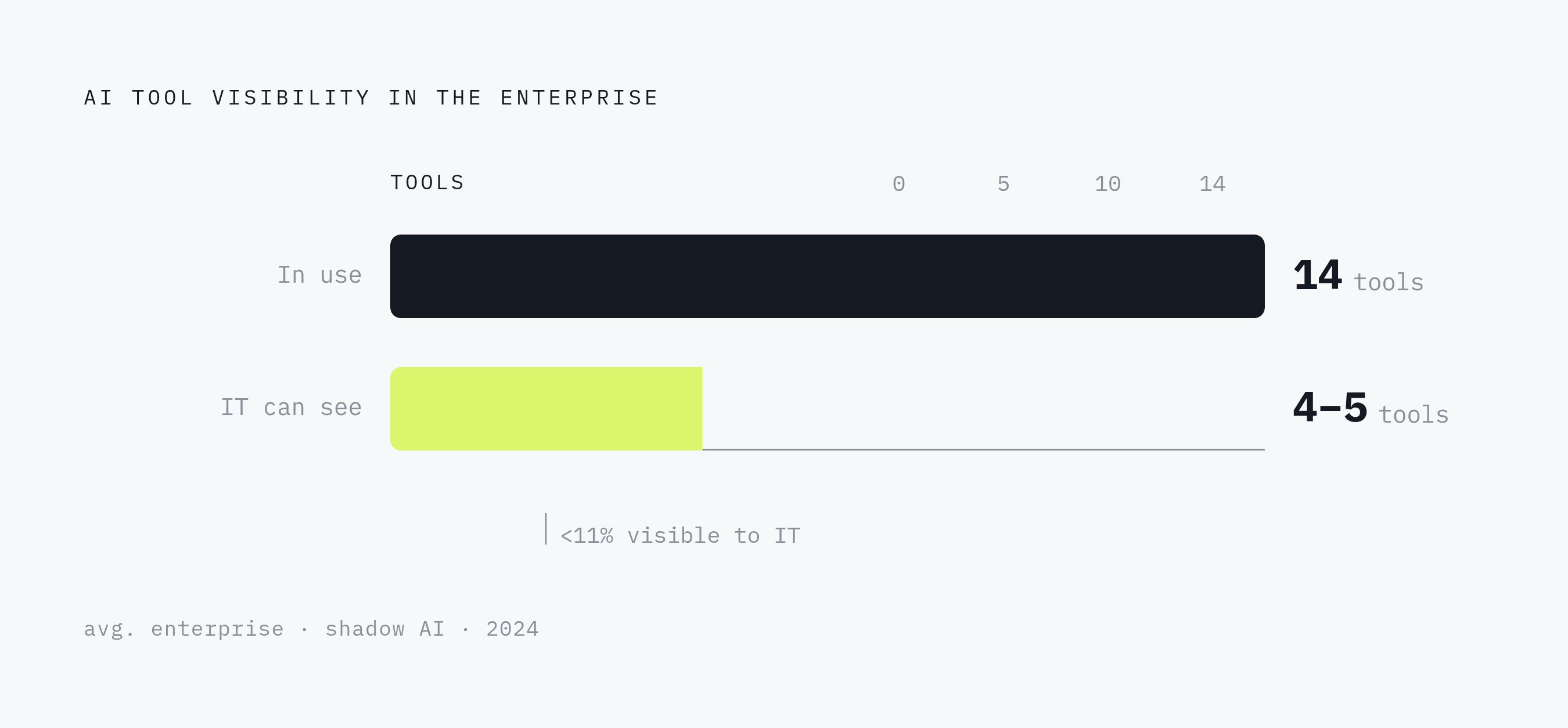
Most enterprises have an AI governance problem they haven't measured yet. Sixty-seven percent of employees use AI tools at work. Eighteen percent of organizations have formal AI security policies. The average enterprise runs 14 AI tools; IT knows about four or five. Fewer than 11% of AI applications in use are visible to IT at all.
GenAI traffic surged over 890% in 2024. Menlo Security reported a 68% surge in shadow GenAI usage in 2025 alone. The gap between what employees use and what IT can see is getting wider.
Banning doesn't close that gap. Understanding it does.
What Shadow AI Is, and Why It Is Not Shadow IT
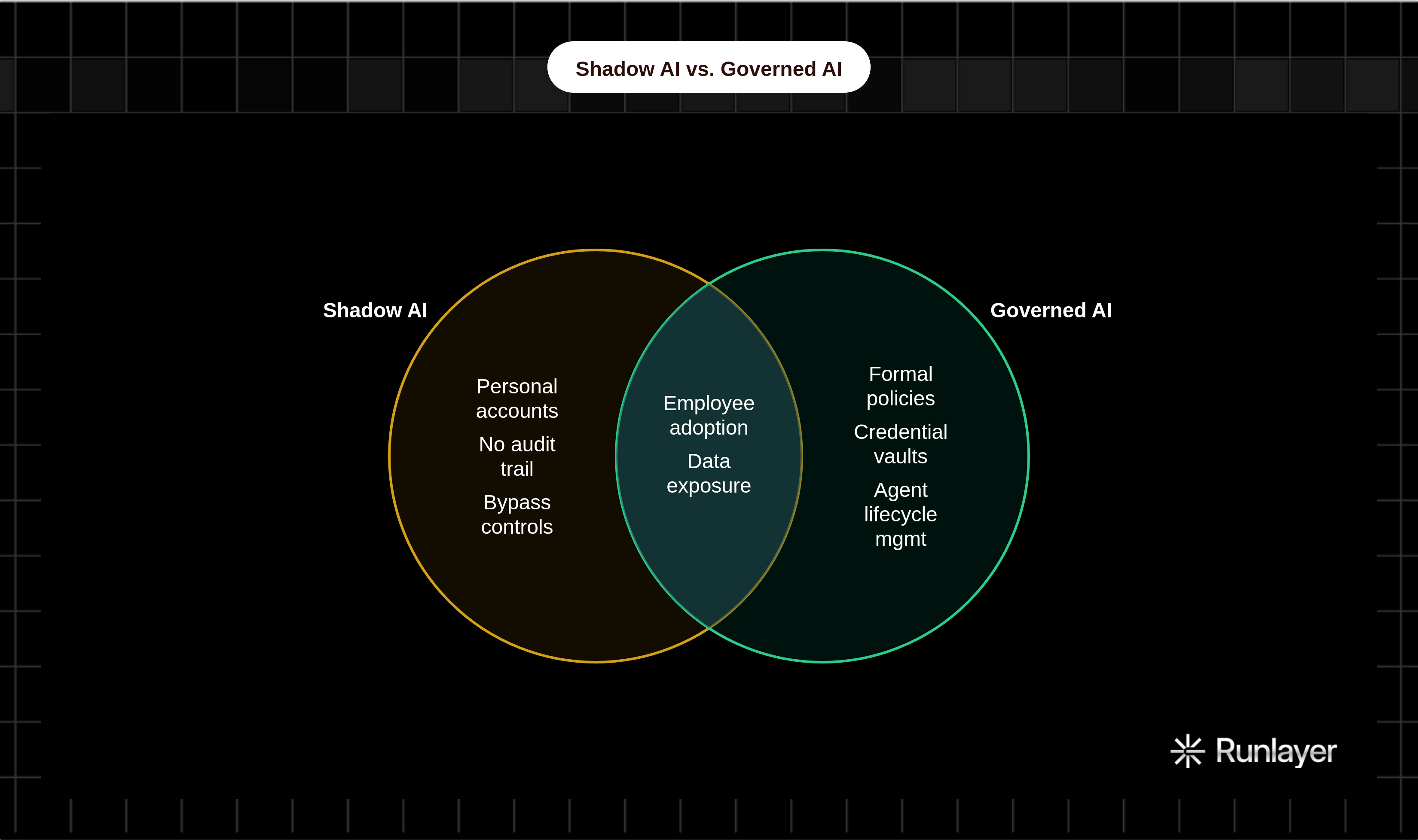
Shadow AI is the use of AI tools, assistants, browser extensions, or personal AI accounts without approval, visibility, or governance from IT, security, or compliance.
Shadow IT was unauthorized Dropbox or personal Gmail forwarding: storage and routing problems, mostly containable. Shadow AI is a different category. These tools don't just store data; they process and transform it, then expose it to third-party model providers. The data leaves, changed, with no record of what happened.
In practice: 68% of employees use free-tier tools like ChatGPT through personal accounts. Fifty-seven percent input sensitive data. Fifty-four percent install AI tools without consulting IT. Forty-seven percent access tools through personal accounts that bypass enterprise controls entirely.
The Model Context Protocol layer adds a new attack surface on top of all of this. Anthropic introduced MCP in late 2024 as a universal connector for AI systems to interact with file systems, databases, APIs, and SaaS applications. The ecosystem grew from a handful of reference implementations to 9,400-plus public servers by mid-2026. Employees connect agents to any of those servers without IT awareness, and 53% of MCP servers expose credentials through hardcoded values in config files.
Why Banning Fails
Nearly half of employees would continue using personal AI accounts after an organizational ban. Prohibition drives shadow AI underground. The tools stay in use; the visibility disappears.
Employees using unauthorized tools are not acting irrationally. They are solving real problems faster. Remove those tools without a replacement and you get resentment and workarounds, not compliance.
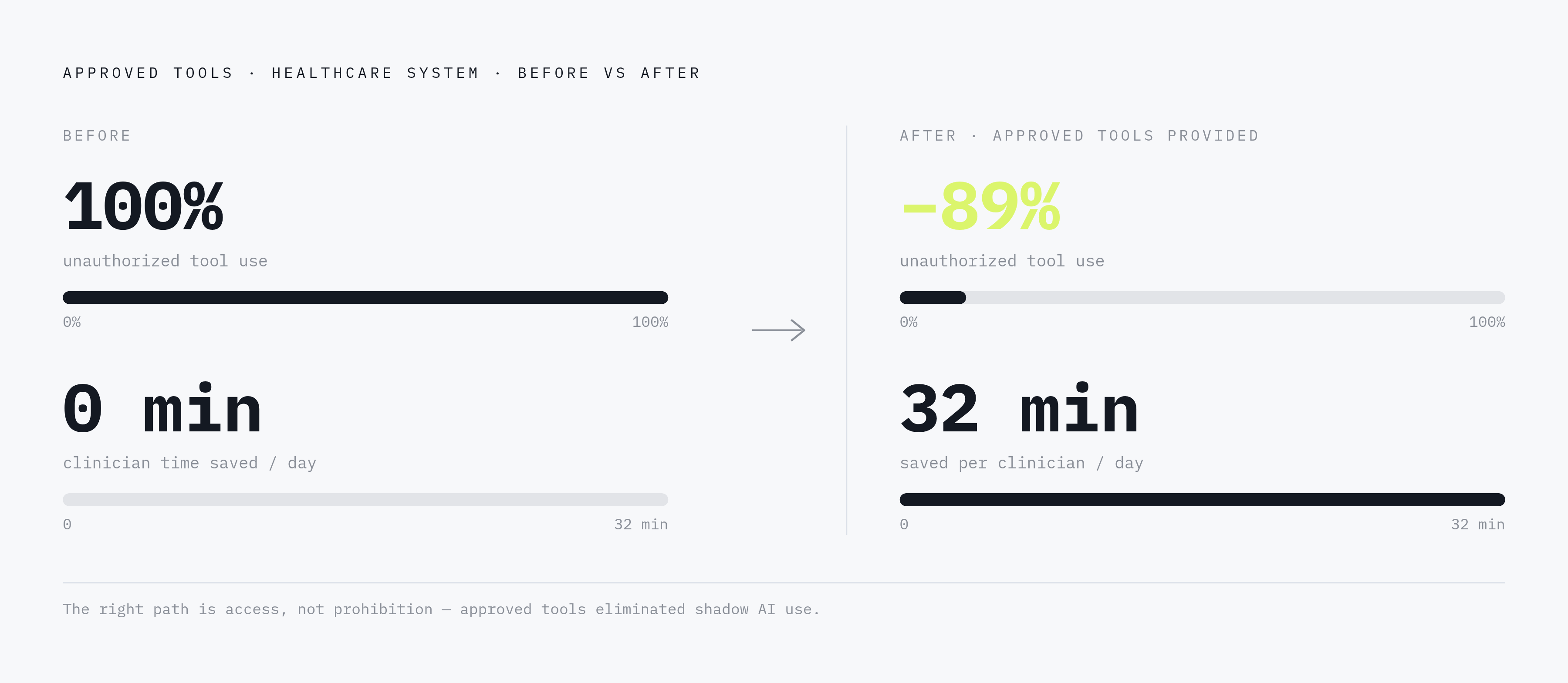
A healthcare system that provided approved AI tools saw unauthorized use drop 89% and saved 32 minutes per clinician per day. When the approved path is the easiest path, adoption follows.
What It Costs When Shadow AI Goes Ungoverned
IBM's 2025 Cost of Data Breach Report puts shadow AI incidents at $4.63M per breach versus $3.96M for standard breaches. Shadow AI incidents account for 20% of all breaches. The average company experiences 223 incidents per month of users sending sensitive data to AI tools, double the prior year's rate.
PII appears in roughly 65% of shadow AI-related incidents. Intellectual property in roughly 40%. Source code, financial records, legal contracts, and clinical data are all in the exposure set.
The regulatory exposure is concrete. A pharmaceutical company whose employees uploaded clinical trial data to AI tools faced potential FDA and EMA violations worth tens of millions. Samsung banned ChatGPT in 2023 after engineers leaked semiconductor designs. Gartner projects that by 2030, more than 40% of enterprises will experience security or compliance incidents linked to unauthorized shadow AI.
The operational risk is less visible but equally serious. When unauthorized AI produces bad financial advice, incorrect legal interpretation, or flawed technical guidance, there is no audit trail of what happened, who acted on it, or why.
Ninety-one percent of organizations already use AI agents. Forty-four percent have no governance framework. Fewer than 30% of AI systems have structured audit trails of agent tool access.
MCP Is a New Category of Risk
The original MCP specification shipped without a mandatory authentication framework. It was designed to make agents more capable; enterprise security was not a first principle.
A July 2025 scan found 1,862 publicly accessible MCP instances responding to unauthenticated requests. Only 8.5% of MCP servers implement OAuth 2.1 authentication.
The attack vectors are not theoretical. Tool poisoning works when MCP servers misrepresent their functionality through hidden malicious code or weaponized metadata. In MCPTox benchmark testing, o1-mini had a 72.8% attack success rate against tool poisoning, and more capable models proved more susceptible, not less. Prompt injection is already happening in production: in June 2025, a Supabase Cursor agent processing support tickets was tricked into leaking integration tokens. Context poisoning runs through legitimate servers that fetch external documents containing embedded malicious instructions. Credential sprawl is structural: GitGuardian found roughly 24,000 secrets in MCP config files on public GitHub.
Real consequences from 2025 and 2026 illustrate the range. CVE-2025-53967 allowed remote code execution via command injection in the Figma MCP server. A Replit agent deleted a production database with 1,200-plus records despite explicit freeze instructions, through overprivileged MCP access. A malicious MCP server silently exfiltrated an entire WhatsApp message history. Between December 2025 and January 2026, a single attacker used Claude to breach Mexico's federal tax authority, electoral institute, four state governments, and a water utility.
Multi-turn prompt injection attacks achieved 92% success rates across eight open-weight models in 2025 testing. Passive logging is not a defense against any of this.
The Technical Foundation
OAuth 2.1 with PKCE is mandatory for any MCP server accessible over the internet, per the November 2025 spec revision. Currently, 8.5% of servers implement it. That gap is the attack surface.
The June 2025 spec revision separated the MCP server from the authorization server role, a critical architecture change for enterprise deployments. The 2026 spec adds incremental scope consent so clients request only minimum access per operation.
In Kubernetes and OpenShift environments, offload authentication to an external OIDC provider and use OAuth Token Exchange for scoped internal access. Backend and internal agents use mutual TLS or M2M OAuth client credentials. Never pass through tokens from an MCP client to upstream APIs; this creates confused deputy vulnerabilities.
For credential management: vault services only, specifically AWS Secrets Manager or HashiCorp Vault. No plaintext in environment variables, process lists, or logs. Default credential expiration is one hour, 24-hour maximum. Distinct identities per agent and per agent task type, with no credential sharing between agents or between agents and human users. Gartner's IAM report flags credential sharing between agents and users as a practice to eliminate. Build break-glass procedures that can revoke all agent credentials in under five minutes.
Fewer than 15% of organizations can reconstruct agent decision chains after the fact. Every agent needs a registered identity, a defined owner, and a governed permission scope. Audit logs must be tied to individual tool calls, not session-level records. Reserve token introspection for write operations and PII access. SSO, SCIM, and controlled onboarding are non-negotiable for production MCP deployments.
Standard SIEM and DLP tools are not designed to detect tool poisoning, prompt injection, or intent drift in agent workflows. Detection operates at tool-call depth, or it doesn't work.
What Smart Organizations Do Differently
Start with inventory. Survey employees to understand what problems shadow AI is actually solving. Identify which data types are at risk given real usage patterns, not assumed ones. You cannot govern what you haven't mapped.
Build the supported path. Ninety-five percent of employees are not power users. They need a clear, easy route to AI that outperforms the unauthorized alternative. The healthcare case study is the template: when the approved path is better than the shadow path, unauthorized use falls sharply.
Write policies for the people who follow them. Data classification determines which data types can be shared with which tools under what conditions. The tool approval process has to move fast enough to stay ahead of employee adoption. Acceptable-use guidelines are written for the employees who will read them, not the legal team that drafts them. ISACA recommends auditing unauthorized AI tools as part of regular enterprise risk assessment cycles.
Govern agents as non-human identities. Agents need full lifecycle management: provisioning, scope review, deprecation, and revocation, at the same rigor as privileged human accounts. No reusing human credentials for agent access.
Avoid fragmented stacks. A separate agent builder, gateway, and security tool creates visibility gaps and policy inconsistencies between layers. Organizations responding to breaches rather than preventing them are almost always running governance as an afterthought.
Employees using unauthorized tools signals an unmet need. Treat it as a product requirement, build the better path, and unauthorized use follows the numbers down.