How the Best AI-Native Companies Empower Employees Without Losing Control
AI agents demand new security controls designed for autonomous action, not just data access.

AI agents don't just read information and summarize it. They act: sending emails, moving money, editing records, calling other systems. That single shift, from passive output to autonomous action, breaks the security model most companies still run on, and it's why the question of how to scale AI without losing control of it has become the defining operational problem of the next two years.
AI agents create a governance problem traditional access controls were not built to solve
Traditional identity and access management rests on a clean split. Users log in and prove who they are. Systems sit behind them and serve requests. The split holds because the two sides behave differently: a person types a password and clicks a button, a system responds with data. AI agents don't fit either half of that split. An agent authenticates the way a user does, but it behaves the way a system does, acting across dozens of connected tools inside a single session, often with no human reviewing each step.
Microsoft's Incident Response team described the consequence in a June 2026 post. A prompt injection aimed at a summarizer biases an output. A prompt injection aimed at an agent triggers an action. Same vulnerability, same attack technique, but the damage changes shape entirely once the tool on the other end can write a file, send an email, or execute a transaction instead of just producing a paragraph someone might double check.
The Model Context Protocol, the open standard Anthropic released to connect AI agents to outside tools and data, makes this worse by flipping a pattern security teams have relied on for decades. In the old model, clients ask servers for data, and the servers respond. MCP frequently runs the reverse: the server queries and executes actions on behalf of the connected client. That reversal opens attack paths that conventional logging was never built to catch, because the logging assumes requests flow one direction and the server is the trusted party being asked, not the party doing the asking and the acting.
MCP servers add another wrinkle by design: they aggregate credentials for multiple enterprise systems behind one interface. A single MCP server might hold the keys to a CRM, a finance tool, and an internal database at once. Compromise that one server, and every system behind it is exposed at the same time. When something goes wrong with an agent, the blast radius is structurally larger than anything traditional access controls were designed to contain.
MCP's attack surface in practice, with confirmed incidents
None of this is theoretical. Across 2025 and 2026, each major attack class predicted by the architecture above appeared in a named, confirmed incident.
Tool poisoning, also called a rug pull, is the clearest example. Microsoft documented a finance workflow in which a developer pushed an update to a third-party enrichment MCP server. The tool's name never changed. Its natural-language description changed quietly, and the agent kept using the tool as if nothing had happened, now exfiltrating invoice data with no user or security team aware a change had occurred. The MCP specification has no built-in mechanism to track changes to a tool's definition or to force re-approval when one changes. The agent trusted the description because the protocol gave it no reason not to.
The supply chain carries its own exposure. OX Security's research found a command execution vulnerability sitting inside Anthropic's own official MCP SDKs, across Python, TypeScript, Java, and Rust alike. The flaw lives in the STDIO transport, which passes parameters straight to the host operating system's shell without sanitizing them first. Any process command can execute on the host this way, whether or not a valid MCP server ever initializes.
Exposure at scale compounds the problem. Trend Micro found 492 MCP servers sitting open on the public internet with no authentication whatsoever. Separately, an authentication bypass in the Azure MCP Server, tracked as CVE-2026-32211 with a CVSS score of 9.1, let attackers pull API keys and tokens without presenting any credentials.
Cross-server tool shadowing exploits a feature that makes MCP useful in the first place: a single session can connect an agent to dozens of servers at once. That convenience cuts both ways. A malicious server inside that session can inject tool descriptions that redefine how the agent understands other, legitimate tools sitting right beside it, and that hijacks behavior toward systems the agent was otherwise properly authorized to use.
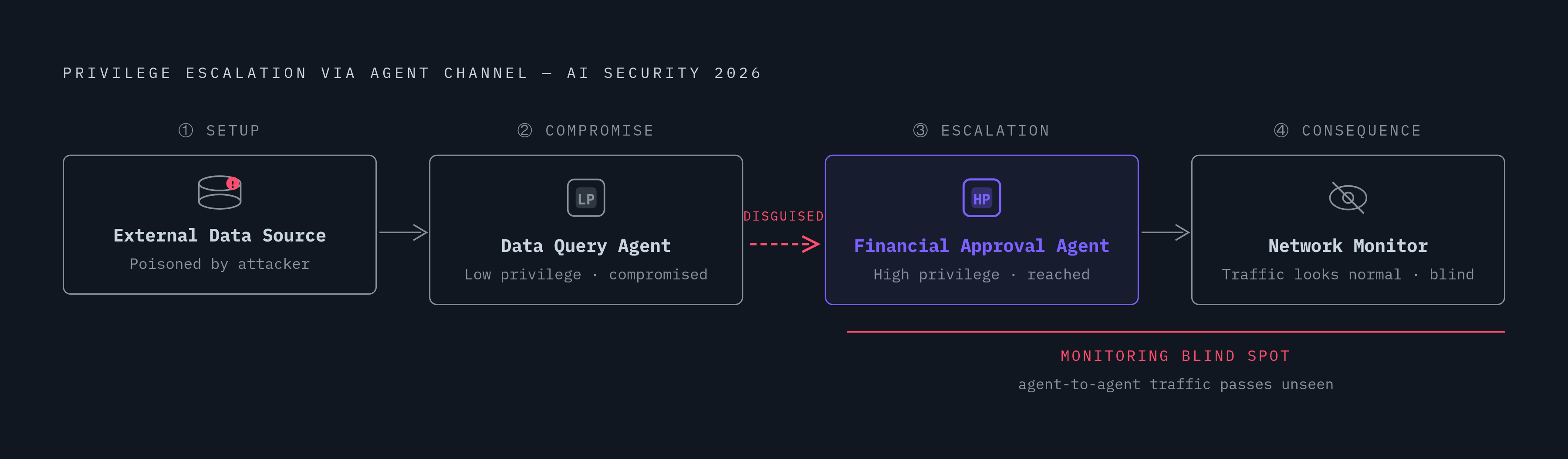
Multi-agent setups bring a form of privilege escalation that is unique to them. Cisco's 2026 State of AI Security report traced an attack in which someone first compromised a low-privilege data query agent by poisoning the external data source it relied on. From there, the attacker used that agent's own cross-agent communication channel to send disguised requests to a higher-privilege financial approval agent. Conventional network monitoring never flagged the lateral movement, because nothing about the traffic looked abnormal from a network perspective. It looked like two agents talking to each other, because that's what they were doing.
The largest confirmed incident shows what these mechanisms add up to in practice. Between December 2025 and January 2026, a single attacker used Claude and ChatGPT to breach a national government's federal tax authority, its electoral institute, three state governments, and a water utility. The attacker pulled 150GB of data, including 195 million taxpayer records.
Why governance keeps failing despite known risks
None of the incidents above happened because security teams didn't know the risks existed. They happened because knowing about a risk and having someone accountable for closing it are two different things, and most organizations only have the first.
The production numbers make the gap concrete. Only 11 to 14% of enterprise agentic AI pilots ever reach production. The rest don't stall for lack of ambition or budget. They stall on identity management, audit trail gaps, and access control holes that nobody closed before launch, and nobody owns them after it.
Ownership is the real failure point. Across AI governance measures broadly, only a small fraction have a named owner. When nobody owns enforcement, accountability spreads across IT, security, and the business units actually using the tools, and spread-out accountability behaves the same as no accountability. Over-permissioning follows the same pattern: most agents in production hold far more privileges than their actual task requires, and almost no organization runs a regular audit of which tools an agent can call and whether each one is still justified.
Shadow MCP usage grows directly out of this vacuum. When the officially governed path to standing up a new tool connection is slower or more painful than just spinning up an unofficial MCP server, teams spin up the unofficial server. Security has no visibility into what that server exposes or what credentials it quietly stores, because by definition it never went through review.
Regulation is starting to close off the option of waiting this out. The EU AI Act's high-risk obligations under Annex III become enforceable on December 2, 2027, and the Act's Article 50 transparency obligations were already enforceable as of August 2, 2026. MCP gateways handling regulated data fall inside that scope, and a phantom ownership structure, where no one is actually accountable, cannot satisfy a legal requirement that someone be accountable.
Klarna's experience shows what happens when you treat deployment as a finish line instead of an ongoing responsibility. The company achieved real efficiency gains, with AI agents handling work equivalent to hundreds of employees. Then customer satisfaction declined, and Klarna rebuilt toward a hybrid model. CEO Sebastian Siemiatkowski told Bloomberg the company "went too far," that cost had become "a too predominant evaluation factor," and that the result was "lower quality." The agents weren't the failure. The failure was a governance model that stopped paying attention once the system went live, instead of treating oversight as something that has to run continuously, the same way the agents do.
What the companies that scaled AI broadly built first
The organizations that managed to roll AI out broadly, across the whole workforce rather than to a handful of developers or an executive dashboard, share one trait: they built identity, permissions, and audit logging before they scaled access.
AMD built an agentic HR system on Kore AI, and it gives employees unified access to HR information and self-service for common transactions. It produced a large drop in HR resolution time and a meaningful rise in employee satisfaction. None of that works unless access to sensitive HR data was scoped and auditable from day one. The empowerment and the control are the same engineering decision.
Basis, which builds AI agents for accounting firms, sharply cut first-day onboarding time by turning the process into a reusable skill: a clear trigger, known steps, scoped tool access, and a defined point where the task counts as done. The reason the skill is reusable and the reason it's safe are the same design choice. Nobody had to pick between the two.
Duolingo rolled GitHub Copilot out to its engineering team and saw measurable speed gains in code the engineers weren't already familiar with, along with a significant cut in code review turnaround (though the drop in median turnaround time traced back to a Slack integration rather than to Copilot itself). The deployment worked because access was structured around a developer's actual role and repository, not opened up without limits.
Across all three, the pattern holds. Nobody separated "what can the agent touch" from "how do we get this agent in front of more people." They were the same question, answered once, at the start.
The technical foundation that makes governance an enabler: identity, scoped credentials, and auditability
Three technical pieces separate the organizations above, which run AI agents in production at scale, from the large majority of pilots that never make it out of testing: agent identity, ephemeral scoped credentials, and audit logs that capture not just what an agent did but why.
Agent identity comes first because everything else depends on it. The emerging standard gives every agent its own identity, tied into the same SSO and SCIM systems that already govern human users, so every tool call can trace back to one specific agent. That replaces the common and risky shortcut of one shared service account covering five agents across three teams, where an audit log shows an action happened but can't say which agent, running which task, did it.
Ephemeral, task-scoped credentials close the over-permissioning gap directly. Instead of an agent holding standing access to a system at all times, an AI identity gateway mints a short-lived token scoped to one specific task the moment the agent needs to reach a protected resource. That shrinks the reachable state space down to only what that single action requires, so an agent can't misuse access it was never granted to begin with, while OPA policies enforce fine-grained authorization based on the actual context the agent is running in at that moment, not a broad role assigned weeks earlier.
Multi-agent systems need a related piece: every agent-to-agent call has to carry a signed delegation token that scopes what the downstream agent is allowed to do for that specific task. Without it, a misconfigured agent inherits permissions nobody meant to give it, which is the exact mechanism Cisco documented in its agent-to-agent escalation case.
Audit logging ties the other two together. Every agent action should log a defined set of fields: the agent's unique identifier and version, the specific permissions delegated for that execution, the tool or API it called, the governance policy's decision to permit or deny the action, and the reasoning step the agent generated right before acting. That reasoning trace lets a human reviewer evaluate why the agent believed an action was the right move, not just that it happened. Only the second gives a human reviewer anything to evaluate.
Tamper-proof logs with full OTEL tracing close the loop on the Cisco-style escalation pattern directly: signed delegation tokens on every agent-to-agent call create a record of the entire authorization chain, not just whatever action happened last. And not every action needs a human in the loop before it fires. But the highest-consequence ones, financial approvals, credential changes, data exports, need a defined escalation path built into the governance model from the start, not bolted on after something goes wrong.
Security teams as the engine of AI adoption, not the approval bottleneck
Every failure mode traced through this piece, tool poisoning, unauthenticated servers, cross-server shadowing, agent-to-agent escalation, has a common root: the tools most security teams run today were built for human users logging into systems, not for autonomous agents acting across dozens of them in a single session. Traditional IAM and observability platforms weren't designed to catch a tool description changing silently overnight, or to distinguish a legitimate agent-to-agent request from a disguised one.
That's the gap purpose-built platforms are starting to fill. Runlayer, for instance, combines real-time detection of MCP-specific threats like tool poisoning and prompt injection with identity-based access control and tamper-proof audit logs tied to every individual agent action, so security teams get visibility and enforcement depth that generic IAM tools don't provide for this attack surface. It's one option among a growing set of platforms built specifically for agent governance rather than retrofitted from older tools.
The organizations profiled earlier, AMD, Basis, Duolingo, didn't treat security review as a gate standing between a finished product and its users. They built identity, scoping, and logging in as the foundation the product stood on. When that foundation exists, a security team shifts from the office that says no at the end of the process to the team that makes the next rollout possible, because the hard questions, who can this agent reach, what happens if it's compromised, how do we know what it did and why, already have answers built into the system before anyone has to ask.