Why Every Team Builds AI Differently—And Why That’s a Problem
Fragmented AI strategies compound costs and risks faster than benefits grow.
Your AI Strategy Is Fragmented. That's Going to Cost You.
Most large organizations don't have an AI strategy. They have dozens of them, one per team, built in isolation, governed differently, invisible to each other. It feels like agility. It is accumulated risk with a deferred invoice.
What's Happening Inside the Enterprise
Walk any enterprise floor and the variation hits immediately. One team fine-tunes open-source models on proprietary data. Another pipes prompts to the OpenAI API with no internal review. A third bought a no-code tool after a vendor demo. A fourth outsourced everything to a consultancy. Nobody coordinated any of this.
The divergence runs deeper than model choice. Orchestration frameworks, vector databases, evaluation pipelines, prompt versioning, human oversight thresholds: all different by team. Some log AI outputs for audit; most don't. Some run bias testing before deployment; others ship and watch. The organization never decided what it thinks about any of this, so every team filled the vacuum themselves.
This happened for understandable reasons. The tooling landscape moves faster than any central body can track. New models and frameworks appear monthly. By the time a governance committee evaluates a tool, the team that needed it six weeks ago is already six weeks into building on something else. Add to that the fact that most organizations haven't resolved whether AI belongs under IT, data, product, or engineering, so there's no owner to drive coordination. Teams default to what's fastest for them.
Vendor sales motions make it worse. AI vendors target team-level buyers because that's where budget moves. They close deals before anyone above the team level has evaluated the risk. The fragmentation is, in part, designed by the people profiting from it.
The Costs You're Not Counting
The visible cost is redundancy. Multiple teams solve identical problems in parallel, pay separate licensing fees for overlapping capabilities, and produce solutions that never benefit each other. That's waste you can quantify on a spreadsheet.
The invisible costs are larger.
Knowledge compounds nowhere. When a team discovers a particular model fails on edge cases in their domain, that learning stays local. Twelve months later, a different team runs the same experiment. Expertise doesn't institutionalize; it leaves when people do.
Maintenance burden doesn't scale linearly with fragmentation. Every distinct stack needs dedicated upkeep. When underlying models and APIs change, each custom integration breaks separately and gets fixed separately. The debt grows geometrically.
Talent costs are consistently underestimated. New hires onboard to whichever tools their team uses, which have no relationship to tools on adjacent teams. Internal mobility stalls because moving teams means relearning the stack from scratch. Organizations compete hard for AI talent and then structurally prevent that talent from being useful across the business.
Customer experience degrades when quality standards diverge across products. One team ships a rigorously evaluated model. Another ships something that hallucinates 8% of the time. Both carry the same brand.
The Compliance Exposure Is Not Theoretical
Teams routinely send sensitive data to external APIs that have never been reviewed for data handling compliance. In most organizations, no one holds a complete picture of which AI vendors receive customer data, on what terms, or under what retention policies. That's not a future risk. It's a current one.
The EU AI Act creates tiered obligations based on use-case risk. Most organizations cannot answer, across all their AI deployments, which systems qualify as high-risk under the regulation. They can't answer it because no one has the full inventory.
Bias and fairness failures concentrate in the gaps between team standards. Without a shared baseline for testing outputs against protected characteristics, discriminatory outcomes surface in production. The reputational and legal consequences arrive externally, not inside a testing environment where fixing them is cheap.
Six different LLM providers means no leverage with any of them. The procurement team negotiates each contract from a position of weakness.
A developer integrates an open-source framework with an unpatched vulnerability. No central team has visibility. The attack surface grows by accident, which is the worst way to grow it.
What a Unified Strategy Actually Means
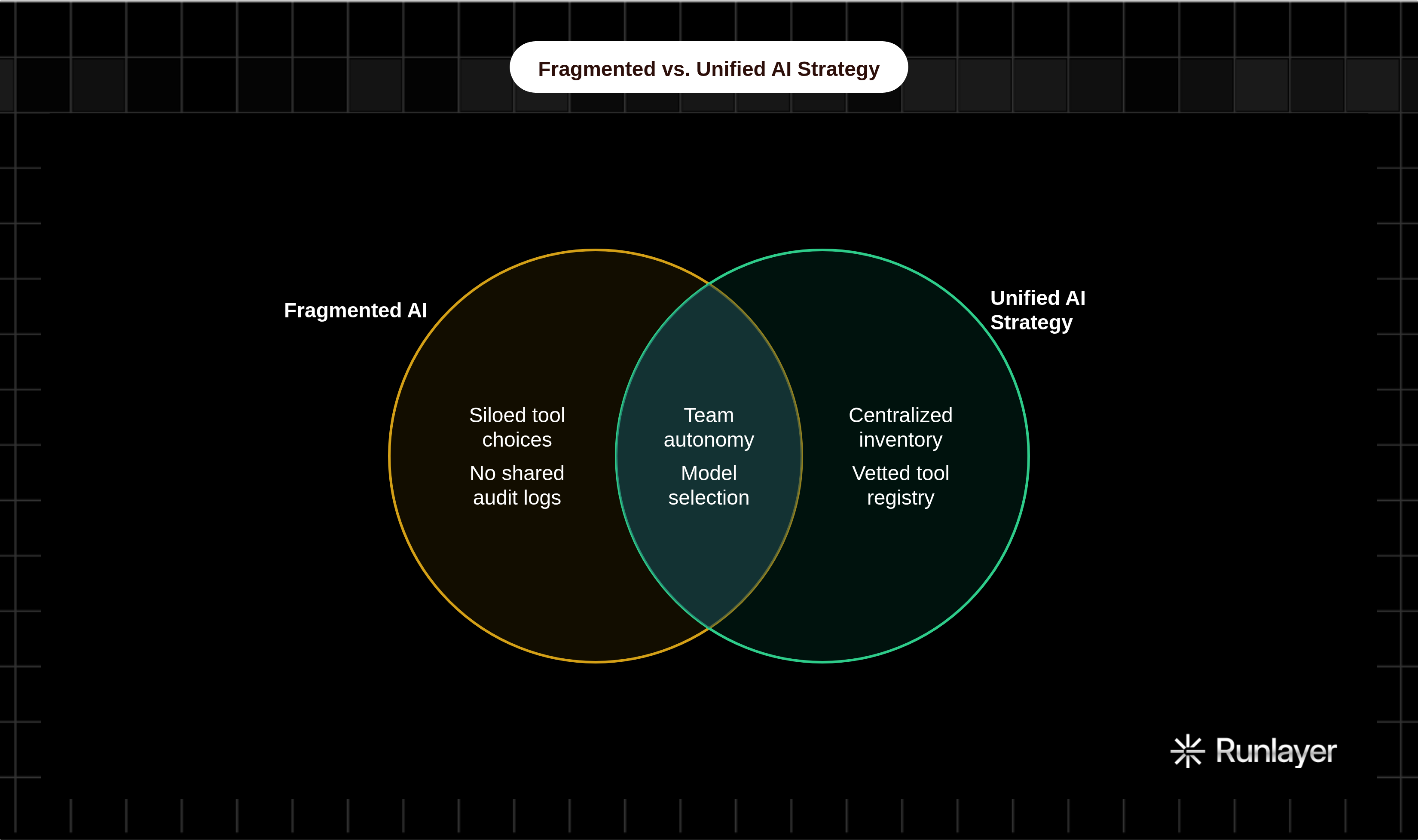
Not one model for every use case. That's a different kind of dysfunction.
Shared principles, shared governance, shared infrastructure, and shared accountability. Teams retain tool choice inside a framework that sets non-negotiable floors on security, data handling, documentation, and evaluation. The floor is the strategy. What teams build above it is their call.
The cloud governance parallel is close enough to be useful. Early cloud adoption was equally fragmented. Organizations eventually built frameworks covering approved providers, security baselines, cost visibility, and tagging requirements. Innovation continued. Uncontrolled sprawl stopped. AI requires the same arc, compressed, because the stakes arrived faster.
The competitive argument is direct. An organization with shared AI infrastructure compounds capability. Every deployed model contributes to a shared evaluation dataset. Every failure informs shared standards. A fragmented organization gets smarter only inside silos, and silos don't scale.
Alignment Without Bureaucracy
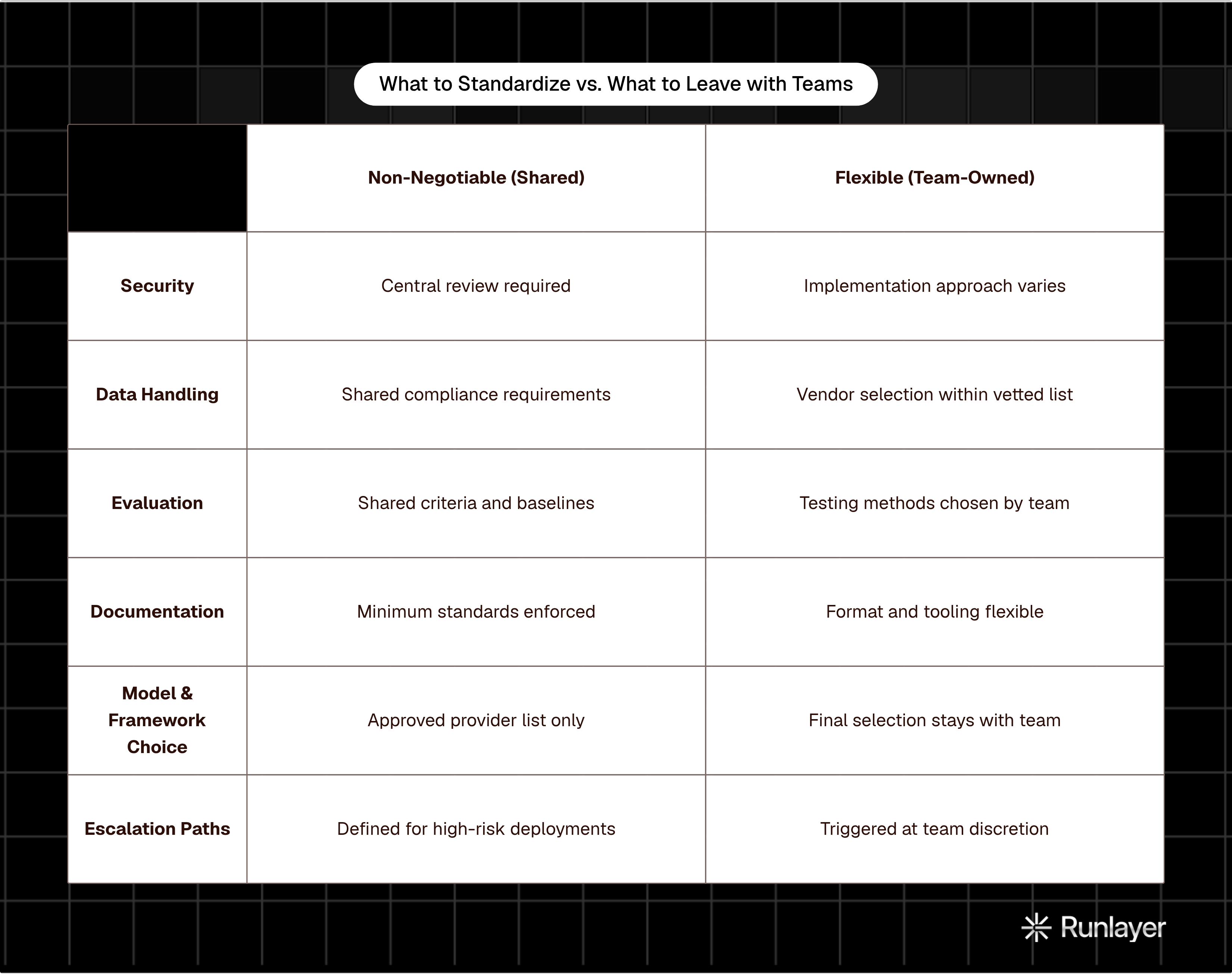
The distinction that matters is what must be standardized versus what stays flexible.
Security review, data handling requirements, evaluation criteria, documentation minimums, and escalation paths for high-risk deployments belong in the non-negotiable column. These protect the organization regardless of what any team builds above them.
Specific models, frameworks, experimentation approaches, and product decisions stay with teams. Teams that need speed should have it. They just operate inside a defined perimeter.
A center of excellence structured as a resource rather than a gatekeeper accelerates this. It maintains a curated list of vetted tools. It runs cross-team showcases so learnings transfer without a memo. It doesn't approve every project; it raises the floor on what every project does by default, which is less work than approving each one.
Internal platforms do more than mandates ever will. When a team can start from a shared SDK, a pre-built evaluation harness, and approved infrastructure with sensible defaults, the right path is also the fast path. Adoption follows ease. Build the path, not the policy.
Lightweight rituals replace bureaucracy. A project registration process that takes twenty minutes surfaces the inventory problem without slowing shipping. Quarterly cross-team reviews of AI incidents institutionalize failure analysis without standing up a committee. Calendared conversations, not approval chains.
One structural fix most leaders skip: teams that contribute reusable components, shared evaluations, or documented findings get nothing for it under most current incentive structures. Collaboration without recognition produces none. Fix the incentive before wondering why sharing isn't happening.
Finally, build review cadences into governance from the start. A framework written today for transformer-based LLMs will be incomplete for whatever ships in eighteen months. Treat governance as a living document, not a ratified policy, or find it obsolete and ignored.
Do This First
Audit the current state. Most organizations don't have an accurate inventory of their AI deployments, vendors, or data flows. Build one. The inventory alone will surface risks demanding immediate action, before a regulator or journalist surfaces them for you.
Then determine what belongs in shared standards and what stays with teams. That conversation doesn't require consensus on everything. It requires agreement on the non-negotiables and one named person accountable for holding the line.
The longer this waits, the more expensive it gets. AI systems are embedding themselves more deeply into products and processes every quarter. Misalignment between teams compounds with that depth. Coordination now is a planning problem. Coordination after a compliance failure or three years of technical debt is a crisis.