The Fastest Way to Kill AI Adoption Is to Lock It Down
Overly strict AI governance backfires just as badly as none at all, leaving enterprises exposed.
The Fastest Way to Kill AI Adoption Is to Lock It Down
Enterprises are failing at AI governance in both directions at once, and the damage is already accumulating.
Adoption Has Already Outrun Governance
88% of organizations used AI in at least one business function in 2025. 72% are deploying or planning agentic AI. 65% say adoption is moving faster than their ability to understand it.
The governance side is nowhere close. Only 8% of organizations maintain a comprehensive AI governance framework. Only 26% can move AI beyond pilots. 74% still cannot translate AI investment into measurable outcomes.
The 95% of employees who are not power users are not rogue actors. They are waiting for a path that works. Most organizations are not providing one.
Two Ways Enterprises Get This Wrong
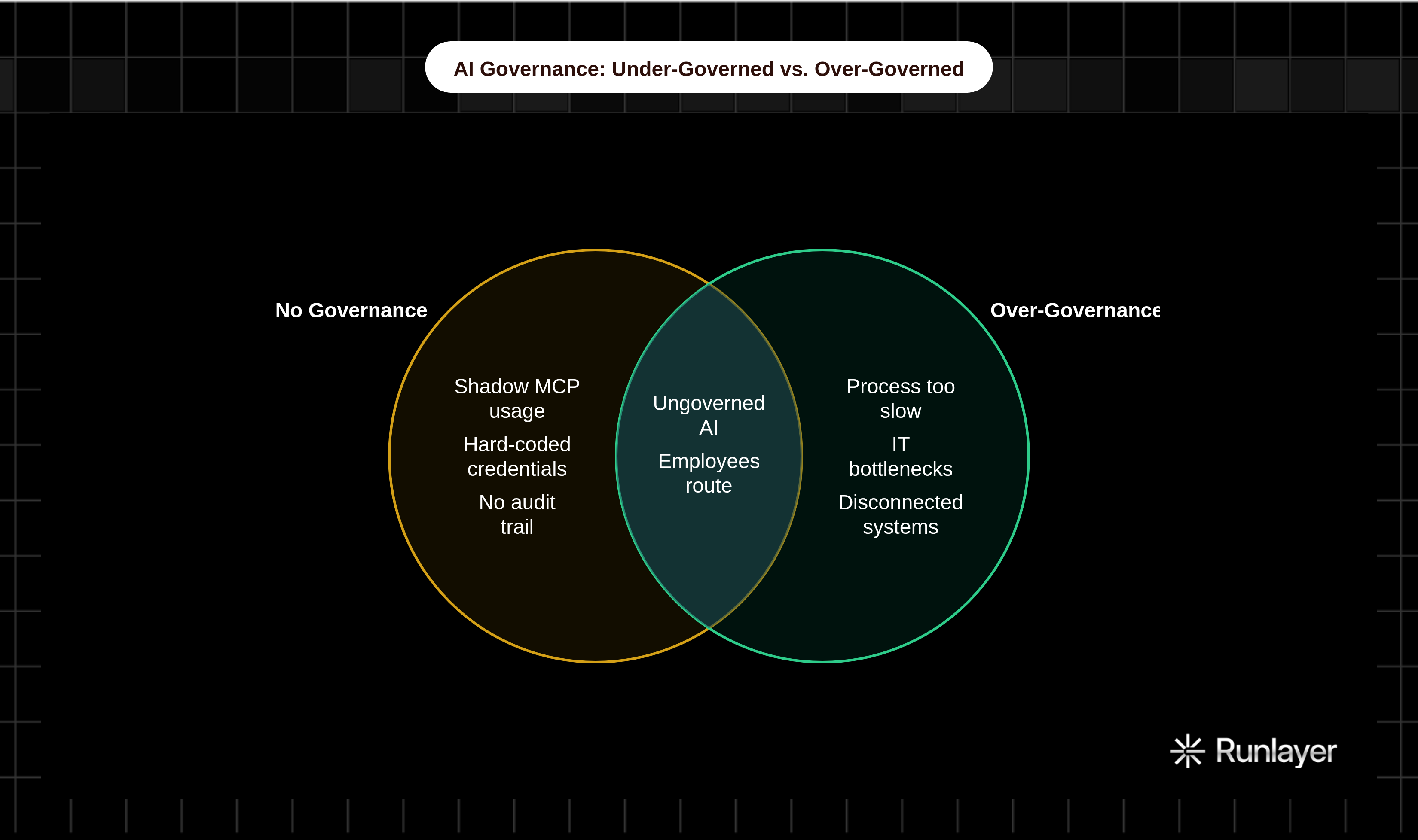
No governance: employees wire personal AI tools to company data with no IT visibility. Credentials get hard-coded, shared, and abandoned. No audit trail means no accountability. When a Replit AI agent deleted a production database of 1,200-plus records despite an explicit code and action freeze, the root cause was not malice. It was overprivileged tool access and no circuit breaker.
Governance so heavy it stops working: 44% of governance leaders call the process too slow. 24% say it is overwhelming. 58% cite disconnected systems as their top blocker. When IT becomes a perpetual bottleneck, employees route around it. Shadow MCP usage is already happening. Platform engineers get trapped rebuilding auth and access plumbing for every team rather than shipping anything.
Both failure modes produce the same outcome: ungoverned AI in production, with different paper trails.
MCP Changed the Stakes
Anthropic released Model Context Protocol in late 2024 as a universal connector standard giving AI models a structured interface to file systems, databases, APIs, code repositories, and enterprise SaaS. OpenAI, Google DeepMind, and Microsoft adopted it. Anthropic donated it to the Linux Foundation in December 2025.
The adoption curve is not gradual. 150 million-plus package downloads by mid-2025. 9,400-plus public servers indexed by mid-2026, with private and enterprise deployments estimated at three to four times that. Gartner projects up to 40% of enterprise applications will include task-specific AI agents by end of 2026, up from under 5% today.
MCP was built for capability, not enterprise security. The original spec shipped without mandatory authentication. The implicit trust model assumed servers were benign. No central authority verifies what a server actually does.
The Real Threats Inside the MCP Ecosystem
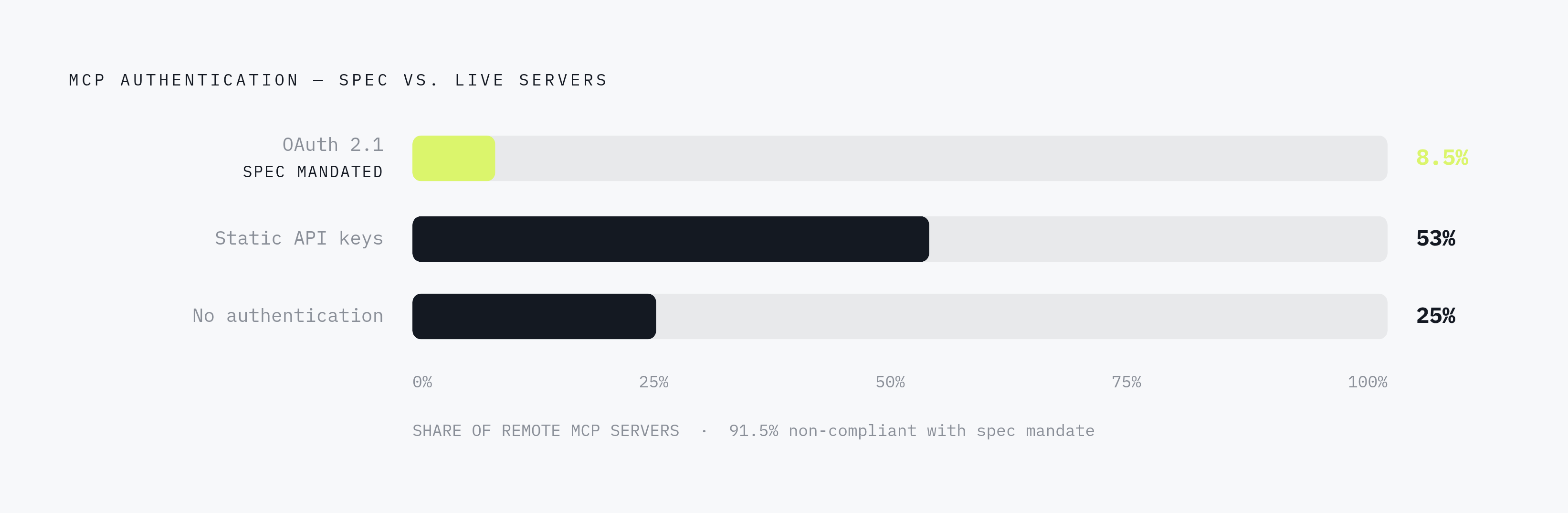
The attack taxonomy is documented and active.
Tool poisoning embeds malicious instructions to manipulate AI behavior. Context poisoning hides directives inside documents agents fetch and execute. Cross-tool attacks exploit shared conversation contexts to steal data from legitimate tools. Multi-turn prompt injection has logged success rates as high as 92% across eight open-weight models.
Production incidents are accumulating. CVE-2025-53967 allowed remote code execution through command injection in the Figma MCP server. The MCPTox benchmark found o1-mini at a 72.8% attack success rate against tool poisoning, with more capable models proving more susceptible, not less. An Asana tenant isolation flaw hit up to 1,000 enterprises. Between December 2025 and January 2026, a single attacker used Claude to breach multiple Mexican government agencies, including the federal tax authority and electoral institute. In one agent-to-agent exploit, a compromised research agent inserted hidden instructions that a financial agent executed as unintended trades.
The authentication gap is the open door. Only 8.5% of MCP servers implement OAuth 2.1 despite it being mandatory for remote deployments. 25% of public servers have no authentication at all. 53% rely on long-lived static API keys that provide indefinite access once leaked. A July 2025 internet scan found 1,862 publicly accessible MCP instances responding to unauthenticated requests.
Agents now read emails, update CRMs, write to databases, and call external APIs without human confirmation. One compromised credential now carries enormous blast radius.
The Credential Sprawl Problem
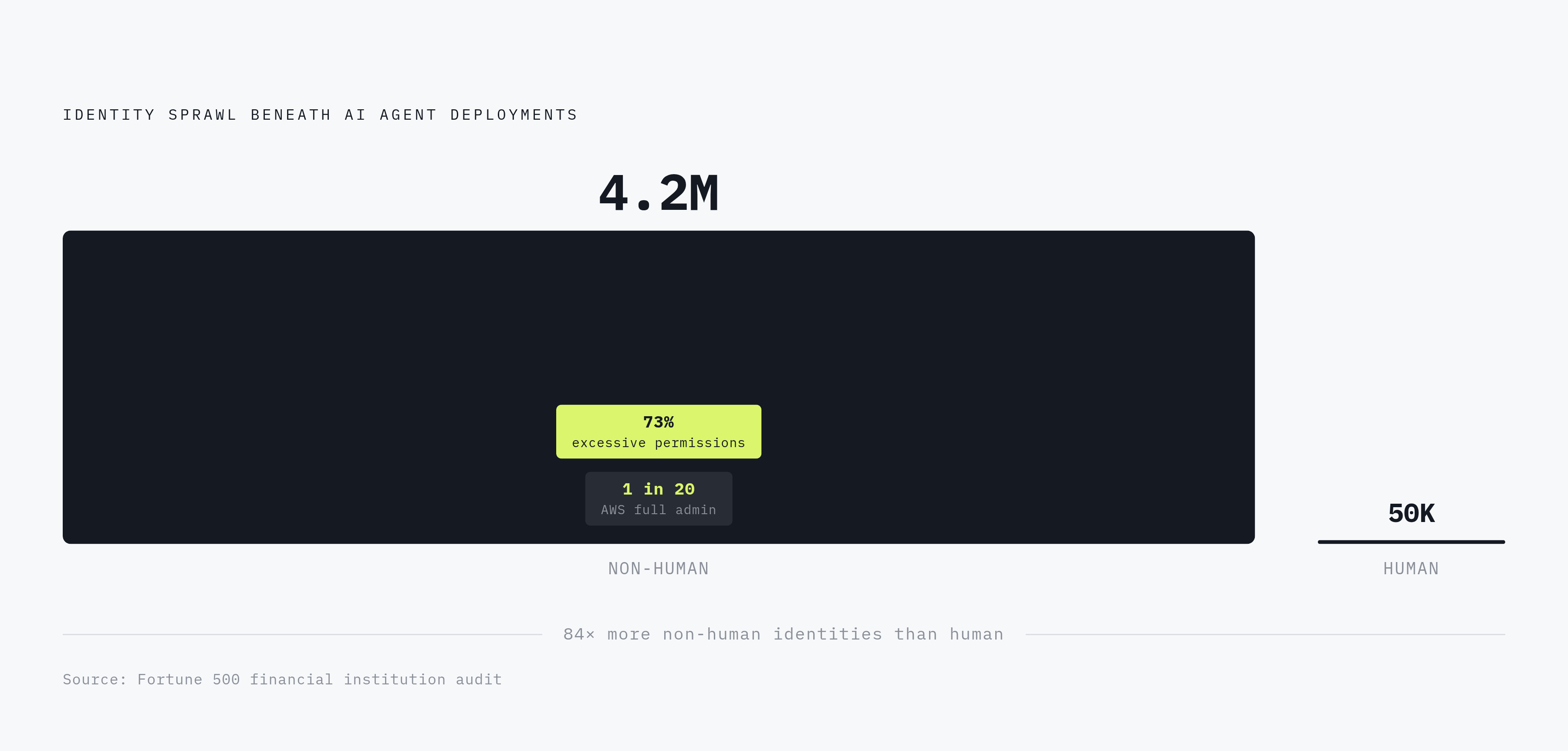
AI agents are landing on top of a non-human identity problem that was already out of control before they arrived.
The average enterprise carries 82 to 144 non-human identities per human identity. One Fortune 500 financial institution audit found 4.2 million non-human identities against roughly 50,000 human accounts. Agents make this structurally worse, creating and replicating credentials at machine speed while behaving autonomously in ways static service accounts never did.
73% of secrets held by non-human identities carry excessive permissions. One in 20 AWS machine identities holds full administrative privileges. 53% of MCP servers expose credentials through hard-coded values in config files. Nearly 50% of organizations have experienced non-human identity-related compromises; 66% of those resulted in successful attacks.
The right pattern is not complicated: vault services instead of config files, one-hour credential expiry with a 24-hour ceiling, session-scoped authorization with explicit human approval for renewal, and OAuth 2.1 with PKCE for any internet-accessible MCP server. The gap between knowing the right pattern and implementing it across a sprawling agent deployment is where most organizations currently live, and where most attackers are currently looking.
Agent Governance Is Different From Traditional IT Governance
A Lambda function operates within a fixed, predictable scope. An AI agent receives a task and determines how to accomplish it, routing dynamically through tools, APIs, and data in ways that fixed-permission models cannot anticipate and were not designed to cover.
An agent without a registered identity, defined owner, and governed permission scope is invisible to the enterprise security program. Most organizations deploying agents through MCP have not established identity governance, lifecycle management, or audit logging for those agents.
Real agent governance means identity tied to every action through SSO and SCIM, policy enforcement at tool-call depth rather than at the gateway, tamper-proof logs capturing what each agent did and under whose authority, full OpenTelemetry tracing so incidents can be reconstructed, just-in-time credentials rather than persistent tokens, and runtime detection for MCP-specific threats including tool poisoning, prompt injection, intent drift, and data exfiltration.
72% of S&P 500 companies disclosed at least one material AI risk in 2025. Audit evidence is not optional.
The Auth Standard Is Maturing
The MCP specification has moved quickly. June 2025 formalized MCP servers as OAuth Resource Servers and mandated Resource Indicators per RFC 8707 to prevent token misuse. September 2025 launched the MCP Registry, which grew to nearly 2,000 server entries within months. November 2025 made PKCE mandatory for all clients and introduced step-up authorization for incremental scope consent. Enterprise-Managed Authorization is now stable, letting organizations centrally control MCP server access through their existing identity provider. Okta is the first identity provider in; Anthropic and Microsoft are among the first to support it.
The compliance gap is still enormous. Only 8.5% of MCP servers implement OAuth 2.1. That gap between the spec and the live ecosystem is the enterprise attack surface right now. Enterprises need a layer that enforces auth standards uniformly regardless of what individual servers implement, because assuming connected servers are compliant is not a risk posture, it is a posture-shaped hole.
Governance Unlocks Adoption
Organizations that treat AI trust as a core business capability scale adoption further than those treating it as a compliance checkbox. Governance creates a repeatable path from experimentation to production. It is a prerequisite for scaling, not a tax on it.
When security and IT build the governed path, the 95% of non-power users finally have somewhere to go. They use AI correctly by default because the secure path is the easy path, not because they read a policy document.
A fragmented stack of separate agent builder, gateway, and security tool is not a strategy. Each seam is a governance gap, and 58% of governance leaders already cite disconnected systems as their primary blocker. Build auth, credential handling, and policy enforcement into the foundation. Adoption scales on top of something solid, or it doesn't scale at all.