Agentic AI Adoption for Non-Technical Employees
Agents executing tasks in systems employees don't fully understand create new security risks.
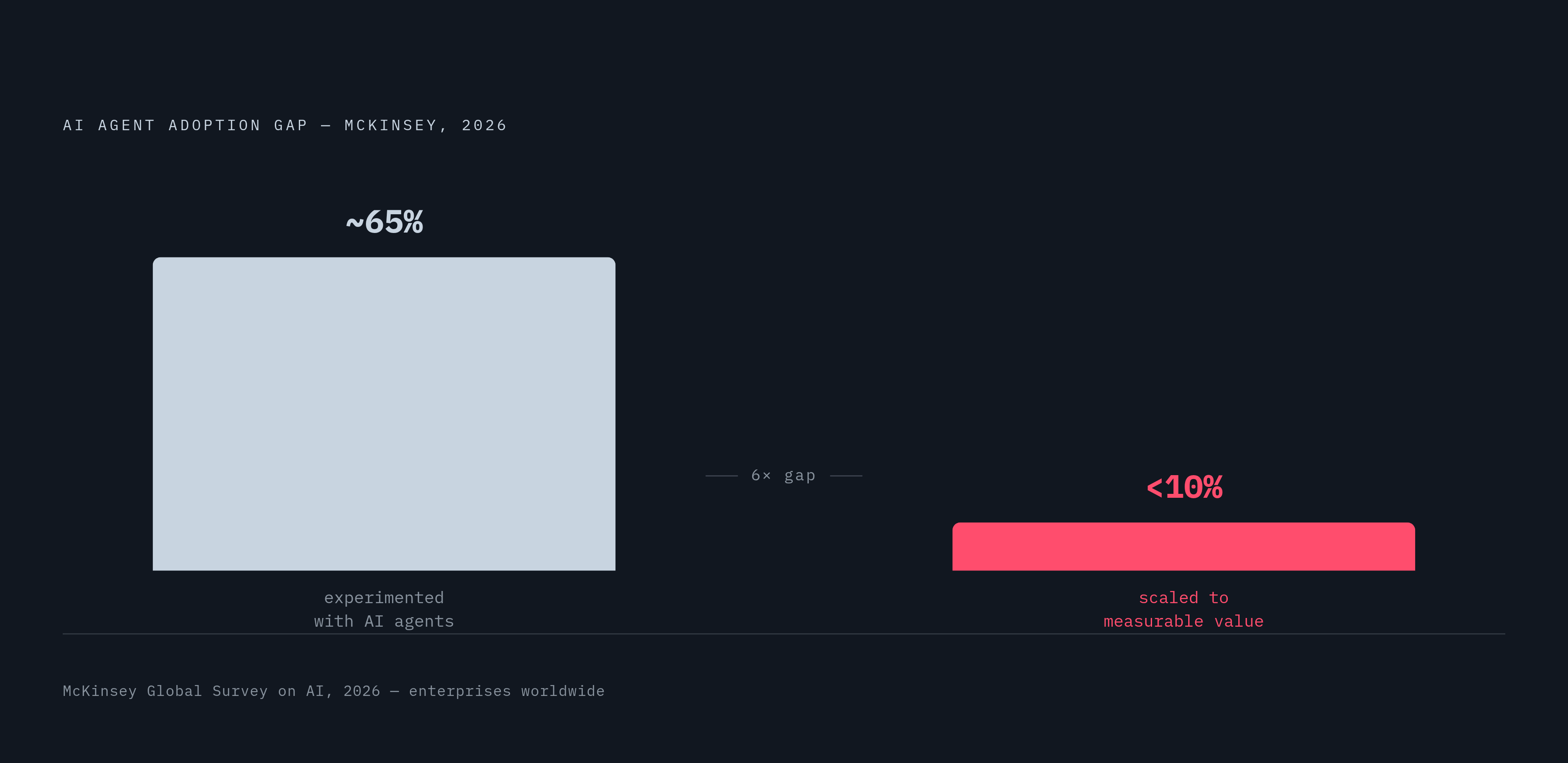
Agentic AI now sits inside most large companies in name, but the results haven't followed the rollout. McKinsey's 2026 research, cited in Gogloby's AI adoption statistics roundup, puts a number on it: nearly two-thirds of enterprises worldwide have experimented with AI agents, yet fewer than one in ten have scaled them into anything that delivers measurable value. That's a six-to-one ratio between companies that tried agentic AI and companies that got something real out of it. The gap between those two numbers is the whole story this piece has to explain, and every section that follows works backward from it.
The productivity gap between power users and everyone else
Inside companies that have deployed agents, the benefit doesn't spread evenly. It concentrates in a small group of employees who've figured out how to use the tools well, while most of the workforce sees almost nothing. Writer's 2026 survey of enterprise AI use found that so-called super-users are dramatically more productive than employees who've been slow to adopt agentic tools, and they save far more hours each week as a result. Leadership has started treating that gap as permanent rather than temporary: the same survey found the C-suite actively cultivating an "AI elite" inside their organizations, while planning layoffs for employees who haven't adopted the tools.
The easy read on that data is that some employees are simply better suited to AI, quicker to learn, more naturally curious about new tools. The structural case shows otherwise. SS&C Blue Prism's 2026 analysis of agent trends makes the structural case directly: non-technical employees stand to benefit the most from agentic AI, but only when they have access to interfaces built for them, low-code or no-code, and agent systems that walk them through tasks that used to require a specialist. The operative word in that finding is "when." Power users aren't more talented. They've found, or built, their own way into these tools, often by going around whatever official path exists or doesn't. Everyone else is still waiting for a path that hasn't been built yet, an organizational design problem rather than a hiring or training problem, and it's the one the next section gets into.
The organizational preconditions for broad adoption
Most companies deployed agentic AI on top of organizational structures that were never built to support it, and that mismatch is why adoption keeps stalling right at the edge of the technical workforce. Forbes Tech Council contributor Barney Krishnan, a Data Executive at UniCredit, frames enterprise readiness along two axes: a people spectrum running from cohesion to fragmentation, and a technology spectrum running from clean-slate systems to tangled legacy mosaics. Most large enterprises land at the high-friction end of both spectrums at once.
The business-IT divide does particular damage to agentic AI adoption, more than it would to a typical software rollout. Autonomous agents execute entire business workflows end to end, which demands operational domain expertise and systemic oversight working together in the same moment. Those two capabilities tend to live in separate parts of the organization, and in a lot of companies those parts treat each other as adversaries rather than partners. For a non-technical employee trying to use an agent to do real work, that divide creates a series of small, concrete dead ends. They can't connect the tool they need to the system that holds their data. They don't know which agents their company has actually sanctioned for use. There's no one to ask who isn't already overloaded with other requests. The question either goes unanswered or gets answered badly, by someone guessing.
The specific ways that ungoverned agent access makes the risk problem worse for non-technical users
When a non-technical employee can't get a sanctioned path to the tools they need, they often build their own, connecting an agent to a business system without anyone in IT or security ever knowing it happened. That employee is doing what the organization implicitly asked them to do: get the work done, not being careless. The shortcut they take exposes the company to risks they have no way of seeing and no way of weighing.
Tool poisoning is one of the clearest examples. A malicious or compromised MCP server can manipulate what an agent does on a user's behalf, and ITECS's 2026 analysis of tool poisoning found that this kind of attack succeeds at high rates against major LLM agents. A non-technical employee connecting an agent to a new business tool has no real way to assess whether the server on the other end of that connection deserves trust. Nothing in the interface tells them to check.
Credential exposure follows the same pattern at a structural level. NimbleBrain's state of MCP security analysis found that 91.5% of MCP servers rely on static API keys stored in configuration files, rather than OAuth. Those keys don't expire on their own. They persist after the employee who set them up has left the company, and they accumulate quietly across every tool someone has ever connected, with nobody tracking the total.
The 2026 incident involving Invariant Labs and Claude Desktop shows what this looks like in practice. An indirect prompt-injection attack, sometimes called a toxic agent flow, exfiltrated private repository data through the official GitHub MCP server, triggered by a malicious GitHub Issue, without the server itself ever being compromised. That's the exact shape of integration a non-technical employee might set up in a few minutes, with no reason to suspect anything was wrong.
And when something does go wrong, most organizations can't even see it clearly after the fact. TrueFoundry's analysis of MCP security found that standard MCP servers don't log execution context in a format that would hold up to a compliance review: they might record that a tool was called, but typically not which person triggered it, what data came back, or whether any policy was checked first. For a company operating under SOC 2, HIPAA, or GDPR, that blindness in the audit trail carries real regulatory weight.
The three components of a structured adoption path
A real adoption path for non-technical employees rests on three things working together: clear entry points, tools that are already connected and authorized, and guardrails built into the system itself. All three depend on each other, so losing any one of them keeps the other two from functioning as intended.
Start with the entry point. Non-technical employees shouldn't need to understand what an MCP server is, how OAuth works, or which agent runtime their IT department happens to prefer, just to start using an agent for everyday work. SS&C Blue Prism's 2026 analysis identifies low-code and no-code interfaces as the actual mechanism that lets non-technical employees reach agent capabilities that used to require a specialist. The entry point carries as much weight as whatever capability sits behind it. If the door is confusing, the room behind it doesn't matter. Entry points work best when they meet employees inside the tools they already use every day, rather than asking them to learn a new primary interface on top of their existing job.
Next, the tools themselves need to already be connected and authorized before an employee ever tries to use them. The friction that stops most non-technical employees isn't a lack of willingness to try agentic AI but the connection step: figuring out which tools are even available, requesting credentials, and getting an agent to actually talk to the real systems where the work lives. It lets organizations centrally provision MCP server access through their identity provider, so a user gets connected servers automatically on first login, with no per-app OAuth flow to navigate. That's the infrastructure a real golden path depends on.
Last, guardrails need to be built into the system rather than bolted onto it after something breaks. A guardrail an employee only encounters after an incident has already happened is a response to an incident, not a guardrail that prevents one. A real guardrail stays invisible during normal, everyday use and only becomes visible at the exact moment it prevents harm. In practice that means identity tied to every single action an agent takes, through SSO and SCIM-provisioned access, so the organization always knows which human stands behind which agent action. It means just-in-time credentials replacing the static API keys that NimbleBrain's research flagged, credentials that expire automatically instead of accumulating forever. It means real-time detection for the specific threats that occur in MCP environments, tool poisoning, prompt injection, intent drift, running at the depth of the individual tool call, where the actual risk lives, rather than sitting at the network perimeter where it can't see any of it. And it means tamper-proof audit logs with full tracing, built to satisfy the SOC 2, HIPAA, and GDPR requirements that TrueFoundry's analysis found standard MCP logging simply doesn't meet.
From gatekeeper to enabler: security and IT on the golden path
None of this asks security and IT teams to do less work. It gives them a different job: building the infrastructure that makes broad adoption safe, instead of reviewing one request at a time and becoming the bottleneck in the process.
Krishnan's Forbes analysis identifies the business-IT chasm as the thing that kills agentic AI transformation. A structured adoption path is the direct structural answer to that chasm, because it changes how IT's contribution happens. Instead of showing up episodically, as a gate someone has to clear, it runs continuously and mostly invisibly, built into the infrastructure every employee already touches.
A single-pane control model, one place where every MCP server, skill, and agent in the company is visible and governed by policy, changes what the security team actually spends its time on. Instead of responding to incidents after they've happened, the team spends its time designing the policies that prevent them. When the governed way to use an agent is also the easiest way to use it, because the golden path and the governed path are literally the same path, something shifts in how security teams function inside the company. They stop being the office that slows adoption down. They become the office that made adoption possible in the first place.
What successful organizations do differently
The small number of organizations that have actually moved agentic AI past the pilot stage into everyday, scaled use share one habit in common: they built the adoption infrastructure itself as a first-class product, with its own design, its own owner, and its own standard of quality, rather than treating it as an afterthought that trailed behind the technology rollout.
That distinction explains the gap McKinsey measured, nearly two-thirds of enterprises experimenting, fewer than one in ten scaling to real value. The companies on the right side of that ratio didn't wait for non-technical employees to figure out agentic AI on their own, the way today's power users have had to. They built the entry point, connected the tools, and embedded the guardrails before asking the rest of the workforce to show up. Everyone else is still asking employees to find their own way into a system that was never built for them, and then wondering why the gains the technology promised haven't turned into a return anyone can point to.